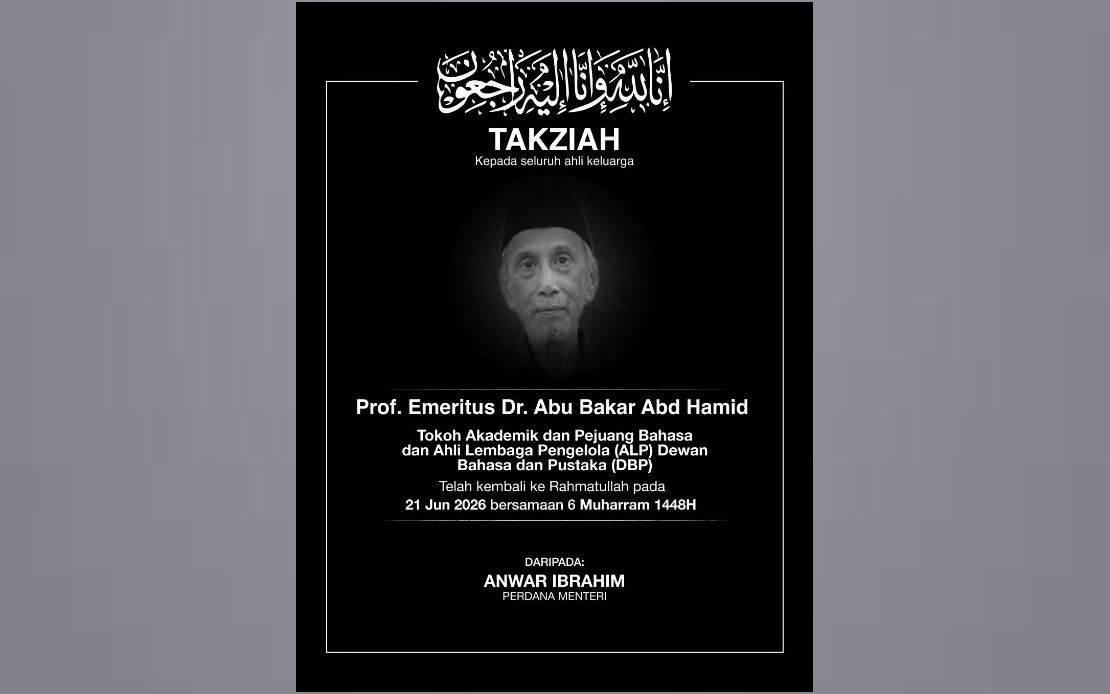
Prime Minister Datuk Seri Anwar Ibrahim has expressed profound grief following the death of Professor Emeritus Datuk Abu Bakar Abd Hamid, an influential academic and custodian of Malay literary heritage who passed away on June 21. The scholar, who was 93, suffered sudden respiratory distress at his residence in Petaling Jaya, Selangor, and died at approximately 10:30 pm. His funeral prayers were held at the Bukit Kiara Muslim Cemetery the following Monday, drawing recognition of his standing within the scholarly and political circles that had sustained Malaysia's intellectual development over several decades.
Anwar's tribute, published via social media on June 24, underscored the deeply personal dimensions of their relationship. As a former student of Abu Bakar, the Prime Minister reflected on the pedagogical influence and moral character that defined his mentor's teaching career. Anwar characterised Abu Bakar not merely as an instructor of academic subjects but as an embodiment of intellectual curiosity and scholarly passion—qualities that extended beyond the classroom to inspire entire generations of Malaysian scholars and writers navigating the formation of national cultural consciousness.
The Johor-born academic's most consequential institutional contributions centred on his role in shaping Malaysia's higher education landscape during pivotal formative years. Abu Bakar served as joint secretary of the foundational committee that established Universiti Kebangsaan Malaysia in 1968, a period when the nation was consciously building indigenous institutions of learning rooted in national values and aspirations. This contribution positioned him as more than a literary theorist or classroom figure; he was an architect of Malaysia's post-independence educational framework, working to embed scholarly excellence within structures that reflected Malaysian identity and constitutional purposes.
His tenure as deputy vice-chancellor of Universiti Malaya from 1987 onward allowed Abu Bakar to exercise institutional leadership at the nation's oldest and most prestigious university. This administrative role complemented his scholarly reputation, granting him influence over curriculum development, academic standards, and the direction of research initiatives within one of Southeast Asia's foremost institutions. During these years, Malaysia was consolidating its position as a regional intellectual hub, and Abu Bakar's stewardship at UM contributed to that trajectory.
Beyond the university sphere, Abu Bakar's significance as a guardian of Malay literature cannot be overstated. His life's work centred on examining, interpreting, and promoting literary traditions that form the cultural bedrock of the Malaysian nation. In an era when literary studies competed for institutional recognition alongside sciences and commerce, Abu Bakar championed the intellectual legitimacy of Malay letters—demonstrating that humanistic inquiry possessed the same rigour and relevance as technical disciplines. His scholarly contributions helped establish Malay literature as a field worthy of serious academic investigation rather than peripheral cultural observation.
The late professor's chairmanship of the Malaysian National News Agency's Board of Governors between 1996 and 2000 illustrated the breadth of his influence across different sectors. Bernama, the nation's official news agency, occupies a critical position in Malaysia's information ecosystem and nation-building efforts. Abu Bakar's stewardship during this period reflected the high regard in which he was held by government and institutional leaders seeking someone with both intellectual standing and commitment to Malaysia's strategic interests.
Throughout his extensive career, Abu Bakar accumulated numerous awards and formal recognition for his contributions to Malaysian letters and academia. These honours represented not merely personal achievement but institutional acknowledgment of his role in advancing Malaysian intellectual culture during transformative decades. The accumulation of such prestigious recognitions suggests consistent excellence and influence across multiple domains—a rare achievement that speaks to both the breadth of his interests and the depth of his scholarly impact.
Anwar's public mourning carries particular significance in contemporary Malaysia, where the Prime Minister's personal testimony to Abu Bakar's character and influence reinforces the importance of intellectual mentorship and scholarly integrity within the nation's political and academic leadership. By publicly honouring his former teacher, Anwar implicitly acknowledged that his own intellectual formation benefited from engagement with traditional humanistic learning and with individuals who embodied commitment to knowledge and ethical conduct. This recognition assumes added weight in a period when Malaysia frequently grapples with questions about the proper balance between technical development and cultural cultivation.
The passing of figures like Abu Bakar Abd Hamid marks the departure of a generation of scholars and administrators who directly participated in Malaysia's post-independence intellectual infrastructure. These individuals bridged colonial and post-colonial academic traditions while establishing distinctly Malaysian institutions of learning. Their contributions established foundations upon which subsequent generations have built, yet their direct influence and personal mentorship—the quality Anwar particularly emphasised—gradually becomes accessible only through memory and legacy rather than direct engagement.
For Malaysian readers and students of the nation's intellectual history, Abu Bakar's death underscores the ongoing importance of preserving and studying the contributions of scholars who helped shape Malaysia's literary and academic cultures. The scholarly networks he participated in, the institutional frameworks he helped establish, and the generations he mentored continue exerting influence across Malaysia's universities and literary circles. His work remains embedded within the curricula and research trajectories that define contemporary Malaysian humanities scholarship, ensuring that his intellectual legacy persists even as his personal presence recedes into historical memory.

