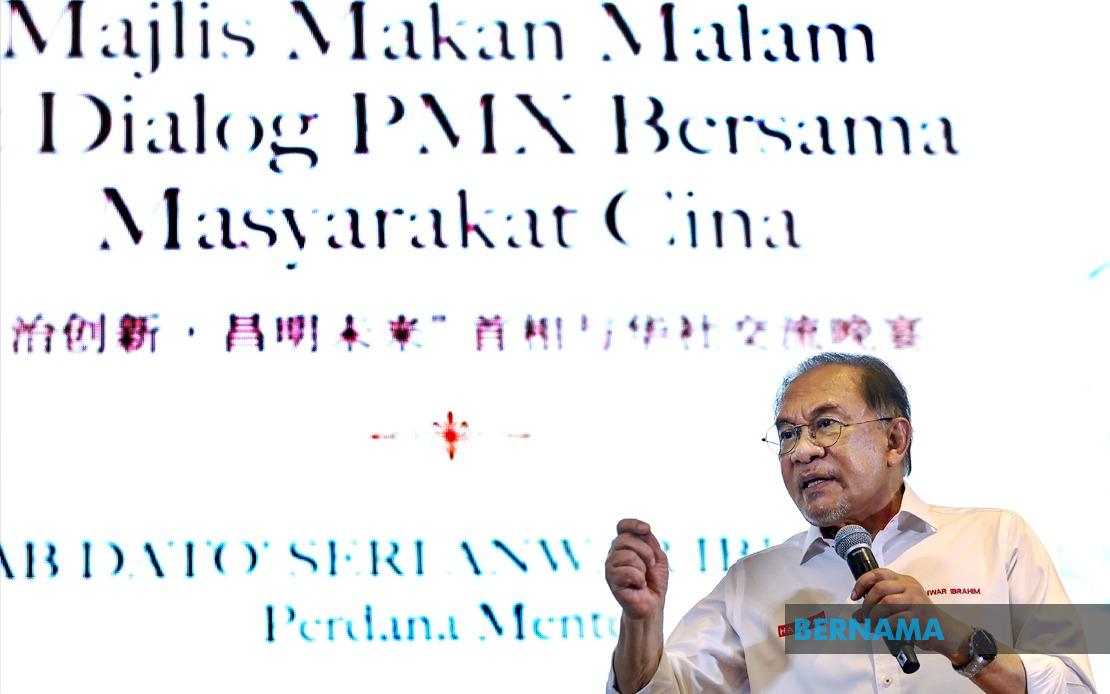
Prime Minister Datuk Seri Anwar Ibrahim has reiterated his determination to guide Malaysia towards prosperity and national greatness, emphasizing that his leadership philosophy centres on inclusivity and ethical governance. Speaking at a community dinner in Johor Bahru on July 4, Anwar articulated a vision where every citizen, irrespective of ethnic or religious background, receives equal treatment and service from government institutions.
At this stage of his political career, Anwar conveyed that his overarching objective has shifted towards establishing a leadership template that prioritizes integrity, impartiality, and genuine dedication to public welfare. The Prime Minister stressed that such principles must extend uniformly across Malaysia's diverse population, reflecting his broader philosophy of national cohesion. This messaging carries particular significance given Malaysia's complex multicultural landscape, where inclusive governance remains essential for sustaining social stability and economic progress.
Anwar's comments underscored a personal reflection on his legacy and how he wishes to be remembered once his tenure concludes. Rather than focusing solely on economic metrics or institutional achievements, he emphasized the relational dimension of leadership—the bond between a leader and the people he serves. This humanistic approach contrasts sharply with transactional models of governance and suggests an orientation towards building trust and demonstrating genuine care for constituents.
The Prime Minister articulated this sentiment directly, noting that as he approaches the twilight of his career, his primary concern is ensuring that Malaysian citizens view him as someone who authentically cared for their wellbeing and worked consistently to protect their interests. This reflection resonates with broader conversations in Southeast Asian politics about leadership accountability and the lasting impact leaders have on their nations long after leaving office.
Anwar's emphasis on serving all communities without distinction carries implications for Malaysia's ongoing national reconciliation efforts and the government's approach to sensitive communal issues. By positioning inclusivity as central to his leadership identity, he signals an intention to navigate divisive topics through a framework that recognizes legitimate concerns across different demographic groups rather than privileging particular constituencies. Such an approach requires navigating complex political terrain, particularly given competing interests and the need to maintain coalition stability within Malaysia's parliamentary system.
The gathering in Johor Bahru, attended by members of the Chinese community alongside Parti Keadilan Rakyat vice president and Selangor Menteri Besar Datuk Seri Amirudin Shari, represented a continuation of Anwar's ongoing engagement with various societal segments. These targeted community interactions serve multiple purposes: they demonstrate accessibility to ordinary citizens, allow for direct dialogue on community-specific concerns, and reinforce the administration's commitment to representation across demographic lines. For a Prime Minister navigating a diverse electorate, such visibility and engagement prove crucial in maintaining legitimacy.
The concept of leaving a legacy of clean governance holds particular resonance in the Malaysian context, where corruption and institutional integrity have featured prominently in political discourse over preceding decades. Anwar's repeated emphasis on fairness and cleanliness in leadership speaks to public expectations for transparent, accountable administration and serves as a benchmark against which his government's actions will ultimately be judged. This creates both an opportunity and an obligation for the administration to demonstrate tangible progress in anti-corruption initiatives and institutional reform.
Anwar's statement about loving his people and expecting reciprocal affection reflects an understanding that political legitimacy extends beyond electoral mathematics or policy implementation. It encompasses the emotional connection between leaders and citizens, the sense that those in power genuinely prioritize public interest, and the demonstration of empathy across societal divides. In Southeast Asia's political landscape, where personal connections and trust in leadership remain influential factors shaping political behaviour, such messaging carries substantive weight beyond rhetorical flourish.
The Prime Minister's acknowledgement of his advancing age introduces an element of reflection that reshapes how his current initiatives might be understood. Rather than viewing his remaining tenure as an opportunity for political empire-building or ideological consolidation, Anwar frames it as a period dedicated to establishing enduring foundations for clean governance and inclusive leadership. This temporal framing suggests urgency in cementing institutional reforms and building political culture that outlasts individual leaders.
For Malaysian policymakers and observers, Anwar's stated priorities offer insight into the administration's direction on governance and national unity initiatives. The emphasis on serving all communities, coupled with the focus on fair and clean leadership, suggests that the government intends to position itself as a custodian of constitutional values and democratic principles. This rhetorical positioning becomes particularly significant given evolving expectations among Malaysia's younger, increasingly diverse electorate regarding leadership standards and governmental accountability in an era of digital transparency and transnational political discourse.

