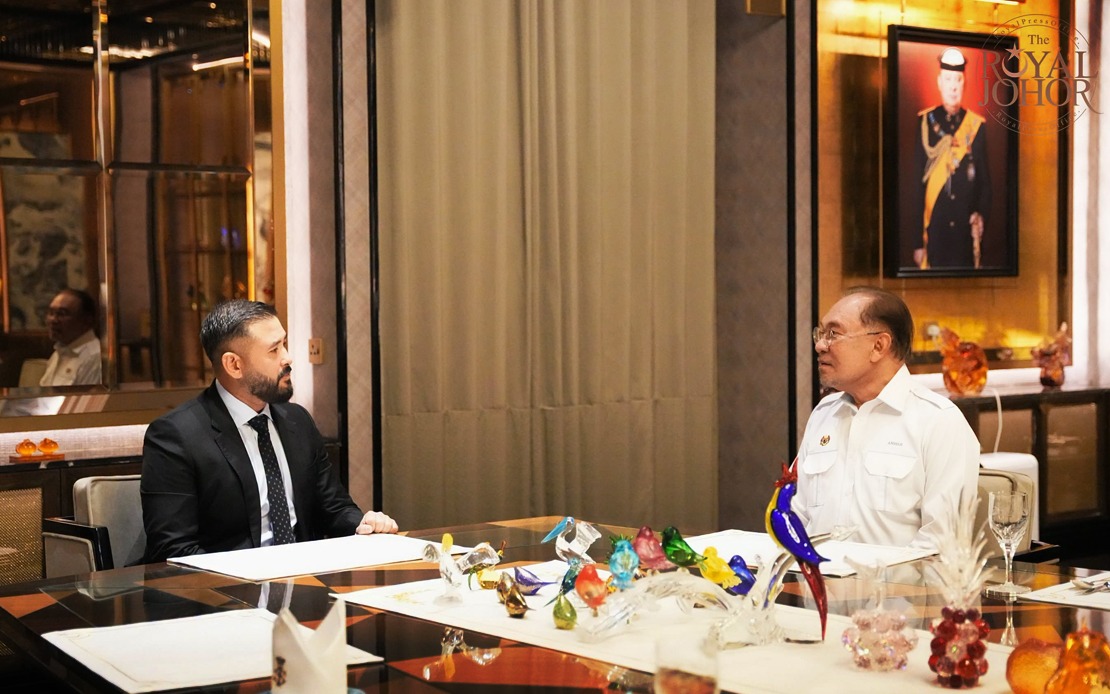
Prime Minister Datuk Seri Anwar Ibrahim has expressed appreciation to the Regent of Johor, Tunku Mahkota Ismail, for extending a gesture of friendship through a recent audience in Kuala Lumpur, framing the meeting as a rebuff to what he characterises as petty political manoeuvring during campaign season. Speaking at the launch of Pakatan Harapan candidates for the 16th Johor state election in Tangkak on June 22, Anwar emphasised that the royal courtesy demonstrated the importance of maintaining appropriate boundaries between the monarchy and partisan political activity.
The Prime Minister used the platform to deliver a pointed message to rival political factions, suggesting that some parties invoke the names of the monarchy whilst avoiding substantive political discourse. He drew a contrast between this approach and his own administration's commitment to engaging directly with the sultans, stating that accepting the Johor Regent's invitation to an audience provided a practical demonstration of proper protocol. Anwar's comments appeared directed at opposition voices who have previously questioned the federal government's policies, sometimes referencing royal opinion in their critiques.
During his discussion of the Johor Regent's visit, Anwar highlighted that the occasion allowed him to brief the royal house on development initiatives undertaken by the federal government that directly benefit Johor's residents. This framing suggests that the Pakatan Harapan administration views such royal audiences not merely as ceremonial courtesy but as opportunities to explain policy directions and secure constructive feedback from the institution. The approach reflects a broader strategy of consolidating support across stakeholder groups ahead of state-level elections in Johor, a strategically significant state with deep historical ties to the monarchy.
The Prime Minister articulated a nuanced position regarding the relationship between the executive and the institution of the Malay Rulers, acknowledging that disagreements sometimes arise but insisting that the government maintains channels of communication and consultation. He noted that whilst there are occasions when the federal government and individual sultans may hold diverging perspectives, the administration commits to hearing their concerns, explaining its own viewpoint, and ultimately accepting royal guidance offered in good faith. This stance suggests a recognition that in Malaysia's constitutional framework, the Rulers retain significant moral and ceremonial authority that can influence public perception of government decisions.
Anwar's remarks extended to the relationship between his administration and the Yang di-Pertuan Agong, Sultan Ibrahim, King of Malaysia, describing a pattern of respectful engagement in which both parties present their positions and remain open to reconciliation. He framed disagreements as natural elements of a mature governmental system rather than indicators of dysfunction, suggesting that consultation and willingness to listen form the foundation of constructive relations between the federal government and the institution of the Rulers. This messaging appears designed to counter narratives suggesting tension between the current administration and Malaysia's royal houses.
The presence of senior coalition partners at the Tangkak event—including DAP secretary-general Anthony Loke Siew Fook and Amanah president Datuk Seri Mohamad Sabu—underscored the Pakatan Harapan leadership's effort to project unity heading into the Johor state election. The gathering also served as a formal announcement of the coalition's candidacy for the polls, a significant electoral moment in a state where Pakatan Harapan has been working to consolidate its position against both entrenched state-level competitors and opposition forces.
For Malaysian political observers, Anwar's emphasis on the proper relationship between the monarchy and electoral politics carries particular significance. Malaysia's constitutional arrangement grants the Rulers substantial residual powers, particularly in state affairs, and their public positioning during election cycles can meaningfully influence voter perceptions and campaign dynamics. By highlighting his respectful engagement with the Johor Regent and by cautioning other political actors against inappropriately invoking royal authority, Anwar attempted to both claim the moral high ground on constitutional propriety and subtly suggest that his administration enjoys royal support or at minimum cooperation.
The timing of these comments—made during the formal launch of Johor state election candidates—indicates that Anwar viewed the Johor Regent's courtesy visit and his own response as tactically valuable for the broader campaign. In Johor, where the Sultanate commands deep loyalty and historical significance, demonstrating respectful relations with the royal house serves as a significant political asset. Conversely, suggestions that opposition parties have inappropriately invoked royal names without engaging in substantive dialogue potentially weakens their standing among voters who prioritise deference to monarchical authority.
The Prime Minister's insistence that his administration will continue consulting with all nine Rulers and remain receptive to their counsel suggests a strategy of positioning Pakatan Harapan as the coalition most aligned with Malaysia's constitutional traditions and established institutions. This approach contrasts with opposition messaging that sometimes emphasises direct popular will over elite consultation, framing the current government as one that respects constitutional hierarchies and the wisdom of traditional authority structures. Such positioning becomes particularly important in states like Johor where institutional loyalty and respect for established order carry substantial weight among significant voter blocs.
Looking forward, Anwar's public gratitude to Tunku Mahkota Ismail and his articulation of proper boundaries for royal engagement in politics establish markers against which future political conduct can be measured. Should opposition parties or rival political actors invoke royal names during campaigns without similarly demonstrating direct consultation and respectful engagement, they risk appearing to violate the norms Anwar has publicly established. This represents a subtle but consequential rhetorical manoeuvre in Malaysia's intensely competitive electoral environment, where control of the narrative surrounding institutional relationships significantly influences campaign outcomes.

