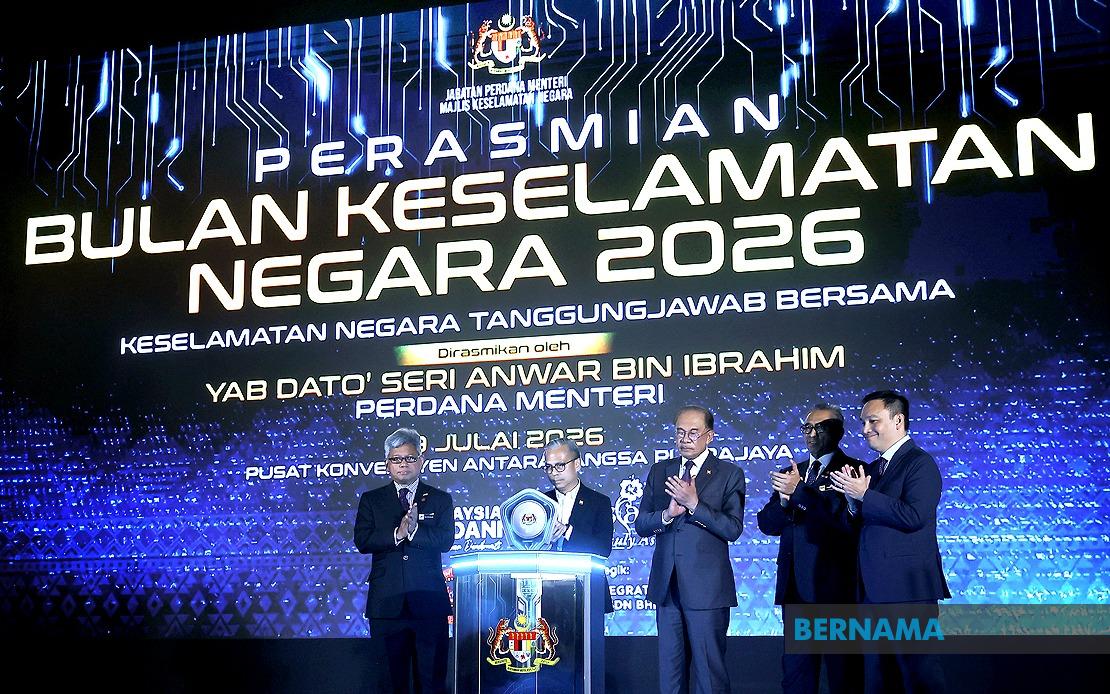
Prime Minister Datuk Seri Anwar Ibrahim has issued a pointed warning about the persistent use of divisive identity-based narratives in Malaysian politics, contending that these lingering tensions undermine the nation's ability to respond cohesively to mounting security challenges. Speaking at the launch of National Security Month 2026 in Putrajaya on July 9, Anwar stressed that continued focus on historical grievances centred on race, religion, and state boundaries threatens both national harmony and collective security at a time when Malaysia faces increasingly sophisticated threats from technological and digital domains.
The Prime Minister's remarks reflect a broader frustration with the state of parliamentary discourse, where he frequently observes colleagues rehashing decades-old political arguments rather than addressing contemporary dangers. During legislative sessions, Anwar noted, discussions often return to conventional fault lines that have characterised Malaysian politics since independence, yet these debates consume valuable time and political energy without contributing substantively to national progress. His intervention signals an executive-level effort to reset the tone of governance toward pragmatism and forward-looking strategic priorities.
The timing of Anwar's statement carries significance within Malaysia's current political climate. The nation remains marked by deep communal sensitivities and competing narratives about state autonomy, religious authority, and ethnic representation. Yet Anwar's argument suggests that perpetuating these tensions at the highest levels of government distracts from vulnerabilities that transcend traditional communal divisions. Cyber threats, transnational criminal networks, and emerging technologies represent dangers that no single ethnic or religious community can address in isolation, requiring instead coordinated institutional responses.
Aware of the practical dimensions of security governance, Anwar emphasised that institutional leaders across all departments, agencies, and ministries must adopt proactive rather than reactive postures toward emerging challenges. The traditional bureaucratic approach of waiting for crises to materialise before responding proves insufficient given the rapid evolution of security threats. Instead, government entities must develop capacity for early identification and swift adaptation to technological shifts and novel security scenarios.
The occasion also drew attendance from Communications Minister Datuk Fahmi Fadzil, Chief Secretary to the Government Tan Sri Shamsul Azri Abu Bakar, and National Security director-general Datuk Raja Nurshirwan Zainal Abidin, indicating whole-of-government commitment to the initiative. This assembly of senior officials underscores the cross-sectoral nature of modern security challenges, which no single ministry can address independently.
Anwar's dual portfolio as both Prime Minister and Finance Minister positions him uniquely to connect security concerns with budgetary allocation and economic planning. The emphasis on proactive leadership reflects recognition that security threats increasingly operate at the intersection of public safety, economic stability, and technological infrastructure. Financial institutions, digital payment systems, and technological infrastructure all constitute security assets that demand protection from evolving threats.
The characterisation of old political polemics as distractions rather than substance suggests Anwar's conviction that Malaysia possesses adequate constitutional and institutional frameworks to manage established communal concerns. Rather than relitigating these settled matters, he implies, leaders should redirect attention toward novel challenges where Malaysia's current institutional competency may lag. This strategic reframing attempts to deprioritise identity politics without dismissing the underlying concerns that motivate such discourse.
For Malaysian stakeholders across the political spectrum, Anwar's intervention presents both opportunity and challenge. It offers an opening for consensus-building around security investments and institutional modernisation, potentially bridging ideological divides through shared concern for national welfare. Simultaneously, it risks appearing dismissive to communities for whom historical grievances retain contemporary resonance and practical implications for resource distribution and political representation.
The broader regional context amplifies the urgency of Anwar's message. Southeast Asia faces interconnected security pressures including maritime disputes, cyber warfare, transnational organised crime, and the proliferation of advanced weaponry. Malaysia's response capacity depends significantly on internal cohesion and the ability of government institutions to operate across communal lines. Domestic divisions that hamper institutional coordination ultimately weaken Malaysia's strategic position within an increasingly contested region.
Moving forward, the success of Anwar's initiative depends on whether senior leadership can translate rhetorical commitment to security modernisation into concrete institutional changes and resource allocation. Government departments must develop enhanced capabilities in digital forensics, cyber defence, and emerging threat assessment. This requires recruiting technical expertise, fostering innovation, and potentially restructuring bureaucratic processes that evolved during an earlier security environment.
The National Security Month 2026 programme serves as a platform for articulating this vision and mobilising commitment from institutional leaders. Yet the actual measure of progress will appear in subsequent budgetary decisions, personnel appointments, and structural reforms that signal genuine prioritisation of security modernisation over conventional political concerns. For Malaysian citizens and regional observers alike, the coming months will reveal whether Anwar's warning about distraction from complex threats translates into substantive policy reorientation or remains primarily rhetorical repositioning.

