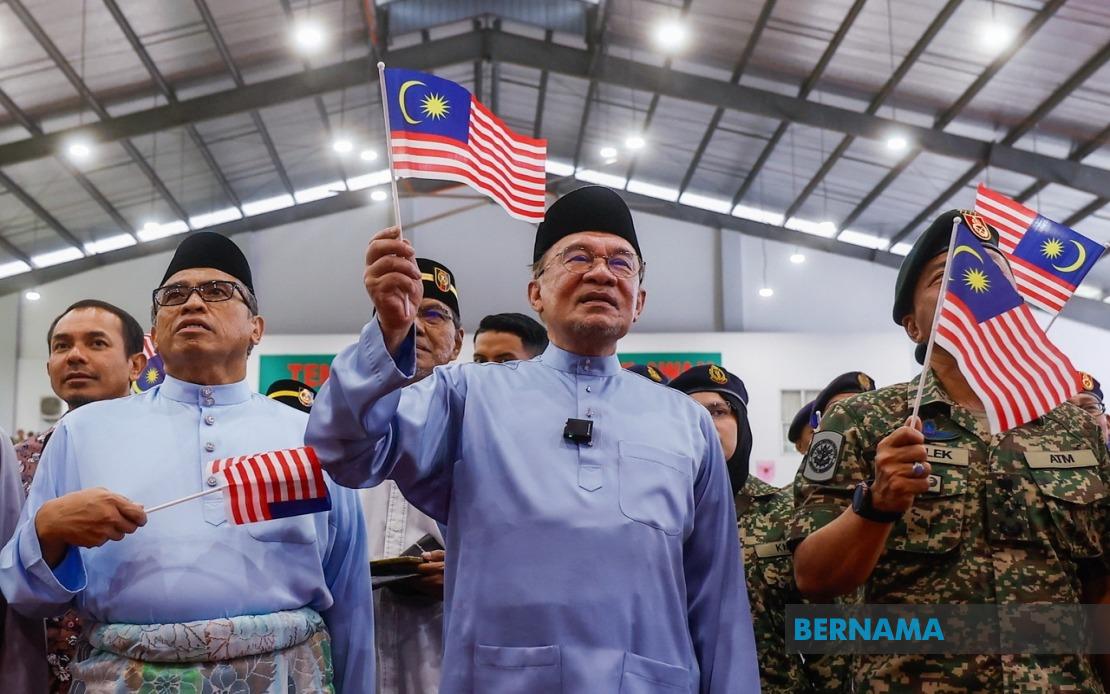
Prime Minister Datuk Seri Anwar Ibrahim has made an impassioned plea for political parties contesting the 16th Negeri Sembilan state election to reject dirty tactics and refrain from spreading unsubstantiated claims for electoral advantage. Speaking during a campaign event in Port Dickson on July 24, Anwar highlighted the corrosive effect that falsehoods and personal attacks have on democratic discourse, drawing on his own experience as a target of misinformation.
The Prime Minister revealed that he had been confronted with a fabricated claim that morning, in which he was accused of organising a gathering specifically to disseminate propaganda among active military personnel and veterans. Anwar expressed dismay at how quickly false narratives gain traction in the political sphere, describing how incomplete statements and taken-out-of-context remarks are routinely reassembled and presented as authentic quotes. The incident underscores a pattern of deliberate distortion that has become increasingly prevalent during election seasons, where unverified allegations spread rapidly through messaging platforms and social media channels before fact-checking can occur.
Acknowledging his own imperfections and past mistakes, Anwar adopted a measured tone in his remarks, indicating a willingness to own genuine missteps and apologise where warranted. However, he drew a clear distinction between legitimate criticism of his record and the fabrication of entirely false allegations designed purely to damage his reputation. This framing is significant because it demonstrates that political accountability and honest debate need not require tolerance for outright deception. The Prime Minister's position reflects frustration with a campaign environment where the bar for truth has been significantly lowered, and where manufactured scandals can influence voter perception regardless of factual basis.
Anwar's comments reflect his extensive history of being the subject of false accusations spanning decades of public life. Throughout his career in politics and during his periods outside government, he has faced numerous allegations that he has characterised as politically motivated fabrications. By invoking this context, he is positioning himself as someone with hard-won perspective on the damage that slanderous campaigns inflict both on individual reputations and on the broader health of democratic institutions. His appeal carries particular weight given that he has previously been vindicated on several matters that were once presented as settled scandals.
The campaign event brought together senior government figures, including Chief Secretary to the Government Tan Sri Shamsul Azri Abu Bakar, Deputy Defence Minister Adly Zahari, Chief of Defence Forces General Tan Sri Malek Razak Sulaiman, and Army chief General Tan Sri Azhan Md Othman. The presence of these military and administrative officials signifies government solidarity and may also serve as a subtle countermeasure to the very allegations of inappropriate military involvement that Anwar had just denounced. Their attendance sends a message that the government apparatus stands united against what the Prime Minister characterised as baseless attacks.
Beyond the immediate concern about campaign conduct, Anwar used the platform to reinforce his administration's commitment to civil service reform and institutional change. He called upon the civil service to continue bolstering government efforts to maintain national peace and security while effectively delivering on the reform agenda and policy initiatives that have been announced. This dual messaging—criticising opposition tactics while rallying governmental support for implementation of the ruling coalition's priorities—reflects the juggling act that incumbent governments must perform during election campaigns.
Pakatan Harapan, the ruling coalition, is contesting all 36 state seats in Negeri Sembilan with a carefully balanced slate reflecting its three main components. The coalition is fielding 16 candidates from PKR, 11 from DAP, and nine from Amanah, a distribution that reflects both the relative strength of each party within the alliance and efforts to maintain internal coalition harmony. This composition is particularly noteworthy given that DAP, as the coalition's non-Malay majority component, maintains a significant presence despite the Malay-Muslim demographic composition of the state. The strategy suggests confidence that coalition unity and shared policy platform can overcome traditional communal voting patterns.
The electoral timeline is now set in motion, with early voting scheduled for July 28 and election day designated for August 1. This compressed campaign period means that the weeks ahead will be intense, with limited time for either substantive policy debate or correction of misinformation. The abbreviated schedule increases the stakes around campaign conduct, as false claims that take root during such a brief window have less opportunity to be addressed and debunked before voters cast their ballots. For an electorate navigating multiple competing narratives, the pressure on information sources to verify claims before amplification becomes even more acute.
Anwar's intervention on the question of campaign ethics reflects broader concerns within Malaysia's political establishment about the trajectory of electoral discourse. As digital platforms have proliferated and made rapid dissemination of unverified claims trivially easy, the challenge of maintaining campaign standards has intensified. The Prime Minister's public call for restraint serves multiple functions: it establishes a rhetorical high ground for the government, appeals to voters who are fatigued by negativity, and creates a record of his stated standards against which his government's own campaign conduct might be measured.
The Negeri Sembilan contest will serve as an important indicator of voter sentiment following the mid-term performance of the Anwar administration and the broader political coalitions. Control of the state government carries practical implications for resource allocation, patronage networks, and agenda-setting authority. Beyond the immediate electoral arithmetic, however, the campaign will reveal whether Malaysian voters remain responsive to appeals for elevated campaign standards or whether the tolerance for negativity continues to erode. Anwar's intervention suggests that the government believes there remains an audience receptive to the message that electoral competition need not come at the cost of basic truthfulness.

