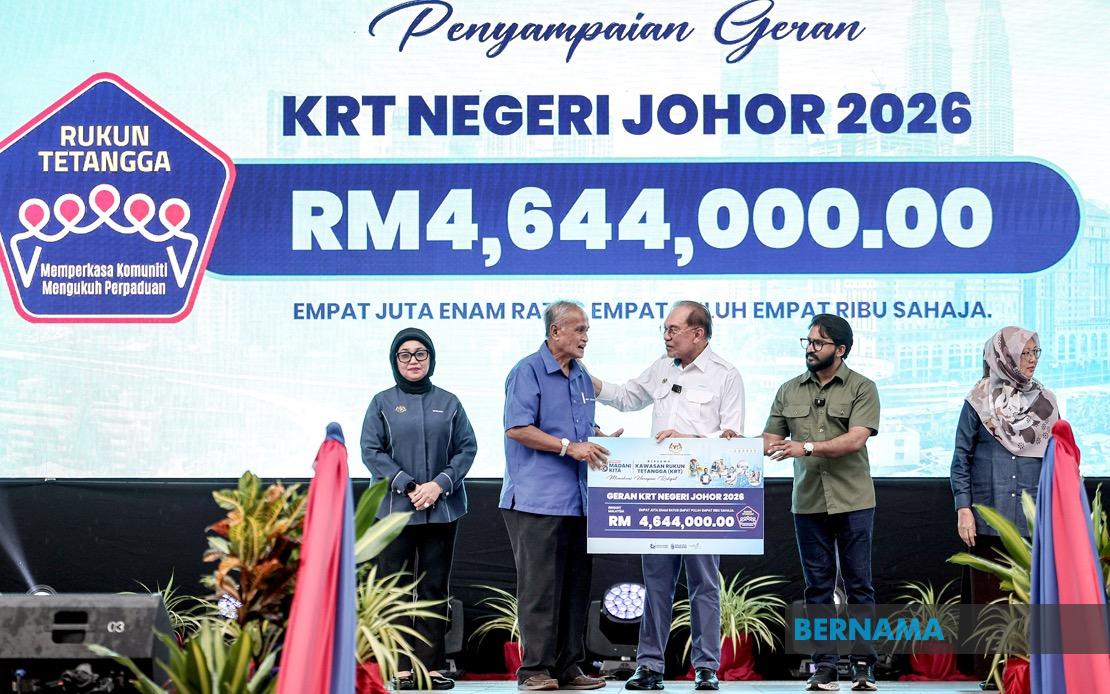
Prime Minister Datuk Seri Anwar Ibrahim has sanctioned a substantial uplift to community policing funding across the nation, increasing the annual grant provided to Neighbourhood Watch Areas (KRT) to RM10,000, a 67 per cent jump from the existing RM6,000 allocation. The decision comes after the grant remained frozen at its previous level for the past decade, despite the institution's pivotal contributions to local governance and security. The enhanced funding will commence on January 1, 2027, providing a material boost to grassroots community organisations that have shouldered growing responsibilities without corresponding resource increases.
Addressing gathered KRT representatives at the MADANI KITA Programme in Dataran Segamat on June 24, Anwar underscored the rationale for the overdue adjustment, emphasising that community safety networks deserve recognition proportionate to their role. The government views these neighbourhood organisations as essential partners in addressing developmental challenges at the ground level, where they serve as intermediaries between residents and state institutions. The timing of the announcement reflects broader government acknowledgment that inflation and operational costs have eroded the purchasing power of earlier allocations, necessitating course correction to sustain community engagement.
The Prime Minister framed the funding increase within Malaysia's broader governance narrative, stressing that KRT operations fundamentally reinforce the democratic consensus and social cohesion upon which the nation's stability depends. By channelling resources towards these grassroots structures, the government signals commitment to preserving the institutional mechanisms that have historically bonded disparate communities. Anwar characterised the move as investment in Malaysia's foundational strength—the demonstrated capacity of multiracial, multireligious populations to coexist peacefully and productively. This framing contextualises the grant not merely as fiscal allocation but as affirmation of civic partnership.
The Prime Minister took the occasion to reaffirm a foundational principle of Malaysian nationhood: that cultural, racial and religious plurality represents a distinctive asset rather than liability. In remarks directed at KRT leadership, Anwar cautioned against weaponising difference for factional advantage, urging instead that communities celebrate their heterogeneity as common heritage. This messaging carries particular resonance given contemporary polarisation trends across Southeast Asia, where identity-based mobilisation has fractured social bonds in several neighbours. By tying community policing funding to this pluralistic vision, the government positions KRT as guardian of consensus values.
Beyond the KRT allocation, Anwar announced complementary investments targeting Islamic educational infrastructure, approving RM3.205 million for urgent repairs at religious schools, madrasahs and tahfiz centres across Johor districts including Batu Pahat, Muar and Segamat. These facilities education approximately one-fifth of Malaysia's student population and frequently operate with constrained budgets. Facility deficiencies can compromise educational delivery and discourage enrolment, particularly in rural areas where alternatives remain limited. The targeted intervention recognises that educational access for religious students constitutes part of broader social cohesion agenda, ensuring no community perceives itself excluded from development dividends.
Simultaneously, Anwar committed RM1.0 million to address critical maintenance backlogs at Royal Malaysian Police (PDRM) quarters in Johor, prioritising officer accommodation standards. Personnel welfare materially influences morale, retention and operational effectiveness across law enforcement hierarchies. By addressing housing deficiencies, the government acknowledges that security force capacity depends not only on training and equipment but on dignified living conditions that recognise officer contributions. This investment particularly matters in lower-cost jurisdictions where salary progression remains gradual and housing represents largest household expense.
The multi-pronged announcement—spanning community organisations, religious education and security personnel—suggests coordinated strategy to reinforce institutional capacity across governance pillars. These constituencies represent frontline workers in Malaysia's social contract: KRT members facilitate neighbourhood surveillance and dispute resolution; Islamic school instructors transmit values and knowledge; police officers enforce law and maintain order. Strengthening their operational environment and morale theoretically enhances state effectiveness in delivering security and social services.
For Malaysian readers, these developments merit attention as indicators of budget prioritisation. The RM10,000 KRT allocation, though materially significant for neighbourhood associations, remains modest in national fiscal context—suggesting government capacity to implement promised enhancements without major expenditure reallocation. The January 2027 commencement date provides substantial lead time for budgetary incorporation, indicating serious implementation intent rather than rhetorical commitment. Regional counterparts—particularly Indonesia, Thailand and Philippines—have faced credibility deficits when announcing community-policing initiatives without sustained funding, lending importance to observing whether Malaysia's pledge translates to actual disbursement.
The KRT funding precedent also illuminates Malaysian governance trajectories. These organisations originated from colonial-era neighbourhood committees and have evolved into hybrid structures—simultaneously grassroots civic networks and state extension mechanisms. Their dual character reflects Malaysia's distinctive approach to community engagement, blending voluntarism with formalised government partnership. Enhanced funding potentially strengthens this hybrid model, enabling KRT to expand service scope while remaining government-aligned. Whether this produces organic community leadership or tighter state control depends on implementation discretion exercised by local authorities.
Looking forward, the grant increase raises questions about KRT utilisation and accountability. The announcement specifies funding for KRTs that "report on their development and activities," suggesting performance-linked disbursement. This accountability mechanism incentivises documentation and formalisation of KRT work, potentially professionalising grassroots operations while risking bureaucratisation that alienates volunteer participants. Successful implementation requires balancing funding incentives with preservation of voluntary participation that characterises effective community organisations.
The broader context matters for Southeast Asian observers. Malaysia's approach—combining resource investment with pluralistic rhetoric—contrasts with authoritarian neighbour models prioritising security force expansion without community partnership emphasis. Should the KRT funding enhance actual neighbourhood safety and social cohesion, it could offer instructive case study for other regional governments seeking to strengthen community policing within democratic frameworks. Conversely, should funds prove misapplied or KRT capacity remain limited, the initiative risks representing cosmetic funding gesture rather than structural institutional enhancement.

