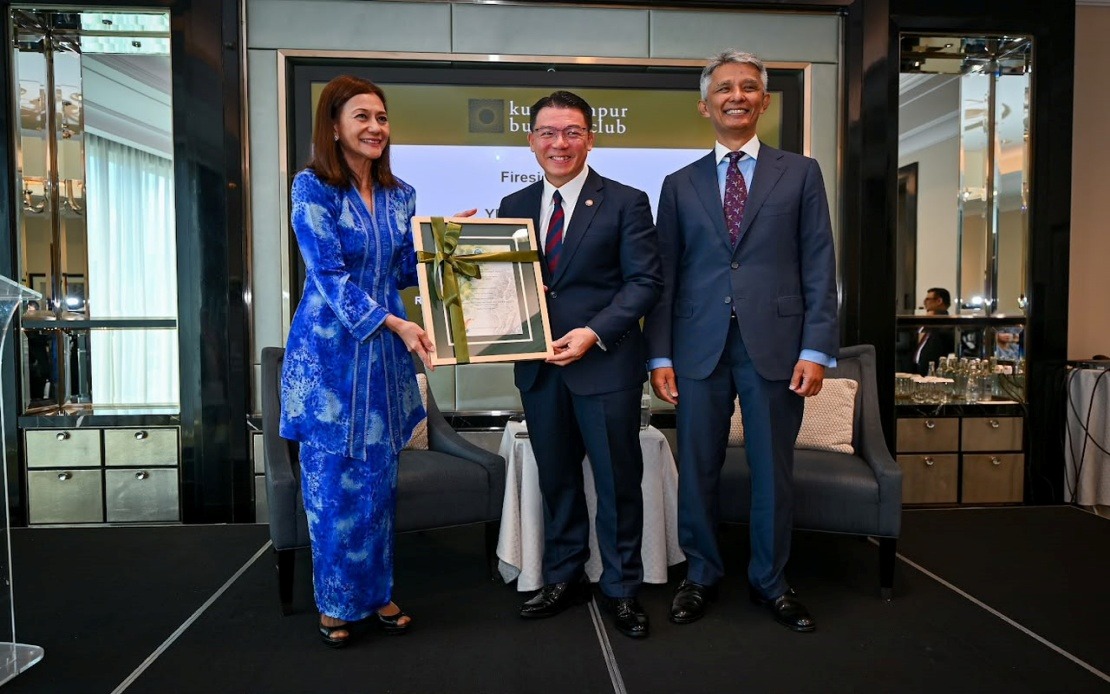
The MADANI government's reform agenda requires sustained policy continuity to ensure Malaysia achieves its long-term economic transformation goals, according to Housing and Local Government Minister Nga Kor Ming. Speaking at an event organised by the Kuala Lumpur Business Club, Nga underscored how consistency in governance and the direction of reforms directly influences investor confidence and Malaysia's ability to maintain its competitive edge in an increasingly volatile global market. He argued that without policy stability, the incremental gains already achieved through various reform initiatives risk being diluted or reversed, ultimately undermining the foundation for future prosperity.
Nga's remarks come as the federal government pursues an ambitious structural reform agenda aimed at reshaping Malaysia's economy for long-term sustainability. The Housing and Local Government Minister contended that a continued government mandate would furnish the necessary institutional stability to deepen structural reforms already in motion, strengthen the capacity of government institutions, and translate long-term economic transformation plans from paper into tangible reality. This framing positions policy consistency not merely as a matter of bureaucratic efficiency, but as a prerequisite for realising the substantive economic gains that policymakers have outlined.
Under Prime Minister Datuk Seri Anwar Ibrahim's leadership, the MADANI framework has served as the overarching philosophy guiding Malaysia's economic and governance strategy. According to Nga, this administration has delivered measurable progress across three interconnected domains: governance reforms, economic management improvements, and enhanced international engagement. These efforts have collectively resulted in stronger investor confidence, a more resilient economic foundation capable of absorbing external shocks, and an improved international standing that elevates Malaysia's attractiveness as a destination for capital and talent.
The minister highlighted Malaysia's emergence as a preferred investment destination, pointing to well-articulated policies, robust economic fundamentals, and political stability as key attractions for foreign investors. In an era of geopolitical uncertainty and volatile capital flows, Malaysia's positioning as a stable, policy-predictable jurisdiction represents a significant competitive advantage over regional peers. This advantage, however, remains vulnerable to shifts in political direction or erosion of investor confidence stemming from perceived policy inconsistency.
Among the concrete achievements Nga cited is Malaysia's improved performance in the Corruption Perceptions Index, a metric closely watched by international investors and development partners. Improvements in this ranking signal that anti-corruption efforts have gained traction and institutional safeguards are functioning more effectively. Simultaneously, enhanced international credit ratings reflect greater confidence among global financial markets in Malaysia's fiscal management and the sustainability of government finances, a critical factor in maintaining access to international capital markets at favourable terms.
The minister also emphasised the diplomatic dimension of Malaysia's economic strategy, noting that proactive international engagement has opened new pathways for investment and bilateral cooperation. These diplomatic initiatives extend beyond traditional trade relationships, encompassing strategic partnerships that address long-term energy security and economic diversification. The RM52.73 billion strategic partnership with Turkmenistan and long-term energy collaboration frameworks with Russia exemplify this approach, positioning Malaysia within broader supply chains and geopolitical alignments that offer both immediate economic benefits and long-term strategic depth.
For Malaysia's business community and foreign investors, the implication is clear: sustained policy continuity translates directly into reduced business uncertainty and improved capacity for long-term planning. When policymakers signal consistency in direction, corporations can confidently invest in capacity expansion, workforce development, and research initiatives without fearing sudden regulatory shifts or policy reversals. This stability is particularly important for industries requiring heavy capital investment or long project cycles, such as infrastructure, manufacturing, and advanced technology sectors.
The urban economy dimension, which formed the thematic focus of the Kuala Lumpur Business Club session, deserves particular attention for Malaysian readers. Urban centres like Kuala Lumpur, Penang, and Johor Bahru are engines of national economic growth, attracting both domestic and foreign investment. MADANI reforms targeting urban development, governance of city institutions, and creation of conducive business environments in metropolitan areas ripple outward, affecting supply chains, labour markets, and consumer activity across the broader economy. Consistent policies in urban development therefore carry outsized significance for national economic momentum.
Regionally, Malaysia's commitment to policy stability positions it as a reliable partner within ASEAN and the wider Indo-Pacific. Governments and multinational corporations increasingly prioritise jurisdictions where policy predictability reduces investment risk. By contrast, neighbouring economies experiencing political volatility or frequent policy reversals often struggle to attract comparable levels of foreign direct investment. Malaysia's potential to differentiate itself through governance consistency offers competitive advantage in competing for the estimated trillions of dollars in capital seeking deployment across Southeast Asia.
However, Nga's emphasis on continuity should not be interpreted as a call for policy stagnation or resistance to necessary reform. Rather, the thrust is that while policies themselves may evolve in response to changing circumstances, the underlying institutional frameworks, governance principles, and reform philosophy should remain coherent and steadfast. This distinction matters because adaptive capacity within a consistent framework differs fundamentally from ad-hoc policy shifts driven by short-term political considerations. The former allows Malaysia to adjust tactics while maintaining strategic direction; the latter risks confusion in the investor and business communities.
The economic gains referenced by the minister—stronger investor confidence, improved resilience, elevated global standing—are not automatic consequences of policy consistency alone. They emerge from the combination of consistent direction and competent execution. This requires sustained institutional capacity, ongoing investment in human capital within government, and mechanisms for translating policy intent into operational reality across federal, state, and local government levels. The MADANI framework's emphasis on both reform and implementation thus carries genuine weight for Malaysia's trajectory.
Looking forward, Malaysia faces the challenge of maintaining this policy coherence while navigating evolving global economic conditions, technological disruption, and demographic shifts. Sustaining business confidence will require not only consistency in direction but also transparent communication about how policies adapt to new realities. For Malaysian businesses, the message is that political and policy stability offers a window of opportunity for expansion and innovation. For policymakers, the implication is that short-term political pressures must be weighed against the long-term institutional and economic costs of inconsistency.

