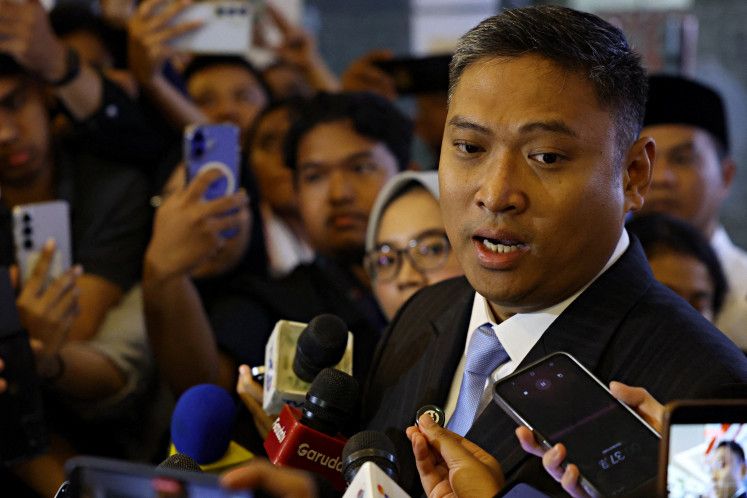
President Prabowo Subianto's signature free nutritious meals programme encountered another leadership crisis this week when Nanik Sudaryati Deyang, the recently installed head of the National Nutrition Agency (BGN), announced her resignation due to health complications. Her departure marks the latest instability affecting one of the administration's most visible social welfare commitments, coming barely two months into her tenure and following the arrest of her predecessor on corruption charges. The rapid turnover underscores deepening institutional challenges within the ambitious initiative, which has struggled to translate political backing into reliable execution since its launch in early 2025.
Nanik disclosed her departure through a Facebook announcement on Wednesday, explaining that she had requested President Prabowo to accept her resignation so she could receive overseas medical treatment for a cardiac condition. The decision followed a concerning medical evaluation conducted the previous evening, when doctors detected an arterial blockage requiring immediate attention. In describing the circumstances surrounding her exit, Nanik offered candid insights into the personal toll of managing the agency's sprawling operations, characterising the experience as deeply traumatic. She attributed her health deterioration partly to the psychological strain of overseeing an institution controlling massive public resources, describing the weight of responsibility as analogous to "standing on the edge of a steep cliff" where careless management could prove catastrophic.
The pressure Nanik experienced stemmed directly from the magnitude of the BGN's financial obligations and her determination to prevent further institutional failures. She revealed that anxiety about safeguarding public funds had become so acute that she adopted an exceptionally cautious approach to decision-making, refusing to authorise spending without exhaustive scrutiny and repeatedly challenging policy proposals before approval. This defensive posture, while reflecting her commitment to proper governance, evidently exacted a severe emotional and physical price. Her candid admission that budget management had become a source of "acute trauma" illustrates the intensity of pressure facing senior officials navigating politically sensitive agencies in developing economies where public accountability remains inconsistent.
Nanik's abbreviated leadership followed the dramatic June dismissal and subsequent arrest of her predecessor, Dadan Hindayana, along with two of his deputies by the Attorney General's Office. The investigation targeted alleged procurement irregularities and financial mismanagement within the multitrillion-rupiah programme, casting doubt on institutional controls and triggering a broader credibility crisis. Nanik herself had previously served as Dadan's deputy before being promoted specifically to restore public confidence and demonstrate administrative reform. Her rapid transition from deputy to chief during such turbulent circumstances, coupled with the unresolved allegations against her former supervisor, likely intensified her anxiety about defending a compromised institution.
Within hours of accepting Nanik's resignation, President Prabowo installed Deputy Agriculture Minister Sudaryono as the agency's new chief during an official ceremony at the State Palace in Jakarta. Sudaryono brings different credentials to the position, serving as a politician from Prabowo's Gerindra Party and having functioned as a presidential aide during the previous decade. The appointment suggests an administrative strategy emphasising political loyalty and prior involvement with programme development rather than specialised nutritional or procurement expertise. Government officials, including State Secretary Prasetyo Hadi, characterised the selection as beneficial because Sudaryono had participated in designing the initiative during its formative stages, ostensibly providing institutional continuity and understanding of original objectives.
Upon his inauguration, Sudaryono articulated a reform agenda focused on systemic transparency and technological modernisation. He pledged to eliminate opacity within BGN operations by converting manual administrative procedures into digitalised systems capable of creating comprehensive audit trails and reducing opportunities for misconduct. His commitment to expose hidden processes and ensure documentation of all transactions reflects recognition that governance failures, particularly corruption, thrive within informational gaps and discretionary decision-making environments. Whether a political appointee can successfully implement such structural reforms while maintaining relationships with the power networks that appointed him remains an open question in Indonesian institutional contexts.
The BGN has confronted mounting operational crises throughout approximately eighteen months of implementation, extending beyond financial and administrative dysfunction to encompass service delivery failures. Multiple documented incidents of mass food poisoning across numerous participating facilities have triggered health concerns among beneficiaries and eroded public confidence in food safety standards. These incidents prompted Nanik to implement a temporary suspension on establishing new meal preparation kitchens while existing facilities underwent comprehensive quality reviews. The moratorium, though administratively prudent, provoked significant backlash from thousands of prospective kitchen operators who had invested substantially in infrastructure anticipating programme expansion.
Recognising the scale of systemic problems, programme administrators announced substantial reductions to projected spending and beneficiary coverage. The provisional 2026 budget was trimmed to Rp229 trillion (approximately US$12.8 billion) from the previously allocated Rp268 trillion, while the agency simultaneously lowered this year's intended beneficiary target to 62.7 million people. These reductions represent dramatic adjustments from original ambitions, which had allocated Rp335 trillion to serve 82.9 million beneficiaries spanning schoolchildren, toddlers, and pregnant women. BGN deputy chief Agustina Arumsari justified the contraction by emphasising quality improvement priorities over quantitative expansion, suggesting that programme architects had belatedly recognised that rapid scaling without adequate operational infrastructure produces counterproductive outcomes.
Indonesian political analysts have identified systemic planning deficiencies as underlying causes of recurring difficulties. Wasisto Raharjo Jati, a respected observer of governance issues, characterised the programme's persistent problems as reflecting inadequate preparatory groundwork despite the political importance Prabowo invested in the initiative. He argued that institutional development was subordinated to political urgency, with the programme driven predominantly by electoral promises rather than rigorous technocratic planning and capacity assessment. This diagnosis suggests that Malaysian policymakers contemplating comparable social welfare expansions should ensure that political timelines align with administrative preparation periods, and that institutional capacity building receives equivalent priority to programme launch announcements.
For Southeast Asian observers, Indonesia's experience illustrates broader challenges confronting large-scale welfare initiatives in middle-income democracies. The BGN's difficulties encompass corruption vulnerabilities inherent in systems distributing resources to numerous decentralised implementation points, quality assurance complications when scaling rapidly across geographically dispersed beneficiary populations, and institutional instability when political pressures override merit-based leadership selection. The programme's trajectory from flagship presidential initiative to troubled agency requiring emergency reforms within eighteen months demonstrates how inadequate institutional foundations and governance frameworks can undermine even well-intentioned social objectives. Malaysia and other regional economies designing similar nutrition or welfare expansion programmes would benefit from observing Indonesia's experience, particularly regarding the necessity of establishing robust monitoring, transparent procurement procedures, and professional administrative capacity before launching ambitious coverage targets.

