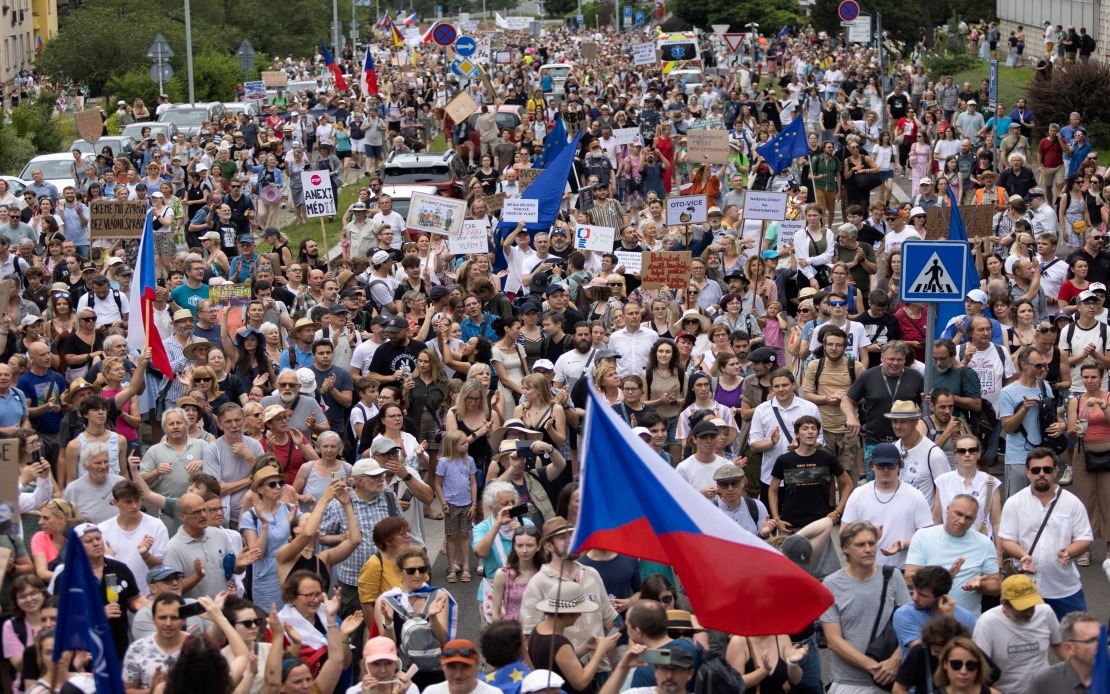
Prague witnessed a significant show of public concern on Sunday when thousands converged outside Czech Television's headquarters to voice alarm over the government's proposed restructuring of public media financing. The demonstration reflected growing anxiety among citizens and media professionals that the changes could undermine the editorial independence of the nation's principal broadcasters at a critical moment for European democracy.
The catalyst for the gathering stems from a recent government decision by Prime Minister Andrej Babiš's administration to eliminate the long-standing radio and television licence fee system that has sustained Czech Television (ČT) and Czech Radio (ČRo) for decades. Beginning in 2025, the broadcasters would instead receive their funding directly from the state budget—a structural shift that protesters and media experts contend creates dangerous vulnerabilities to political pressure. The transition also includes a funding reduction, compounding concerns about the future viability of these institutions.
Prime Minister Babiš, whose right-wing populist party ANO forms the core of the current governing coalition alongside the far-right Freedom and Direct Democracy party (SPD) and the Motorists party, has publicly dismissed worries about editorial interference. He has characterised the change as a cost-saving measure, suggesting that public broadcasters harbour inefficiencies ripe for elimination. However, this reassurance has done little to allay scepticism among citizens and journalists who point to troubling international precedents where direct state budget financing has become a tool for limiting media criticism of sitting governments.
The rally was organised by the civic movement A Million Moments for Democracy, which has already mobilised similar demonstrations across all major Czech cities in May. This continuity suggests the movement has built sustainable organisational capacity and reflects a genuine grassroots determination rather than a one-off protest. Speakers at the Sunday gathering repeatedly invoked the principle that free societies depend fundamentally on free media, a message prominently displayed on placards throughout the crowd.
Demonstrators specifically called upon Culture Minister Oto Klempíř, who represents the Motorists party, to reverse the government's proposals and step down from his position. The targeting of Klempíř reflects the symbolic importance of the culture ministry in shaping media policy, and the demand for his resignation signals the seriousness with which protesters view the threat posed by these reforms. The presence of employees at Czech Television and Radio itself, who unfurled supportive banners from their buildings acknowledging the demonstrators, underscored the solidarity between civil society and media professionals in resisting the changes.
The situation in the Czech Republic carries particular significance for Southeast Asian observers, particularly Malaysia, where questions about media independence and state influence remain persistently contentious. The Czech case demonstrates how structural changes to public broadcaster financing—ostensibly about efficiency and budgeting—can become mechanisms through which governments consolidate control over information flows. This pattern has played out across numerous democracies where initial promises of non-interference have given way to subtle or overt editorial pressures as budget control translates into institutional leverage.
Czech public broadcasters have historically served as important counterweights to commercial media outlets and have maintained editorial standards that prioritise public service journalism over political accommodation. The current government's coalition is notably ideologically fractious, comprising populist and far-right elements that have expressed scepticism toward traditional media institutions. This combination heightens anxiety that licence fee elimination represents a calculated effort to weaken institutional resistance to government narratives rather than a genuine efficiency initiative.
Employees at both ČT and ČRo announced they would strike on Monday in response to the government's plans, representing an escalation from the Sunday protest. This workforce action demonstrates that media professionals themselves view the structural changes as fundamentally threatening to their ability to perform journalism in the public interest. Such collective action by journalists and broadcasters often proves more effective in securing policy reversals than street protests alone, as it immediately impairs the government's ability to communicate through the very institutions it seeks to control.
The timing of these financing changes—scheduled to take effect at the beginning of 2025—creates urgency for opponents who recognise that once implemented, reversing such structural reforms becomes exponentially more difficult. Bureaucratic entrenchment and adjusted budgeting practices quickly become normalised, making restoration of the licence fee system a far more complex political undertaking. This compressed timeline likely explains both the scale of the Sunday mobilisation and the decision to proceed with strike action, as both represent attempts to build sufficient political momentum before new financial arrangements calcify into place.
For regional observers in Southeast Asia, the Czech experience offers instructive lessons about the relationship between institutional design and democratic resilience. Media independence cannot be guaranteed merely through legal frameworks or constitutional provisions; it requires sustained vigilance about the material conditions that allow broadcasters to function independently of executive pressure. The Czech mobilisation suggests that democratic publics remain capable of recognising and resisting threats to media freedom when they are made sufficiently visible and comprehensible.

