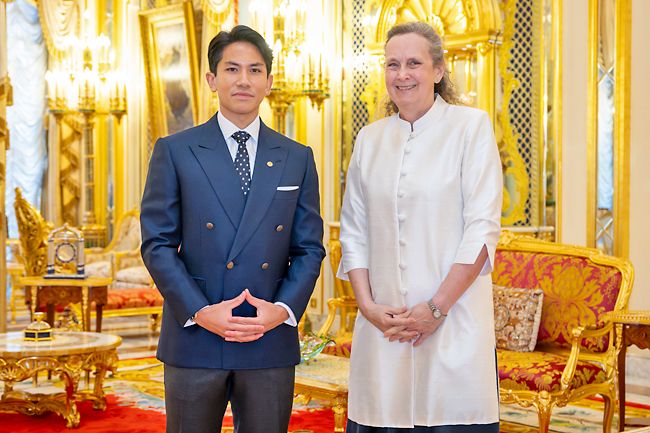
His Royal Highness Prince 'Abdul Mateen, who heads Brunei Darussalam's Ministry of Foreign Affairs, received outgoing United States Ambassador Caryn R McClelland on Saturday, June 20, at Istana Nurul Izzah in Bandar Seri Begawan. The formal audience marked the conclusion of McClelland's diplomatic posting to the Southeast Asian sultanate, reflecting the ceremonial protocols that govern bilateral relations between the two nations.
During the meeting, Prince 'Abdul Mateen acknowledged the ambassador's tenure with appreciation, specifically highlighting her efforts in advancing the historically rooted partnership between Brunei and Washington. The exchange underscored the significance both capitals place on maintaining cordial diplomatic channels and the personal relationships that underpin state-to-state cooperation in the region.
Throughout her assignment, McClelland presided over a period of expanded engagement between the two countries across multiple sectors. The bilateral relationship witnessed notable progression in defence collaboration, reflecting broader regional security dynamics in Southeast Asia and the United States' strategic rebalancing towards the Indo-Pacific. This dimension of ties carries particular significance given Brunei's strategic location along crucial sea lanes and its role within regional organisations.
Educational exchanges formed another pillar of the diplomatic work undertaken during McClelland's tenure. Student mobility programmes and institutional partnerships between American and Bruneian universities strengthened people-to-people connections, fostering mutual understanding and creating networks of future leaders and professionals familiar with both societies. Such human capital development contributes to long-term stability in bilateral relations beyond formal government channels.
Trade and investment cooperation also advanced significantly during this period. The engagement encompassed efforts to facilitate business relationships between American and Bruneian enterprises, explore new commercial opportunities, and create frameworks enabling smoother economic transactions. For a small, oil-dependent economy like Brunei, such partnerships with a major developed economy carry weight in diversification strategies and economic planning.
Beyond the conventional diplomatic portfolio, McClelland's work encompassed broader people-to-people exchanges that transcended governmental structures. Cultural programmes, academic conferences, professional networking events, and civil society interactions all contributed to deepening mutual familiarity between Americans and Bruneians. These grassroots connections often prove durable and influential in shaping long-term perceptions and relations between nations.
The timing of McClelland's departure reflects the standard rotation cycles of diplomatic postings, whereby ambassadors typically serve four to five-year terms before reassignment. Her predecessor had presented credentials to His Majesty Sultan Hassanal Bolkiah on May 24, 2022, suggesting a tenure of approximately four years. The conclusion of her posting opens a transition period during which a new ambassador will eventually arrive to assume responsibilities for furthering American interests and managing the bilateral relationship.
For Malaysia and other Southeast Asian nations, the stability and depth of United States engagement in Brunei carries broader regional implications. Strong American diplomatic presence and active bilateral programmes in each member state of the Association of Southeast Asian Nations reinforce Washington's commitment to the region and its institutions. The renewal of ambassadorial postings thus signals continuity in strategic partnerships that shape the regional balance.
Brunei's reception of the departing ambassador through a formal audience with Prince 'Abdul Mateen demonstrates the sultanate's diplomatic courtesy and respect for established protocols. Such ceremonial gestures, while sometimes overlooked, constitute an essential component of maintaining goodwill and demonstrating that both nations value their relationship sufficiently to observe proper diplomatic conventions. The venue itself—Istana Nurul Izzah, a significant royal residence—conveyed the formal importance Brunei attached to the occasion.
The conclusion of McClelland's posting occurs within a broader context of evolving geopolitical competition in Southeast Asia. As great power rivalry intensifies in the region, nations like Brunei navigate complex relationships with multiple partners. The depth of American engagement, as evidenced by regular high-level diplomatic contact and cooperation across substantive sectors, reflects efforts to maintain relevance and influence within ASEAN as counterbalances emerge from other directions.
Looking forward, the transition to McClelland's successor will provide an opportunity to assess the trajectory of bilateral relations and identify priorities for deepened cooperation. Both governments will likely seek continuity in the areas of defence, economic partnership, and cultural exchange while potentially exploring new dimensions of collaboration responsive to emerging regional challenges. The formal conclusion of one ambassador's tenure and anticipation of the next reflects the permanent institutional nature of state relations, transcending the service of individual diplomatic representatives.

