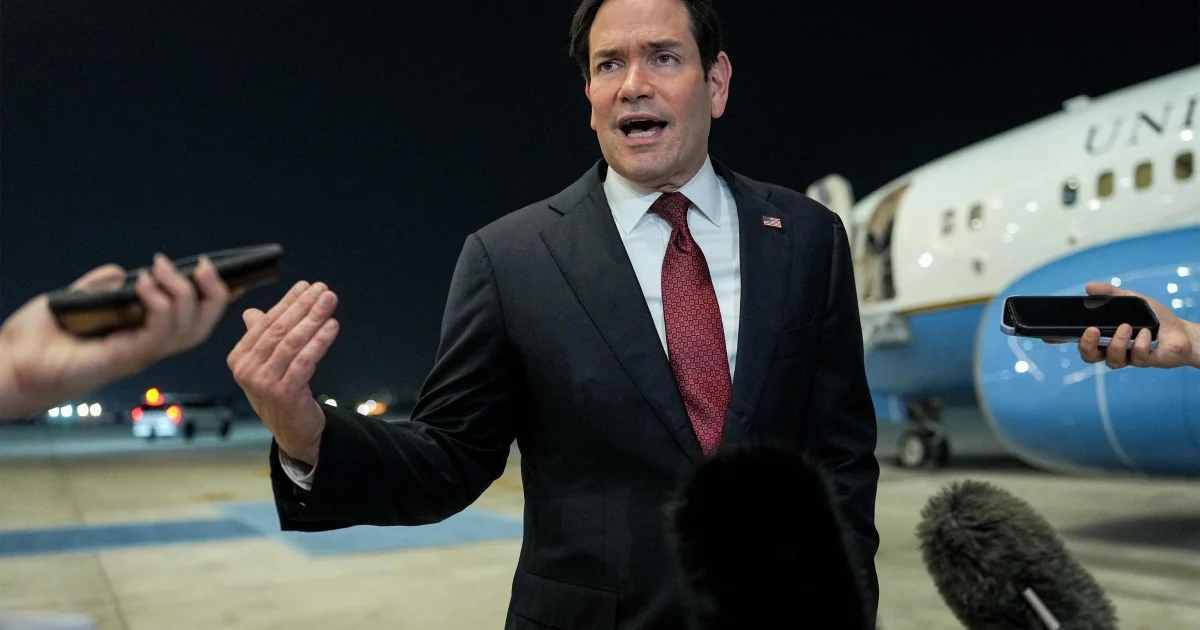
Tensions simmered beneath the surface of nascent Middle East peace negotiations on Tuesday when US Secretary of State Marco Rubio flatly rejected Iranian proposals to levy tolls or fees on commercial vessels passing through the Strait of Hormuz. His statement came as the two sides grappled with a mounting list of contentious issues that threaten to derail early diplomatic momentum intended to resolve the region's protracted conflicts.
The Strait of Hormuz sits at the intersection of global maritime commerce and regional power dynamics. Through its narrow passage flows roughly one-third of the world's seaborne traded oil, making any attempt to impose charges on shipping an extraordinarily sensitive proposition with ramifications extending far beyond Iran and the United States. Rubio's swift rebuff signals Washington's determination to preserve unfettered access to this critical chokepoint, a position that reflects longstanding American strategic interests in maintaining freedom of navigation in international waters.
Iran's proposal appears to stem from its desire to generate additional revenue while simultaneously asserting greater sovereign control over the strategic waterway bordering its shores. For Tehran, such charges might represent a way to offset economic pressures from sanctions while establishing itself as a more authoritative regional actor. Yet the proposal arrives at an inopportune moment, when delicate negotiations require both sides to demonstrate flexibility rather than introduce new demands that complicate already fraught discussions.
Beyond the maritime toll issue, disagreements over nuclear inspections continue to form a substantive fault line in these talks. Iran's nuclear programme remains a central concern for Western powers and their regional allies, who fear that inadequate international oversight could enable weapons development. The precise scope and frequency of inspections, as well as the degree of access international monitors should enjoy at Iranian facilities, have emerged as persistent stumbling blocks where neither side has yet found common ground.
Missile capabilities represent another dimension of the widening disputes. The Islamic Republic's advancing ballistic and cruise missile arsenals worry neighbouring states and Western governments alike, particularly given regional tensions and the proliferation of military technology. Determining how any potential agreement might address these systems—whether through limitations, verification mechanisms, or other constraints—remains unresolved. Washington and its allies insist on robust measures, while Iran resists restrictions it views as infringements on legitimate defence capabilities.
These three contentious areas—maritime fees, nuclear verification, and missile development—form part of a larger constellation of issues that previous peace initiatives have also encountered. Their simultaneous emergence in current negotiations suggests structural rather than merely tactical obstacles. Both sides appear to be testing boundaries, staking out maximalist positions from which they will eventually retreat during the bargaining process. However, the intensity and multiplicity of disagreements raise questions about whether sufficient common ground exists to achieve a durable settlement.
For Malaysian policymakers and regional observers, these developments carry significant implications. Malaysia's economy, like that of many Southeast Asian nations, depends substantially on reliable access to key shipping lanes and stable global energy markets. Any escalation in Strait of Hormuz tensions could disrupt oil supplies and increase costs for ASEAN members. Southeast Asia therefore has a tangible interest in seeing these negotiations succeed, as the alternative could involve military confrontations or further restrictions on maritime transit that ripple through global supply chains.
The current impasse also reflects broader patterns in Middle Eastern diplomacy. Previous attempts to resolve major disputes—from nuclear agreements to ceasefire arrangements—have foundered when parties discovered that their core interests proved irreconcilable or when they calculated that intransigence served their interests better than compromise. The Iran nuclear deal of 2015, the Joint Comprehensive Plan of Action, itself became a casualty of such dynamics when the United States withdrew, demonstrating how fragile such arrangements can be.
Rubio's immediate rejection of the toll proposal, rather than a more nuanced response, suggests Washington views Iranian demands as deliberately provocative rather than as opening positions subject to negotiation. Such rigid posturing from either side tends to harden positions and reduce space for creative solutions. The coming weeks will likely reveal whether both parties possess the political will to moderate their demands and search for compromise formulae that address legitimate security concerns without requiring either to abandon fundamental interests.
The stakes extend well beyond bilateral relations between Washington and Tehran. Regional powers including Saudi Arabia, the United Arab Emirates, and Israel all maintain strong positions on how any agreement should be structured. Their interests in nuclear constraints and missile limitations may sometimes align with American objectives but diverge on other questions, adding another layer of complexity to negotiations that already face substantial obstacles.
As these talks continue, observers should monitor whether new dispute areas emerge or whether the three major disagreements gradually narrow through sustained diplomatic engagement. The pattern of the coming months will indicate whether parties view negotiations as a pathway toward sustainable peace or merely as theatre that allows them to signal toughness to domestic constituencies while avoiding the hard choices that genuine resolution demands.

