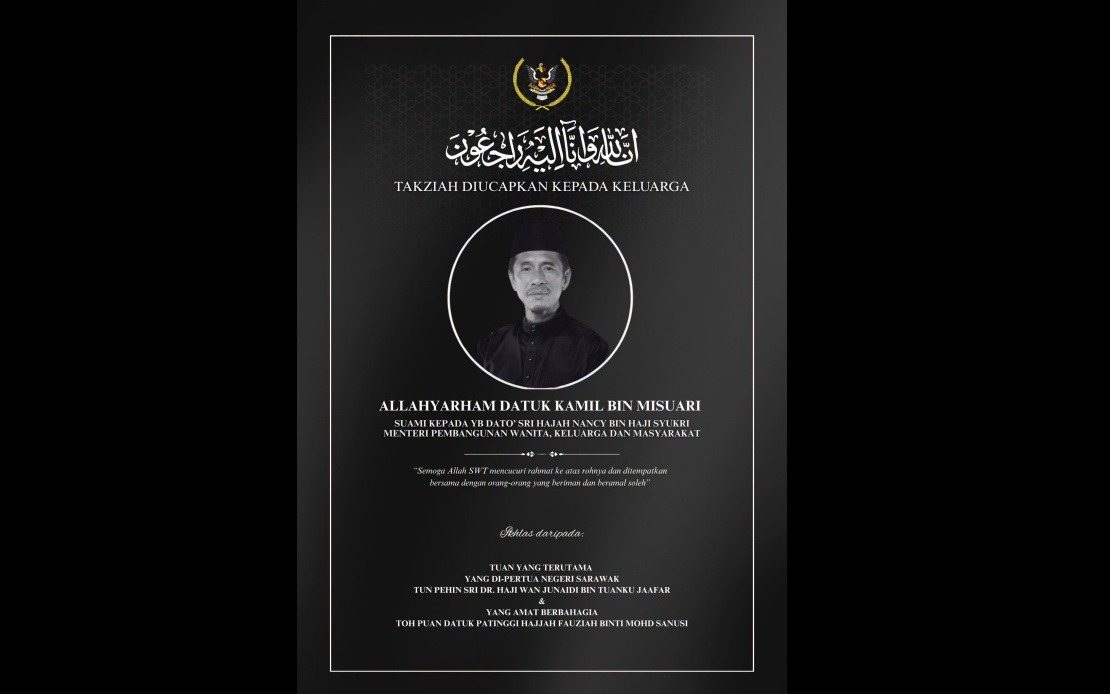
Tun Dr Wan Junaidi Tuanku Jaafar, the Yang Dipertua Negeri Sarawak, has expressed his deepest sympathies to Women, Family and Community Development Minister Datuk Seri Nancy Shukri following the sudden passing of her spouse, Datuk Kamil Misuari. The senior statesman conveyed his condolences through an official statement released by Astana Sarawak, marking a significant gesture of support from the state's ceremonial leadership during a moment of personal loss for one of Malaysia's prominent female ministers.
Datuk Kamil Misuari, aged 65, passed away this evening at a hospital facility in Kuala Lumpur. The Office of the Minister of Women, Family and Community Development made the announcement publicly, acknowledging the passing of the husband of one of the federal cabinet's most visible members. His departure represents a profound personal tragedy for the minister, who has held her current portfolio with considerable visibility in national policy discussions affecting Malaysian families and community development.
In his statement, Tun Dr Wan Junaidi, alongside his wife Toh Puan Fauziah Mohd Sanusi, offered prayers seeking divine blessings upon the deceased's soul. The couple invoked Islamic traditions by praying that Allah SWT would graciously accept the late Kamil's virtuous deeds and grant him a place among the righteous in the hereafter. Such expressions, rooted in Islamic prayer practices, form an important part of the Malaysian cultural and religious response to bereavement among the country's Muslim majority population.
The statement further indicated that Tun and Toh Puan extended their wishes for spiritual and emotional fortitude for Datuk Seri Nancy and her extended family throughout the grieving period ahead. The acknowledgment of the family's strength and patience requirements underscores the recognition that such losses demand considerable resilience, particularly for individuals who maintain high-profile public roles. The formal nature of the gubernatorial statement reflects the customary protocols followed by Malaysia's state leadership when acknowledging the personal tragedies of federal government ministers.
Arrangements for the funeral rites have already been made with considerable logistical coordination. The remains of Datuk Kamil Misuari will be transported to Kuching tomorrow, returning to Sarawak for final rites and interment. This reflects the family's apparent preference for conducting burial ceremonies in the state where the late Datuk had established significant personal and family connections, despite his passing occurring in the federal capital. The choice to return the deceased to Sarawak underscores the enduring importance of state identity and family roots within Malaysian political and social culture.
The late Datuk Kamil will be laid to rest at the Samariang Muslim Cemetery in Sarawak, a location that carries significance for the state's Muslim community. The selection of this burial site, coupled with the return journey to Kuching, indicates the family's intention to honor their ties to Sarawak, the home state of Datuk Seri Nancy Shukri and where she maintains her political base and personal connections. This geographic dimension adds layers of meaning to the funeral arrangements, reflecting how Malaysian public figures often balance their national responsibilities with deep-rooted state and family identities.
Datuk Kamil Misuari and Datuk Seri Nancy Shukri had been married for nearly four decades, having united in matrimony during 1985. Over their time together, they were blessed with three children, building a substantial family unit that has presumably played important roles in the personal lives of both spouses throughout their respective careers and public engagements. The longevity of their marriage places this loss within the context of a deep partnership spanning multiple decades of shared life experiences and family milestones.
For Datuk Seri Nancy Shukri, who has assumed considerable responsibility as the Women, Family and Community Development Minister, this personal tragedy arrives during a period when her portfolio addresses critical national conversations regarding family structures, women's welfare, and community cohesion. The loss of her life partner may affect her capacity to engage fully with ministerial duties in the immediate term, raising questions about continuity of policy initiatives and the balance between personal bereavement and public obligations. The Malaysian government and public will likely afford her appropriate space for grieving while she navigates this significant personal challenge.
The expression of sympathy from Sarawak's Yang Dipertua Negeri carries particular weight given the formal nature of gubernatorial statements and the hierarchical importance assigned to such expressions within Malaysian protocol. When state leaders extend condolences to federal ministers, such actions carry implications beyond mere courtesy, often reflecting broader relationships between state and federal power structures and the recognition of individual family circumstances within Malaysia's political establishment. The deliberate issuance of such a statement signals the gravity with which Sarawak's leadership acknowledges the minister's loss.
This incident, while fundamentally a personal family matter, also intersects with broader considerations about the public and private lives of Malaysian political figures. Ministers and government officials, despite their elevated public positions, remain subject to the same human experiences of loss and grief that affect all citizens. The formal condolences from state leadership underscore the Malaysian tradition of acknowledging that personal tragedies warrant dignified public recognition, even as the affected individuals continue to carry out their duties or step back temporarily to attend to family matters. The coming days will likely reveal how Datuk Seri Nancy Shukri's ministry navigates her absence during this period of bereavement.

