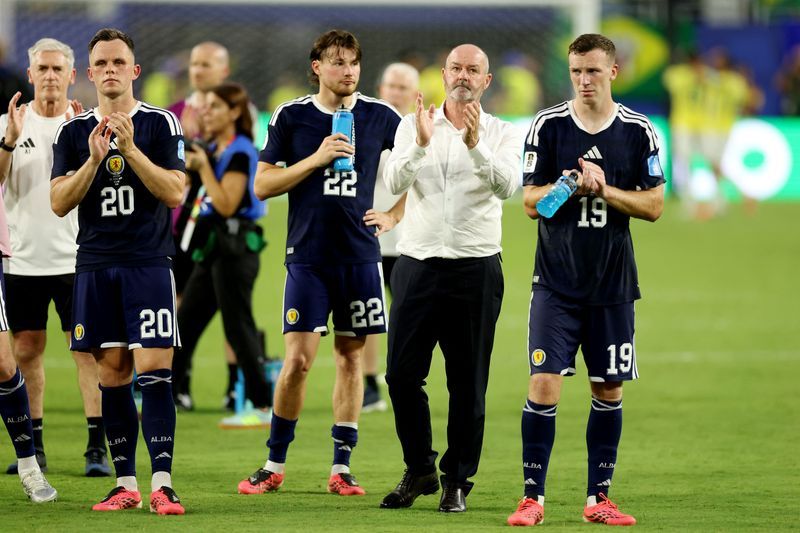
Scotland's first World Cup appearance in 28 years appears to be ending in disappointment after a heavy 3-0 defeat to Brazil in their final Group C encounter, with coach Steve Clarke accepting that his side's own defensive lapses proved fatal against one of the tournament's most clinical attacking units. Playing in Miami on Wednesday, the Scots presented their opponents with gift-wrapped opportunities and paid the price for a performance that fell well short of what Clarke knows his squad is capable of delivering at international level.
Although Scotland technically retain a mathematical pathway to the knockout stages with three points earned from their campaign, the mathematics offer little comfort. As one of eight third-placed teams that will compete for the remaining knockout spots, the Scots currently occupy only the sixth-best record across all 12 groups. With 20 matches still to be played in the group stage, Clarke's frank assessment suggests that at least two other third-place finishers will compile superior records, effectively eliminating Scotland's chances before those matches even conclude.
The Scotland manager's post-match analysis revealed profound frustration not with his players' commitment or professionalism, but with their execution and decision-making against an opponent that possesses world-class finishing ability. Clarke emphasised that Brazil capitalised ruthlessly on the opportunities presented to them, noting that conceding three goals against such elite opposition when those goals stemmed from preventable errors represented a teaching moment for Scottish football. He acknowledged that goalkeeper Angus Gunn produced several quality saves and that Scotland created limited attacking chances themselves, but these positives were overwhelmed by defensive vulnerabilities that a team of Brazil's calibre would always punish.
Clark's remarks carried particular weight given his extensive experience as a top-flight defender during his playing career at Chelsea. From that perspective, he recognised exactly where Scotland's structural problems lay—an inability to maintain shape and discipline against teams possessing both technical excellence and physical dominance. The comparison to Morocco, whom Scotland also faced in the group, extended the critique beyond a single match, suggesting that encounters with the tournament's stronger nations had exposed deep-rooted deficiencies in how the team defended collectively and managed transitions from defence to attack.
Beyond the immediate disappointment of elimination, Clarke identified systemic challenges within Scottish football that require urgent attention at grassroots and development levels. The physicality, power, and technical ability demonstrated by both Morocco and Brazil highlighted a gap in player development that cannot be bridged overnight through tactical adjustments or motivational speeches. Clarke pointedly referenced the need for Scottish football to produce young players capable of competing on the world stage, suggesting that current development pathways and club structures are not generating the calibre of talent required to compete consistently at major tournaments.
Clark's frustration was notably tempered when discussing the contribution of Scotland's supporters, the famous Tartan Army whose presence in the United States had generated considerable goodwill and entertainment value throughout the tournament. Yet he used this acknowledgment to defend his players against potential criticism, reminding fans that without this group's efforts in qualifying, Scotland would not have earned the right to compete in America at all. His message to supporters was measured but clear: the players deserved credit for delivering the qualification that made the World Cup journey possible in the first place.
The coach's perspective on fan engagement carried an implicit warning about maintaining perspective. Clarke stressed that supporters should not overlook the magnitude of qualification itself—a significant achievement in a footballing nation that had endured 28 years without World Cup participation. His reference to supporters sitting on their sofas watching the tournament without Scotland pointedly illustrated what the alternative scenario would have entailed, suggesting that even an early exit carried more value than the pre-qualification reality of World Cup football played without Scottish involvement.
Clark acknowledged his own disappointment that his players had not reached the performance levels that he and Scottish football followers knew they possessed. This distinction between potential and delivery proved central to his post-match assessment, suggesting that the issue was not one of basic quality or commitment, but rather inconsistency and lapses against elite opposition. The narrow margin between competitive performance and abject capitulation had been painfully evident in the match against Brazil, where individual errors cascaded into a scoreline that flattered neither Scotland's preparation nor their defensive organisation.
The broader implications of Scotland's exit extend beyond immediate World Cup mathematics. The tournament has provided concrete evidence of the challenges facing Scottish football in producing competitive squads at the highest level. Clarke's identification of these structural issues signals that the federation and clubs will face pressure to reassess development programmes, recruitment strategies, and training methodologies if future World Cup campaigns are to be mounted with greater hope of sustained progression. The 3-0 defeat to Brazil, while painful, offers diagnostic data about precisely where Scottish football must improve.
As the Tartan Army begins contemplating the journey home, the question of how Scottish football rebuilds from this point remains open. Clarke has provided a candid assessment of both the immediate tactical failures and the longer-term systemic gaps that require attention. Whether his warnings about development and player production resonate with governing bodies and clubs will significantly influence whether Scotland's next World Cup campaign—whenever that occurs—is mounted with greater hope of progressing beyond the group stage.

