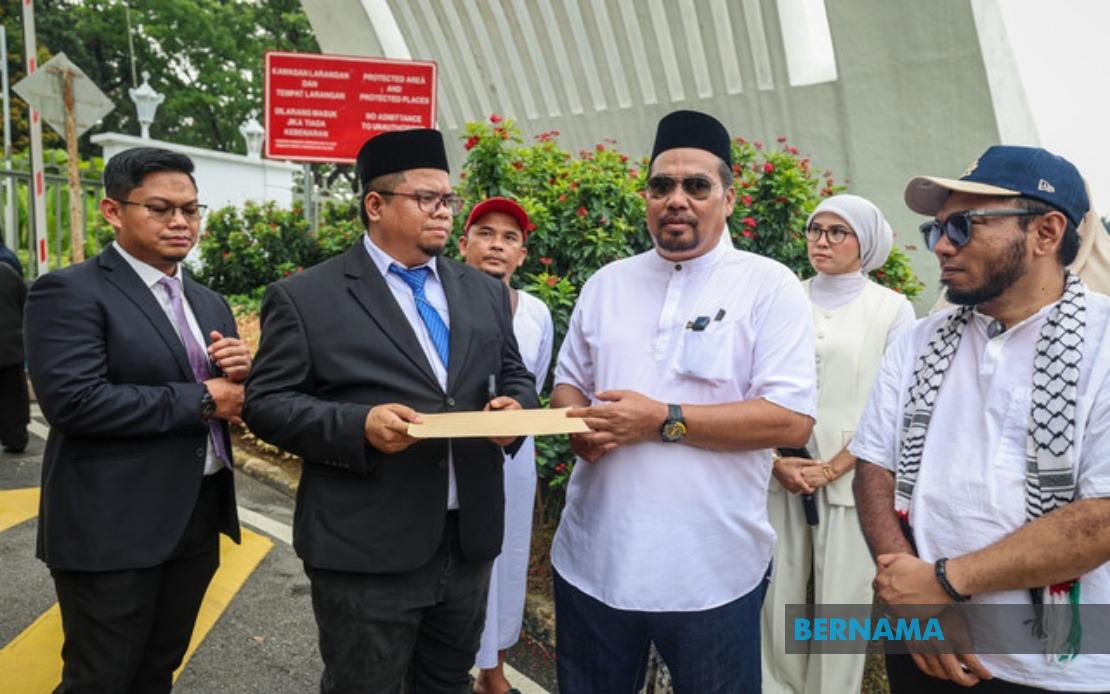
A prominent Malaysian social media activist collective has intensified calls for the government to pursue accountability in the ongoing Tabung Haji crisis, delivering a formal memorandum to Parliament as lawmakers convened to discuss a highly critical inquiry report into the Islamic pilgrimage fund's operations. SEKPUR, representing grassroots civil society sentiment, staged a peaceful demonstration at Parliament's main entrance on August 11 to emphasise the urgency of enforcing consequences against those implicated in the institution's troubled management history.
The memorandum, received by the press secretary to the Minister in the Prime Minister's Department (Religious Affairs), Zairudin Hashim, at 12.35 pm, was intended for onward transmission to Minister Senator Dr Zulkifli Hasan. SEKPUR secretary Mohd Yani Alias articulated the group's position with particular emphasis on the Yang di-Pertuan Agong's directive that accountability must extend to the full extent of the law, signalling royal-level concern about the institution's governance failures.
The submission coincided with a special parliamentary sitting dedicated to examining the Royal Commission of Inquiry report, which Parliament received just weeks earlier. The 211-page RCI document, released publicly on July 29, laid bare systemic weaknesses spanning a six-year period from 2014 to 2020, encompassing management lapses, operational deficiencies, and institutional failures that had undermined public confidence in one of Malaysia's most significant Islamic financial institutions. For Muslim and Malay depositors across the nation, Tabung Haji represents far more than a conventional savings vehicle—it embodies trust, religious obligation, and generational financial planning.
Mohd Yani's statement reflected a deliberate non-partisan stance, emphasising that organisational affiliation should prove irrelevant in determining whether alleged wrongdoing warrants prosecution. This messaging carries particular weight in Malaysia's polarised political environment, where allegations of selective enforcement often complicate public trust in institutional accountability. By explicitly divorcing the demand for justice from factional considerations, SEKPUR articulated a principled position that resonates with ordinary Malaysians concerned about institutional integrity regardless of political colour.
Beyond legal accountability, the activist coalition raised substantive concerns about Tabung Haji's operational sustainability and financial resilience. The memorandum addressed deteriorating hibah distributions—the profit payouts that depositors receive on their accumulated savings—warning that competitive yields must be maintained to preserve the institution's attractiveness compared to conventional banking alternatives. This dimension reflects anxieties among ordinary Malaysians that financial mismanagement could permanently diminish returns on savings accumulated over decades.
The memorandum further highlighted the escalating financial burden imposed on prospective pilgrims as haj costs climb steadily. For Malaysian Muslims, the haj represents both spiritual obligation and significant financial outlay, with many families saving throughout their working lives to afford the journey. Rising expenses, particularly when coupled with transparency concerns about how pilgrimage quotas are allocated and administered, generate frustration among the faithful who view these processes as fundamental to equitable access to an Islamic obligation.
Transparency in quota management emerged as a critical grievance articulated through the submission. Malaysian pilgrims have long raised questions about the mechanisms determining who receives priority allocation for the annual pilgrimage, with allegations of preferential treatment based on connections or influence periodically surfacing. The memorandum's emphasis on this issue reflects genuine public concern that institutional governance reform must encompass not merely financial rectification but also restoration of confidence that systems operate according to clear, equitable principles.
The RCI's preliminary assessment indicated that the institution had already implemented approximately 75 percent of the 25 recommendations contained within the inquiry report as of late July, suggesting some momentum toward institutional rehabilitation. However, this implementation pace alone provides insufficient reassurance to activist groups and civil society stakeholders who view comprehensive reform as non-negotiable. The gap between completing recommended measures and fundamentally restoring public trust remains substantial, particularly when questions linger about whether accountability extends to individuals culpable for the original failures.
For Malaysian policymakers and institutional leadership, SEKPUR's memorandum represents pressure from an important constituency—digitally-organised civil society with capacity to mobilise public opinion through social media channels. The collective's emphasis on depoliticising accountability demands reflects sophisticated understanding that institutional credibility requires demonstrable commitment to justice irrespective of political convenience. This messaging, amplified through social platforms, potentially shapes ministerial deliberations about prosecution timelines and enforcement rigor.
The intersection of Islamic finance, governance accountability, and public trust in this case extends implications beyond Tabung Haji itself. Malaysia's broader Islamic financial sector derives legitimacy partly from perceptions that Islamic principles shape institutional conduct and accountability frameworks. When flagship Islamic institutions encounter governance scandals, confidence extends to other Islamic banking and finance products, potentially affecting sectoral growth and competitiveness. Robust accountability in the Tabung Haji case therefore carries significance for Malaysia's positioning within global Islamic finance markets.
Looking forward, the memorandum submission signals that civil society expectations for concrete action now exceed reassurances about reform implementation rates. Activist organisations have elevated pressure beyond parliamentary debate toward direct government engagement, establishing public benchmarks against which future ministerial performance will be measured. The coming months will test whether government action matches the accountability rhetoric signalled through Yang di-Pertuan Agong's statements and parliamentary deliberations.
As Malaysia navigates post-pandemic economic recovery and reconstruction of institutional confidence, the Tabung Haji accountability question represents a critical test case. Demonstrating that governance failures carry meaningful consequences—regardless of political affiliation—would reinforce rule of law principles essential for broader institutional trust. Conversely, perceived selectivity in enforcement would reinforce cynicism about institutional accountability, potentially extending into other domains where governance integrity proves essential to public confidence and national development.

