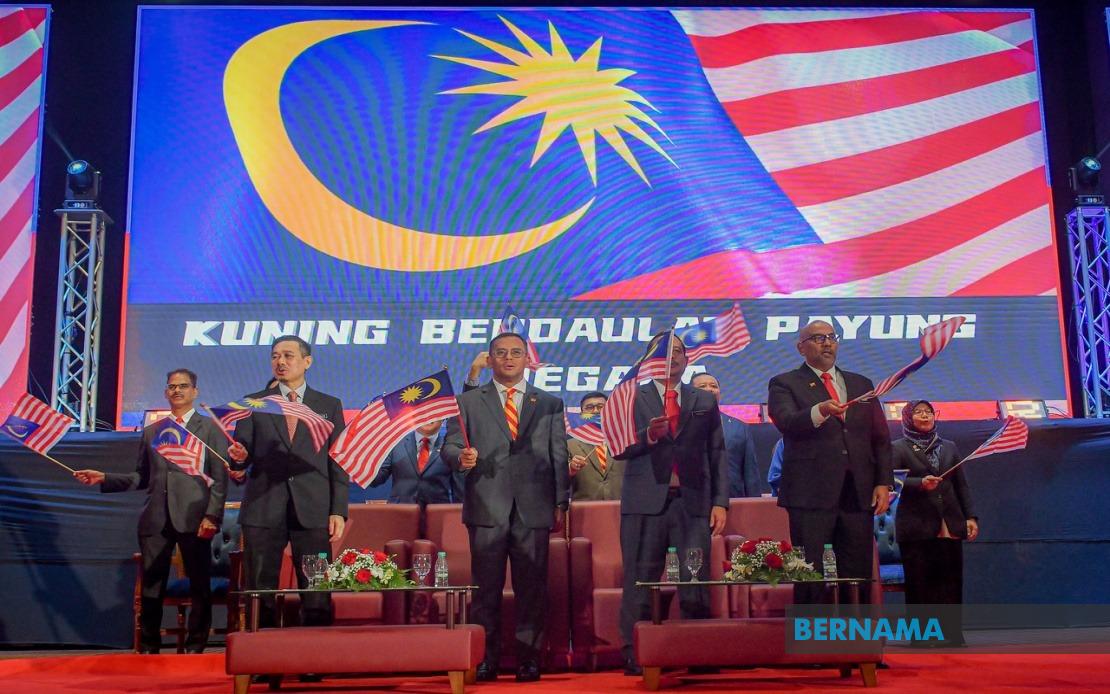
Selangor Menteri Besar Datuk Seri Amirudin Shari has indicated that a determination regarding the validity of a state legislative seat will be reached imminently, setting in motion an Election Commission assessment on whether fresh elections must be called. Speaking in Shah Alam following a civil service assembly and the launch of the Fly the Jalur Gemilang patriotic campaign, Amirudin outlined the procedural steps that remain before the matter reaches resolution.
The state administration is currently in a holding pattern, waiting for formal guidance from the Speaker of the Selangor State Legislative Assembly concerning the contested seat. Simultaneously, the state's legal counsel is drafting a comprehensive advisory opinion that will clarify the position and be presented to relevant authorities. Amirudin characterised these steps as standard protocol, emphasising that the Speaker's role is constitutionally protected and that the legal framework must be respected throughout the process.
This situation emerged following media disclosures that a Selangor state assemblyman's eligibility to hold office has come under scrutiny, though Amirudin did not elaborate on the specific grounds for the challenge. The implications are significant for Selangor's legislative composition, as a finding of ineligibility could trigger a by-election in that constituency, potentially reshaping the balance of power in a state where Pakatan Harapan maintains a slim majority. The timing of such a poll could prove consequential given Malaysia's broader political environment and ongoing jostling between competing coalitions.
Amirudin pledged that the state government would unequivocally accept whatever determination the Election Commission reaches, provided it accords with applicable statutes and procedures. This measured commitment underscores the administration's professed commitment to institutional propriety, even if the outcome proves disadvantageous politically. The statement reflects a wider emphasis on procedural legitimacy that has become increasingly important in Malaysian politics, where perceptions of arbitrariness or political manipulation can undermine public confidence in democratic processes.
Beyond the legislative seat matter, Amirudin addressed the vexing issue of stray dogs in Selangor, a concern that has intensified following recent viral incidents involving animal cruelty. The Menteri Besar articulated the state government's commitment to protecting public safety while acknowledging legitimate concerns about animal welfare—a balance that reflects growing societal attention to both issues. He outlined the challenge succinctly: enforcement actions are necessary to prevent incidents that endanger residents, yet such actions must be executed with compassion rather than brutality.
The stray dog question has gained political resonance in recent weeks, particularly following expressions of concern by Tengku Permaisuri Norashikin of Selangor, whose interventions carry symbolic weight in state affairs. The Permaisuri's statement articulating sadness and anger over animal cruelty incidents has intensified public scrutiny of local authority responses. Amirudin was careful to acknowledge her position, indicating that the state government values her concerns and remains committed to humane enforcement practices, thereby aligning the administration with broader societal values regarding animal welfare.
Amirudin deflected suggestions that local authorities act only when public pressure builds, contending that community safety regarding stray animals has consistently featured among state priorities and has been raised previously within the State Legislative Assembly itself. He pointed specifically to a submission from the Port Klang assemblyman, suggesting that the issue predates recent viral incidents and that selective criticism of enforcement efforts overlooks this longer history. This framing attempts to reposition enforcement officers not as reactive to pressure but as implementers of a sustained policy agenda.
The Menteri Besar emphasised the necessity of striking equilibrium between necessary action and procedural restraint. He acknowledged that enforcement inevitably provokes criticism, but contended that inaction creates different but equally serious problems. By acting within legal frameworks, the state government aims to prevent incidents involving stray or roaming animals that could jeopardise public safety, while simultaneously ensuring that such actions do not cross into unnecessary cruelty. This nuanced position reflects recognition that both animal welfare and public safety constitute legitimate concerns that cannot be easily reconciled through simplistic approaches.
The stray dog issue also touches on broader questions about Selangor's municipal governance and the coordination between state-level policy direction and local authority implementation. Recent incidents suggest that enforcement has sometimes proceeded in ways that have generated concern among animal welfare advocates and individuals who take to social media platforms. The state government's emphasis on humane execution of enforcement policies may signal an effort to improve oversight and training within local authorities, ensuring that necessary pest management does not devolve into unnecessary suffering.
Meanwhile, Istana Alam Shah has reportedly encouraged the Federal Government to review penalties under the Animal Welfare Act 2015, advocating for stricter and more consistent sanctions against offenders convicted of animal cruelty. This intervention from the palace represents a form of soft power that can shape policy priorities without direct legislative action, and signals royal backing for strengthened protections for animals. Should the Federal Government respond by tightening legal provisions, it would reflect broader shifting expectations around animal welfare that transcend party lines and resonate across Malaysian society.
The convergence of these two narratives—the pending legislative seat determination and the stray dog governance challenge—illustrates the multifaceted responsibilities of contemporary state government. While the seat eligibility matter engages fundamental questions about legislative legitimacy and electoral integrity, the animal welfare issue reflects evolving social expectations regarding government responsibility for community protection and ethical governance. Both demand that Amirudin's administration navigate competing pressures while maintaining institutional credibility, a challenge amplified by the increasingly interconnected nature of Malaysian politics and society.

