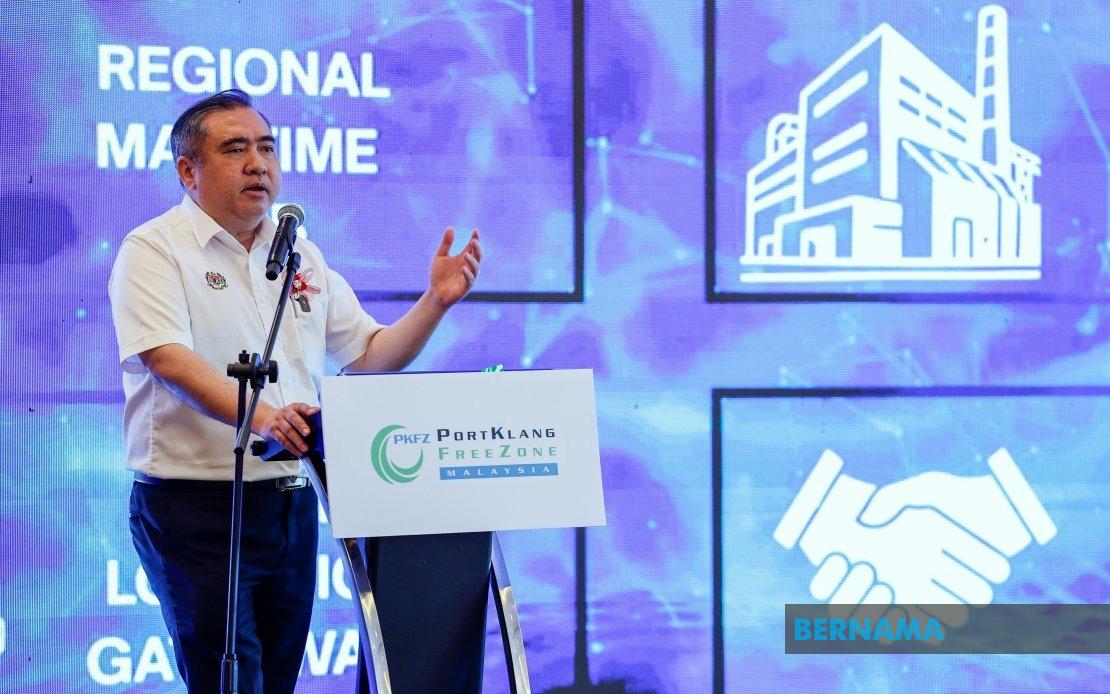
The development of Port Klang's third terminal on Carey Island faces a critical bottleneck as the Selangor State Government races to finalise a land settlement that has delayed the megaproject. Transport Minister Anthony Loke revealed that resolving the land issue has become the immediate priority before any construction work can commence, signalling that while the broader project remains government-backed, practical obstacles are slowing its advance.
Loke outlined the framework being discussed among the Transport Ministry, Selangor State Government, and private-sector partners through a concession arrangement. The project is expected to operate under a Build-Operate-Transfer model, a structure commonly used in Southeast Asia for major infrastructure development where private operators assume responsibility for construction and management before eventually transferring assets back to government control. Officials expressed hope that construction could begin within the calendar year, though this target remains conditional on the land question being resolved swiftly.
The third terminal represents a strategic expansion for Malaysia's busiest port and sits within a broader effort to strengthen the nation's competitive position in regional shipping and logistics markets. Prime Minister Datuk Seri Anwar Ibrahim previously directed all relevant agencies to accelerate the project's realisation, underscoring its importance to the government's economic agenda. This high-level endorsement reflects recognition that Port Klang, which handles over 12 million TEUs annually, requires capacity growth to maintain relevance as Southeast Asian ports intensify competition for container traffic and transhipment business.
Selangor Menteri Besar Datuk Seri Amirudin Shari has identified approximately 1,699.68 hectares across Pulau Carey in Kuala Langat as the intended development footprint. The parcel comprises two distinct components: 1,011.71 hectares of seabed land administered by the Selangor State Development Corporation (PKNS) and 687.96 hectares of coastal land held by Yayasan Selangor. This mixed ownership structure—combining state corporate assets with land managed by a foundation—appears to lie at the heart of the current settlement negotiations, as coordinating interests across multiple public bodies demands careful legal and administrative choreography.
The port expansion carries particular significance for Malaysia's regional standing. As container volumes grow and larger mega-ships demand deeper-water berths, ports that fail to expand risk losing cargo to competitors in Singapore, Thailand, and Indonesia. Port Klang's existing infrastructure, while substantial, has approached effective capacity, making a third terminal economically logical. The project also aligns with Malaysia's broader infrastructure modernisation agenda and efforts to position the Selangor-Kuala Lumpur corridor as a logistics hub rivalling established competitors.
Beyond the port facility itself, the project sits within a wider industrial ecosystem. Loke's remarks came during ceremonies launching multiple ventures within the Port Klang Free Zone, including new manufacturing facilities and centralised labour quarters representing RM566 million in fresh investment. These ancillary developments underscore how port expansion catalyses broader industrial activity, creating knock-on demand for warehousing, processing capacity, and support services. The Smart Intelligence Industrial Park launch signals intent to build a technology-enabled ecosystem rather than merely expanding bulk-handling capacity.
Employment considerations flavour the government's approach to port and logistics expansion. Loke noted a memorandum of understanding signed between PKFZ and the Armed Forces Ex-Servicemen's Affairs Corporation (Perhebat) to facilitate skilled hiring, particularly targeting military retirees for logistics roles. This initiative reflects a strategic insight: major infrastructure projects require talent, and Malaysia's significant ex-military population represents an underutilised reservoir of disciplined, trainable workers. In March, the government also launched a dedicated licensing programme enabling military veterans to obtain heavy-vehicle driving qualifications, directly addressing documented shortages in Malaysia's trucking sector.
The skills initiative carries particular relevance for Malaysian regional competitiveness. While port terminal automation progresses globally, logistics chains remain labour-intensive, and driver shortages persistently constrain Malaysian haulage operators. By systematically channelling veterans into transport roles, authorities aim to simultaneously ease supply-chain bottlenecks and provide dignified employment pathways for those transitioning from military service. This nexus between infrastructure projects, labour demand, and social policy represents an approach that successive Malaysian governments have employed, though implementation gaps have sometimes limited effectiveness.
The timeline pressure evident in Loke's statements suggests cabinet-level urgency surrounding the third terminal. That officials speak of commencing construction within the current year, despite unresolved land matters, indicates they view the delay as increasingly unacceptable from a competitive standpoint. However, the conditional framing—that construction hinges on land settlement—also betrays recognition that rushing through legal and administrative procedures risks creating future complications. Southeast Asian infrastructure projects often encounter delays when foundational issues like land title, environmental clearance, or stakeholder alignment are inadequately resolved beforehand.
For Malaysian businesses reliant on port facilities—from container transporters to manufacturers dependent on import-export logistics—the third terminal's eventual opening promises meaningful capacity relief and potentially lower port fees as competition increases. The project's delayed progress frustrates stakeholders who have waited years for expansion signals, yet the government's cautious approach to land settlement may ultimately prove prudent. Premature commencement without clear title and stakeholder alignment could trigger litigation or construction halts more damaging than measured resolution beforehand.
The Port Klang third terminal exemplifies infrastructure governance challenges endemic across Southeast Asia: major projects require coordination among state agencies, private operators, and communities; land ownership complexities often prove more intractable than technical or financial obstacles; and timeline expectations frequently outpace administrative reality. Resolving these tensions determines whether Malaysia sustains port competitiveness and whether government promises to boost logistics capabilities translate into actual operational benefit. The coming months will test whether Selangor and federal authorities can convert stated intent into tangible progress on the ground.