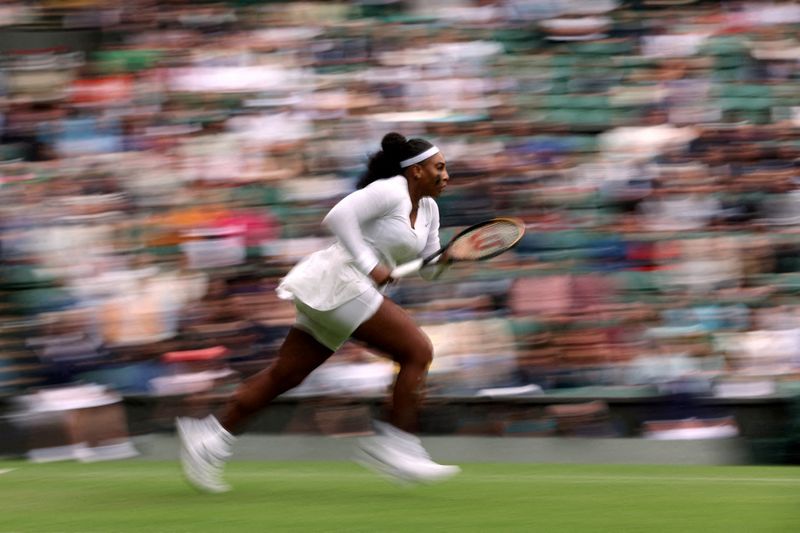
Serena Williams will overshadow every other storyline at Wimbledon when the 44-year-old American icon takes to Centre Court next week, a decade after capturing her seventh singles title at the All England Club. Her competitive return marks a stunning pivot for the 23-time Grand Slam champion, who appeared to have departed professional tennis four years ago. While the women's draw itself presents unprecedented fragmentation among contenders, with multiple talented players eyeing glory, Williams' presence fundamentally reshapes the narrative and public consciousness surrounding this year's championship.
The grasscourt elite entering this edition presents a constellation of compelling ambitions. World number one Aryna Sabalenka carries the burden of favourite status while seeking to recover from a deeply troubling collapse at Roland Garros, where she surrendered ten consecutive games following a quarter-final exit that exposed her mental vulnerability. Poland's Iga Swiatek harbours designs on consecutive Wimbledon titles, a feat unachieved since Williams accomplished the feat in 2016. Meanwhile, Russian phenom Mirra Andreeva arrives as the tournament's most dynamic wildcard, having claimed the French Open at just 19 years old and bringing an unorthodox, aggressive style to the manicured lawns of SW19.
American Coco Gauff continues her eternal quest to master grass-court tennis, where her typically dominant baseline game finds less purchase. Elena Rybakina, the 2022 champion, wields a serve and power game so formidable it often appears impenetrable to opponents. British hope Emma Raducanu carries the weight of home expectation as she pursues a maiden Grand Slam title and the first British women's singles triumph since Virginia Ruffin's victory in 1977. Yet these narratives, however substantial individually, fade into obscurity once Williams enters the conversation.
The American's wildcard status grants her access to Centre Court without navigating qualifying rounds, representing the eighth and final allocation from Wimbledon organisers. Her first singles competitive match since the 2022 U.S. Open will immediately generate astronomical television viewership and overwhelm social media platforms with commentary and speculation. The mere spectacle of a 44-year-old returning to professional tennis at sport's most prestigious venue creates gravitational pull that transcends normal sporting interest.
Williams' preparation reveals serious intent beneath any narrative of romantic comeback. She rejoined the anti-doping testing pool in December, demonstrating compliance with regulatory requirements essential for competing. Her physical transformation involved approximately 20 pounds of weight loss aided by pharmaceutical intervention, complementing intensive training sessions conducted under the guidance of coach Rennae Stubbs. A doubles appearance alongside Victoria Mboko at Queen's Club provided competitive sharpness, during which her legendary 120mph serve—arguably the most destructive weapon in women's tennis history—remained formidable and her baseline power generated genuine authority.
Singles competition presents qualitatively different demands than doubles play, yet Williams' pedigree suggests she could become the oldest woman to claim a singles victory at Wimbledon since Martina Navratilova triumphed at age 47 in 2004. Former world number one Andy Roddick articulated the psychological dimension of her gambit, marvelling that Williams possessed the confidence to target Wimbledon as her competitive re-entry point rather than scheduling multiple preparatory events. Such self-assurance appears virtually incomprehensible to players accustomed to methodical build-ups across lesser tournaments.
Lindsay Davenport, herself a Grand Slam champion, acknowledged that Williams would not have committed to this venture unless genuinely convinced of her capacity to produce immediate impact. Grass courts notoriously punish rustiness, with balls traveling quickly and bouncing low, demanding explosive athleticism and precise movement. The surface's unforgiving nature typically requires extensive preparation and match conditioning. Yet if any player possesses the technical mastery and competitive instinct to transcend such obstacles, Williams' career trajectory suggests she remains uniquely positioned to overcome the disadvantages presented by extended absence.
The broader competitive landscape has fractured dramatically since Williams last claimed the title in 2016. Eight different first-time Wimbledon champions have emerged in the intervening decade, reflecting extraordinary parity at tennis's apex. Players including Naomi Osaka, Sabalenka, Swiatek, Gauff, Rybakina and Ash Barty have accumulated multiple Grand Slam titles, yet none has achieved the categorical dominance Williams exercised throughout her career. The last six consecutive Grand Slams have been claimed by six different champions, a statistic unimaginable during Williams' reign.
Sabalenka's position as favourite appears precarious despite world number one ranking. Her Roland Garros meltdown—relinquishing a two-point advantage in a semi-final race before losing ten straight games—raised acute questions about her emotional resilience under pressure. A Berlin tuneup provided no reassurance, with Sabalenka surrendering the deciding set 6-0 to Jessica Pegula, another capitulation suggesting fragile confidence. Her well-documented emotional expressiveness, typically a source of competitive fire, becomes liability when matches slip beyond her control.
A prospective encounter between Sabalenka and Williams creates an asymmetrical strategic calculus heavily favoring the American. Should Williams merely achieve three or four service holds while reacclimatizing to singles competition, Sabalenka faces an entirely unfavourable scenario. Victory over the returning Williams icon would garner minimal credit—the narrative would emphasise Williams' prolonged absence—while defeat would constitute a catastrophic result for the tournament favourite. This psychological disadvantage could prove decisive against an opponent already demonstrating emotional fragility.
The decade separating Williams' last Wimbledon triumph from her return crystallizes the sport's transformation. Grass-court mastery has become democratized among elite players, with no individual possessing overwhelming superiority. Yet Williams' technical brilliance, particularly her serve and court positioning, transcends era-specific conditioning. Her comeback represents not merely personal sporting endeavour but a statement about competitive longevity and the enduring relevance of generational talent. For Malaysian and Southeast Asian audiences following tennis, Williams' narrative exemplifies how elite athletes can reshape sporting discourse through sheer presence and historical significance, regardless of ultimate tournament outcome.

