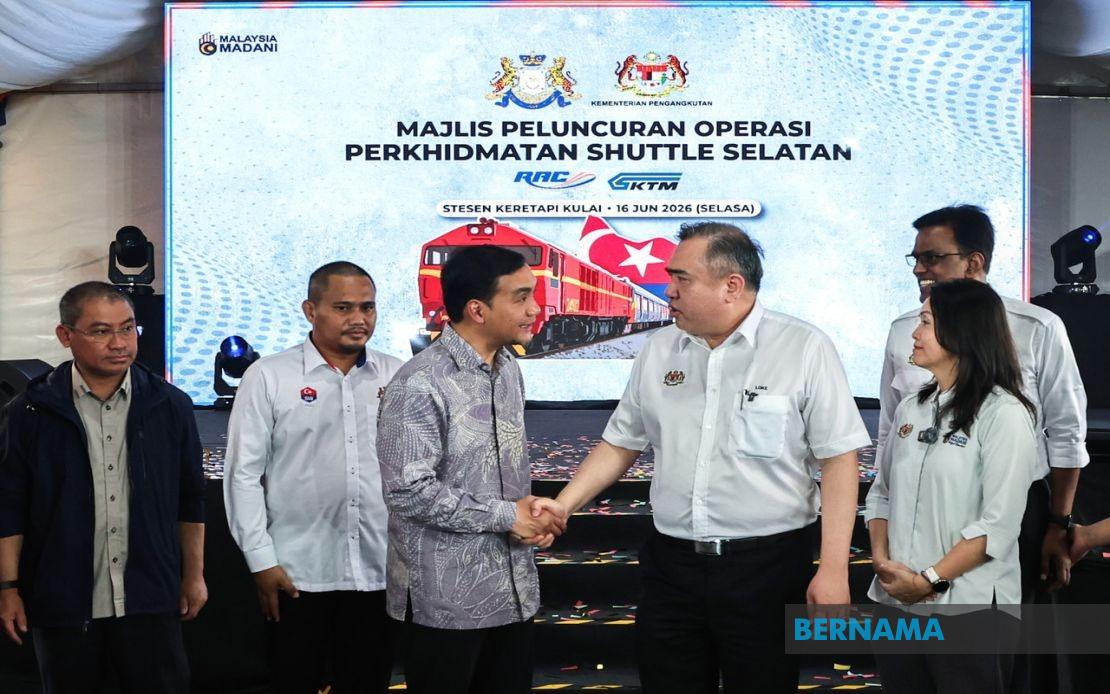
Transport Minister Anthony Loke officially inaugurated the Shuttle Selatan service at Kulai KTM station on June 16, marking a significant step in enhancing public transportation connectivity across southern Johor. The new service establishes dedicated rail links between Kulai, JB Sentral, and Pasir Gudang, three densely populated areas whose combined population exceeds two million residents. This launch represents the culmination of collaborative efforts between the Ministry of Transport, Keretapi Tanah Melayu Berhad (KTMB), and the Railway Assets Corporation (RAC), addressing longstanding connectivity challenges in one of Malaysia's most economically dynamic regions.
The service commences operations on two principal routes designed to capture different travel patterns across the region. The first route connects Kulai directly to JB Sentral and back, while the second serves the Kempas Baru corridor through to Pasir Gudang. Journey times have been optimised for commuter convenience, with the Kulai to JB Sentral leg requiring approximately 40 minutes, whilst the Kempas Baru to Pasir Gudang section takes between 40 to 45 minutes. These travel durations position the shuttle service as a competitive alternative to private vehicle use, particularly for workers and students navigating daily commutes within this increasingly congested zone.
Looking beyond the immediate launch, the government has outlined an ambitious expansion blueprint that will substantially extend the shuttle network's reach across southern Johor. Transport Minister Loke disclosed plans to eventually extend service coverage from Paloh through to Kulai, incorporating intermediate stations at Kluang, Renggam, and Layang-Layang. This expansion strategy reflects the state's trajectory as one of Malaysia's fastest-growing economies, with burgeoning industrial, logistics, port, educational, and trade sectors requiring seamless regional connectivity. The phased approach allows for operational refinement on existing routes before tackling more complex extensions.
Three additional stations have been identified for development to enhance accessibility and broaden the service's catchment area. The proposed stations at Taman Daya, Bandar Baru Sri Alam, and Pasir Putih will provide intermediate access points, enabling more residents from surrounding residential communities to access the shuttle network conveniently. This station expansion strategy demonstrates deliberate planning to ensure that rail-based public transport benefits extend beyond major commercial hubs to encompass residential precincts where commuters originate.
Recognising that rail connections alone cannot solve last-mile connectivity challenges, the government has implemented a comprehensive ecosystem of supporting measures. Feeder bus services have been coordinated with the shuttle schedule, whilst Bas.My routes have been integrated to provide seamless transfers. A dedicated shuttle service operates at Kempas Baru specifically to consolidate passenger flows, and park-and-ride facilities at AEON Bandar Dato' Onn enable drivers to transition to public transport at convenient locations. These complementary initiatives transform Shuttle Selatan from an isolated rail service into a coherent mobility network addressing the complete journey experience.
To catalyse behavioural change toward public transport adoption, the government introduced the Commuter MADANI Shuttle Selatan Card, a subsidised travel pass with considerable incentive value. The RAC allocated over RM150,000 to fund distribution of 3,000 complimentary cards to Johor residents, whilst the RM50 travel card permits unlimited rides throughout its validity period. This financial incentive mechanism acknowledges that fare subsidies remain an effective policy instrument for overcoming resistance to mode switching amongst populations accustomed to private vehicle convenience.
For Malaysian readers and regional observers, Shuttle Selatan exemplifies the government's commitment to addressing congestion and environmental concerns through rail infrastructure investment. Johor's economic significance—encompassing major ports, industrial zones, and educational institutions—makes transportation efficiency a critical economic enabler. The service directly impacts productivity by reducing commute variability and travel times, whilst simultaneously contributing to congestion mitigation and emissions reduction objectives.
The presence of Johor Menteri Besar Datuk Onn Hafiz Ghazi and the state's Public Works and Transport Committee chairman at the launch underscores political alignment between federal and state governments on public transport priorities. This institutional coordination reduces implementation friction and signals sustained commitment to service expansion, though success ultimately depends on consistent management and responsive operational adjustments based on ridership patterns.
The broader regional implications merit attention. Southeast Asia's rapid urbanisation and industrial development create similar connectivity challenges across the region. Shuttle Selatan's design—combining dedicated rail infrastructure with integrated feeder services and digital mobility integration through Bas.My—offers a replicable model for other Malaysian metropolitan areas and regional counterparts grappling with congestion. The emphasis on first-mile, last-mile solutions and behavioural incentives reflects evolving best practices in sustainable urban mobility.
Operational success will ultimately determine whether Shuttle Selatan achieves its ambitious two-million-person target. Ridership growth requires consistent service reliability, competitive journey times, and user-friendly integration with other transport modes. The subsidy mechanism provides an important launch window, but the service must develop sustainable ridership momentum extending beyond subsidised passengers to become a self-sustaining component of Johor's transport infrastructure.
Looking forward, the expansion roadmap positions Shuttle Selatan as a foundational element in a broader southern Johor transport strategy. Successful execution could catalyse investment in complementary infrastructure improvements, potentially including enhanced pedestrian connectivity around stations and integrated ticketing systems. The service demonstrates that despite Malaysia's historical automobile-centric planning orientation, major policy shifts toward public transport remain feasible when institutional commitment, financial resources, and considered design converge around clear objectives.