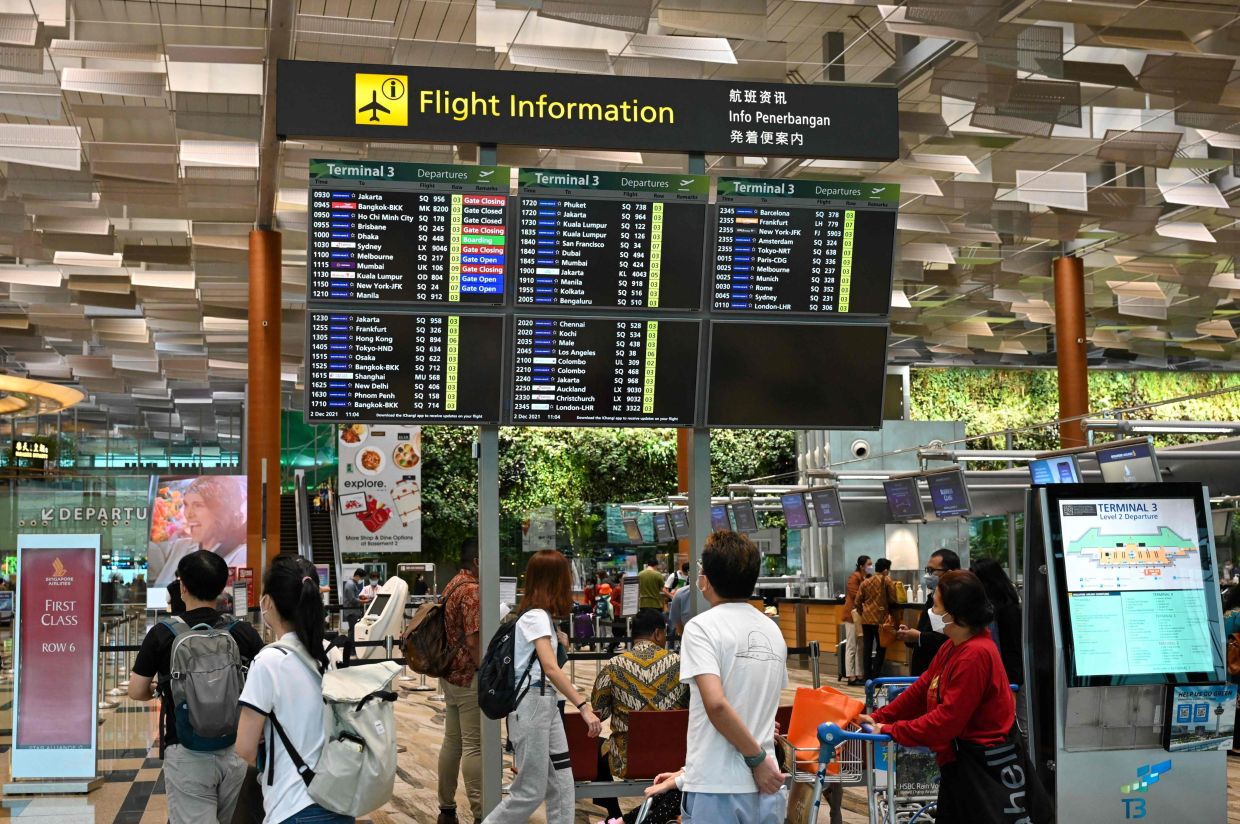
A Singapore court has handed down prison sentences to a Hong Kong mother and her adult son following a violent incident at Changi Airport's Terminal 3 that left a bystander injured and resulted in a police officer being bitten. Chan Sui-kwan, 65, received a six-month jail term for voluntarily causing hurt to deter a public servant from performing his duties, while her son Chan Wing-kwan, 42, was given a 10-day sentence for voluntarily causing hurt. The sentencing came after both were convicted on July 29, with the mother receiving her sentence on Monday.
The confrontation unfolded on the afternoon of June 30, 2024, when the son became increasingly agitated after misinterpreting actions by nearby passengers. According to court documents, he believed bystanders were mocking him, prompting him to kick his mother in frustration. When a 69-year-old bystander moved to assist the mother and check on her wellbeing, she rebuffed his offer of help, and her son responded by aggressively inviting the man to fight.
The situation deteriorated significantly when the pair relocated to another level within the terminal building. The son again kicked his mother, and when the bystander attempted to contact police to report the disturbance, the son charged at him. What followed was a brief but violent altercation during which the son repeatedly struck the bystander with his fists, causing a head haematoma—a pool of blood under the skin—along with abrasions to the knee and bruising on the fingers.
Initial police response was relatively straightforward. Officers arrived at the scene, documented the incident, and recorded passport details from both the mother and son before returning their travel documents. However, what appeared to be a contained matter took a dramatic turn hours later when officers encountered the pair again in the departure hall of the airport.
At this second encounter, the mother refused to surrender her passport and created a further disturbance that prompted officers to place her under arrest. Her resistance to apprehension was fierce and determined, escalating the incident beyond the earlier physical altercation. During the arrest procedure, she bit a police officer on his right forearm, penetrating his clothing and leaving a visible 1-centimetre mark accompanied by significant bruising. This assault on a law enforcement officer became the basis for her more serious charge relating to obstructing a public servant.
The legal proceedings that followed were marked by notable delays and complications. The mother was initially brought before the courts on November 18, 2024—more than four months after the incident occurred—while her son faced charges on April 24. Their failure to appear at a scheduled court date on July 22 this year resulted in the issuance of an arrest warrant, suggesting the pair may have been apprehended subsequently. Both were eventually convicted on July 29 before receiving their respective sentences.
This incident carries particular significance for regional travellers and law enforcement in Southeast Asia, where airport security protocols have become increasingly stringent. The violent altercation at one of the region's busiest international hubs demonstrates how rapidly situational misunderstandings can escalate into serious criminal conduct when individuals lose emotional control in crowded public spaces. The involvement of a bystander attempting to de-escalate the situation, only to become the primary victim of the violence, reflects the real dangers faced by ordinary citizens who intervene in disputes.
The outcome also illustrates Singapore's firm approach to violence against law enforcement personnel and conduct that disrupts public order in critical infrastructure facilities like airports. The differing sentence lengths—six months for the mother versus ten days for the son—reflect the severity of assaulting a police officer compared to other forms of assault. The mother's sentence was materially harsher because her offence specifically targeted a public servant attempting to execute his lawful duties, which Singapore's courts view as a particularly serious breach warranting substantial penalties.
For Malaysian and broader Southeast Asian readers, the case underscores the importance of maintaining composure in high-stress travel environments and the serious legal consequences that can flow from seemingly momentary lapses in judgment. Airport incidents involving violence increasingly result in criminal charges and imprisonment rather than administrative resolution, particularly when law enforcement personnel are involved. The case also highlights how international travel creates jurisdiction questions and enforcement challenges, though Singapore's resolution of this matter suggests effective coordination in apprehending and prosecuting foreign nationals who commit offences within its borders.

