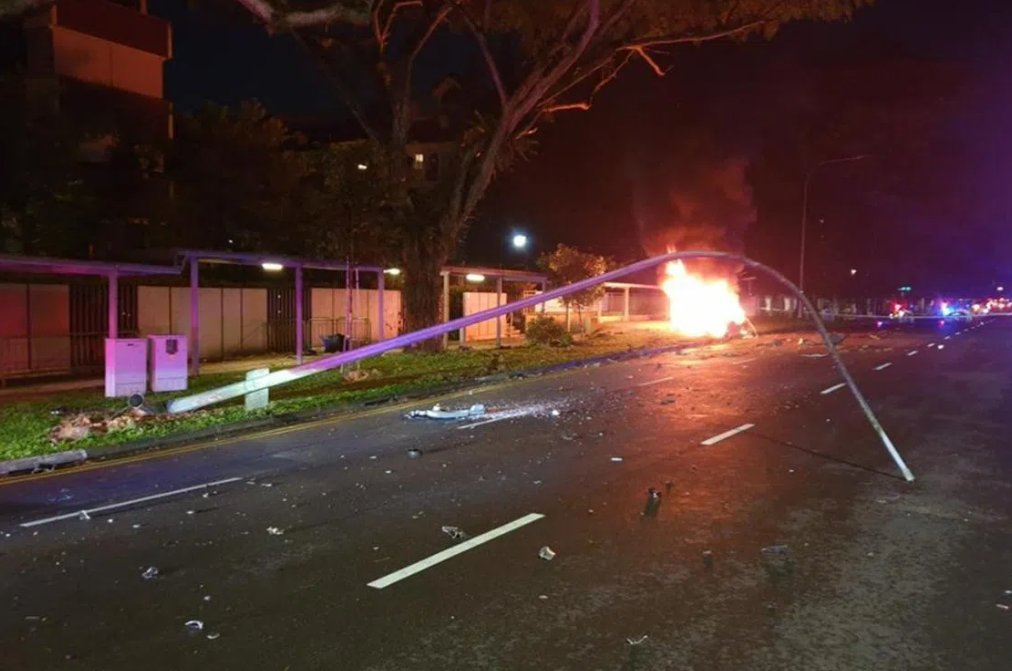
A 29-year-old Singaporean man has been charged with multiple serious traffic offences following a reckless early-morning driving incident that injured two school-aged children. Aaron Tan Yao Cong allegedly drove against the flow of traffic on March 6, 2024, reaching speeds of 114 kilometres per hour before colliding with a bus and lamp post, leaving his vehicle ablaze. The case, which was formally brought before the courts on June 18, underscores the escalating dangers posed by repeat drink-driving offenders and raises questions about road safety enforcement in the region.
According to court documents presented at his hearing, Tan had consumed substantial quantities of alcohol prior to the incident. When arrested, he refused to submit to a breathalyser test at the roadside, yet subsequent blood analysis revealed his alcohol concentration at 148 milligrams per 100 millilitres of blood, significantly surpassing Singapore's legal limit of 80 milligrams per 100 millilitres. The refusal to cooperate with initial testing has itself become a separate charge against him. What distinguishes this case is Tan's prior criminal record, with a previous conviction for drink-driving dating back to 2019, indicating a pattern of disregard for traffic safety regulations and alcohol-impaired driving laws.
The sequence of events on that morning demonstrates a cascading series of dangerous driving decisions. At 5:50 a.m. along Cavenagh Road, Tan first ignored a traffic sign directing vehicles to proceed straight, instead negotiating a left turn to drive directly towards oncoming traffic. He brought his vehicle to a halt on the left side of the two-lane roadway, an action in itself constituting a traffic hazard. His initial vehicle contained four occupants including himself, all of whom would manage to escape as the car subsequently caught fire. However, the incident was far from over at this point.
What followed demonstrated alarming acceleration of dangerous behaviour. Police records indicate that as officers approached the stationary burning vehicle at 6:00 a.m., Tan inexplicably accelerated and fled the scene. By 6:16 a.m., he was spotted racing along Bukit Timah Road towards Upper Bukit Timah Road, weaving in and out of traffic between Coronation Road and Anamalai Avenue. The sustained speed of 114 kilometres per hour, combined with erratic lane changes and his visibly impaired state, created a high-speed danger corridor through an urban area that would inevitably encounter other road users, including public transport vehicles.
The collision that followed was largely predictable given these circumstances. At the junction of Sixth Avenue, Tan failed to conform to a red traffic light signal, colliding directly with a private bus that was executing a lawful U-turn. The impact was sufficiently violent to send his vehicle into a lamp post, the contact igniting a fire that forced occupants to evacuate. Among those aboard the bus were two children aged nine and ten, passengers who likely had no awareness of the danger bearing down upon them from a driver operating under the influence of alcohol and exercising catastrophically poor judgment.
The human consequences extended to six individuals requiring hospitalisation. In addition to Tan and his three vehicle passengers, the bus driver and the two young passengers received medical attention. Most concerning is the injury to the children, whose presence on a school bus suggests they were engaged in routine daily commuting when subjected to harm through another driver's culpability. The psychological impact on these young road users and their families represents a consequence of repeat drink-driving that extends far beyond the immediate physical injuries sustained.
Tan now faces five distinct charges with varying sentencing frameworks. The drink-driving charge, prosecuted as a repeat offence given his 2019 conviction, carries potential imprisonment of up to two years and a fine reaching S$20,000. The dangerous driving causing hurt charge permits imprisonment of up to two years, a fine of S$10,000, or both, with repeat offenders facing enhanced fines of S$20,000. Additional charges relate to leaving his vehicle in a position creating danger to others, failing to provide a breath specimen when required, and driving against the flow of traffic—each carrying their own sentencing ranges that compound the potential total penalty.
The severity of the potential sentences reflects Singapore's increasingly stringent approach towards drink-driving, particularly in cases involving injury to third parties. The legal framework distinguishes between first-time and repeat offenders, with Tan's prior 2019 convictions significantly aggravating the penalties available to the court. The cumulative nature of five separate charges means that even if sentences run concurrently rather than consecutively, the overall custodial term and financial penalties are likely to be substantial, though not at the absolute maximum possible under current sentencing guidelines.
For Malaysian readers and those across Southeast Asia, this case carries instructive significance regarding the consequences of repeat traffic offences and the judicial response to dangerous driving. While Singapore maintains notably stricter enforcement and more severe penalties than most regional jurisdictions, the underlying pattern reflected in this incident—an individual with prior drink-driving convictions reoffending with dramatically heightened danger—remains relevant across the region. The case illustrates how initial lenient treatment of traffic violations can contribute to escalation, as offenders perceive inadequate deterrence.
Tan's return to court is scheduled for July 16, at which point he must formally indicate his plea status on the five charges. His solicitors have not yet signalled whether he intends to contest the charges or accept responsibility through guilty pleas. The fact pattern and evidence gathered appears substantially documented through police reports, blood alcohol analysis, and witness testimony from multiple parties, suggesting a relatively straightforward evidentiary foundation for prosecution. His decisions at this juncture—whether to contest charges, seek mitigation, or accept culpability—will significantly influence the ultimate sentencing outcome.
The incident also raises broader questions about enforcement gaps that allowed someone with prior drink-driving convictions to continue operating vehicles with apparent minimal monitoring or restriction. In several Southeast Asian jurisdictions, repeat drink-driving offenders face enhanced licensing restrictions, mandatory alcohol interlock devices, or other technological safeguards that might have prevented this particular incident. The case provides an opportunity for policymakers across the region to examine whether existing post-conviction management systems adequately protect public safety from recidivist offenders before they cause serious harm.