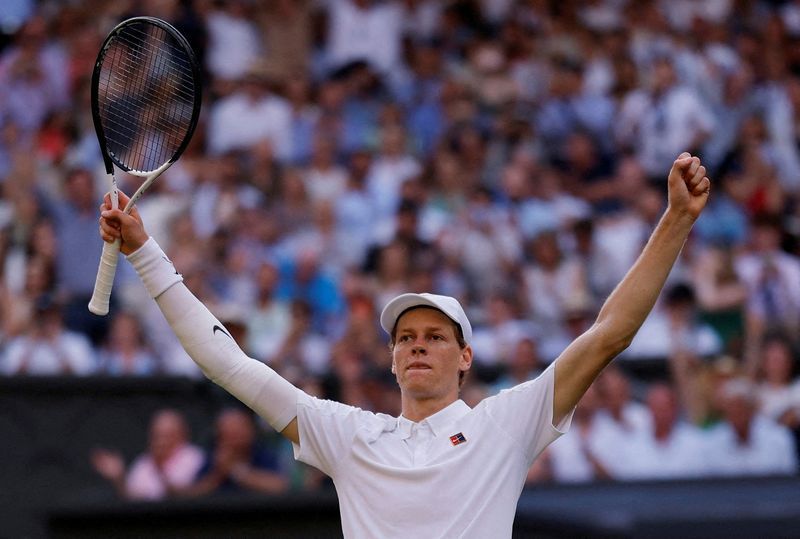
Jannik Sinner's journey to Wimbledon this year carries an unfamiliar weight of vulnerability. The world number one defends his title at the All England Club starting Monday, but the Italian's recent setbacks have shattered the aura of invincibility that surrounded him after a commanding clay-court campaign earlier in the season. His shock second-round exit at Roland Garros last month severed an impressive 30-match winning streak stretching back to February, leaving observers questioning whether he possesses the mental and physical resilience needed to maintain his dominance across different surfaces when stakes reach their peak at the sport's most prestigious events.
The collapse in Paris was particularly jarring given Sinner's commanding form preceding it. He had established himself as the tour's most consistent performer, accumulating victories with seemingly effortless dominance. Yet the accumulated fatigue from an exceptionally demanding two-month preparation schedule—featuring numerous tournaments with inadequate recovery periods and limited dedicated training time—caught up with him at precisely the wrong moment. Now, the rapid transition to grass offers both opportunity and risk. The faster surface typically suits aggressive players and may allow Sinner to reset his approach, though his decision to forego traditional warm-up events raises legitimate questions about his competitive readiness as he attempts to regain his rhythm.
Mats Wilander, a seven-time Grand Slam champion whose expertise on changing court conditions remains influential in professional tennis circles, acknowledges Sinner's vulnerability while maintaining measured optimism about his prospects. Wilander attributes the French Open failure to a straightforward exhaustion issue rather than any fundamental weakness in Sinner's game. The legendary Swedish player notes that adequate rest has theoretically restored Sinner's physical reserves, yet adds an important caveat—that grass-court tennis, with its unpredictable bounces and reliance on serving precision, presents distinct challenges that cannot be assumed away through rest alone. This observation carries particular weight given that Wimbledon's playing surface remains notoriously unforgiving to players attempting to impose their will through pace and aggression.
The most formidable obstacle to Sinner's title retention emerges in the form of Novak Djokovic, whose mastery of grass-court tactics and superior return-of-serve capabilities position him as the most credible contender. The Serbian champion pursues dual objectives at this year's championships: claiming his eighth Wimbledon trophy to match Roger Federer's all-time record, and more pressingly, capturing the elusive standalone 25th Grand Slam title that has eluded him despite his extraordinary career achievements. At 39 years old, Djokovic's window for accomplishing these feats is rapidly closing, lending particular urgency to his campaign. While he too stumbled at Roland Garros, finishing as an early casualty, prominent commentators including former finalist Andy Roddick dismiss suggestions that this diminishes his Wimbledon prospects.
Roddick's analysis, articulated through his influential podcast platform, deserves serious consideration among those assessing the tournament's likely trajectory. The American suggests that Djokovic has undoubtedly reassessed the competitive landscape following his Paris disappointment and identified Wimbledon as his realistic opportunity to reclaim Major championship glory. Roddick contends that despite being 39 and unlikely in his athletic prime, Djokovic possesses sufficient skill, grasscourt experience, and mental fortitude to position himself among genuine title contenders. The subtle suggestion is that Djokovic, observing both Sinner's vulnerability and the absence of injured defending American champion Carlos Alcaraz from the draw, recognizes an unusually favorable circumstance for mounting a serious championship bid in what may represent his final realistic opportunity for Major success.
Alexander Zverev emerges as an unexpectedly powerful contender following his breakthrough French Open victory, ending a frustrating Grand Slam drought that had haunted his career despite consistent high-level performances. The German's newly acquired confidence, bolstered by finally converting a Major championship opportunity, creates momentum heading into the grass-court season where Zverev's exceptional serving prowess becomes particularly valuable. Boris Becker, Zverev's fellow German and a six-time Major winner intimately familiar with grass-court demands, articulates a compelling case for the 29-year-old as a genuine favorite for the title, particularly given the extraordinary circumstances created by Alcaraz's unavailability and uncertainties surrounding Sinner's form.
Becker's reasoning illuminates an important dynamic often underappreciated by casual observers: a dominant serve provides an outsized advantage on grass courts where points conclude with greater frequency on first serves and break opportunities emerge less predictably than on slower surfaces. Becker suggests that Zverev's serving caliber alone positions him within striking distance of a semi-final appearance, from which any competent Major-champion-caliber player possesses legitimate title hopes. The endorsement carries particular weight given Becker's direct experience winning three Wimbledon titles and his sophisticated understanding of the specific requirements for success at the All England Club, distinguishing it from other Major venues.
Carlos Alcaraz's absence from the 2025 Wimbledon draw represents a seismic shift in the competitive landscape, eliminating perhaps the most formidable grasscourt player of the contemporary era. Alcaraz's dominant runs to back-to-back Wimbledon titles in 2023 and 2024 established him as a genuine grasscourt virtuoso capable of imposing his game with the same authority that characterizes his dominance on hardcourts. His injury-forced withdrawal removes the most realistic counterbalance to Sinner's defensive capabilities and opens wider opportunity space for secondary contenders to advance further into the tournament structure than would normally be possible. This circumstance paradoxically creates an unusually wide-open championship scenario, though one complicated by Sinner's presence and uncertain condition.
The secondary tier of contenders benefits substantially from this reconfigured landscape. American prospects including Ben Shelton, Taylor Fritz, and Frances Tiafoe possess the technical weapons and aggressive mindsets suited to grass-court competition, yet have historically struggled to consistently convert these attributes into deep Major-championship runs. Italian emerging talent Flavio Cobolli, buoyed by his performance as French Open runner-up, represents the next generation of serious competitors capable of mounting surprise advances if established players encounter early difficulties. The depth of credible contenders extends unusually far down the seeding structure, reflecting both the departure of defending American champion Alcaraz and the question marks surrounding Sinner's readiness despite his top ranking.
For Malaysian and Southeast Asian readers, this championship carries regional dimensions worth considering. While the region has not produced Wimbledon champions in recent decades, the tournament's positioning as tennis's most prestigious event and its significance within the professional tour's scheduling maintains broad continental interest. Sinner's potential vulnerability and the widened opportunity space for secondary contenders creates a narrative script differing markedly from recent years' dominance patterns, potentially offering fresh engagement angles for audiences accustomed to seeing established hierarchies reinforced at Grand Slams.
The psychological dimensions of Sinner's challenge deserve particular emphasis as he navigates the specific pressures of defending a Major title while managing legitimate fitness and confidence concerns. Returning to a tournament where one has previously triumphed carries intrinsic pressure and elevated expectations, complications intensified when defending a championship in the immediate aftermath of a shocking setback elsewhere. Sinner must simultaneously regain defensive consistency, prove capable of imposing his game on grass surfaces, and manage the mental burden of proving that his recent struggles represent temporary adversity rather than fundamental decline. This multifaceted challenge will likely determine whether he successfully repels Djokovic's challenge and Zverev's newfound confidence, or whether the widened opportunity space created by these circumstances culminates in a genuine upset.
As the tournament begins Monday, the narrative encompasses far more than simple title retention for a dominant player. The circumstances have conspired to create a championship season that offers realistic opportunities for multiple contenders while simultaneously testing whether the world number one possesses the resilience and adaptability required to overcome both external challengers and internal self-doubt. The resolution of these competing storylines will substantially influence the shape of professional tennis during the remainder of the season.

