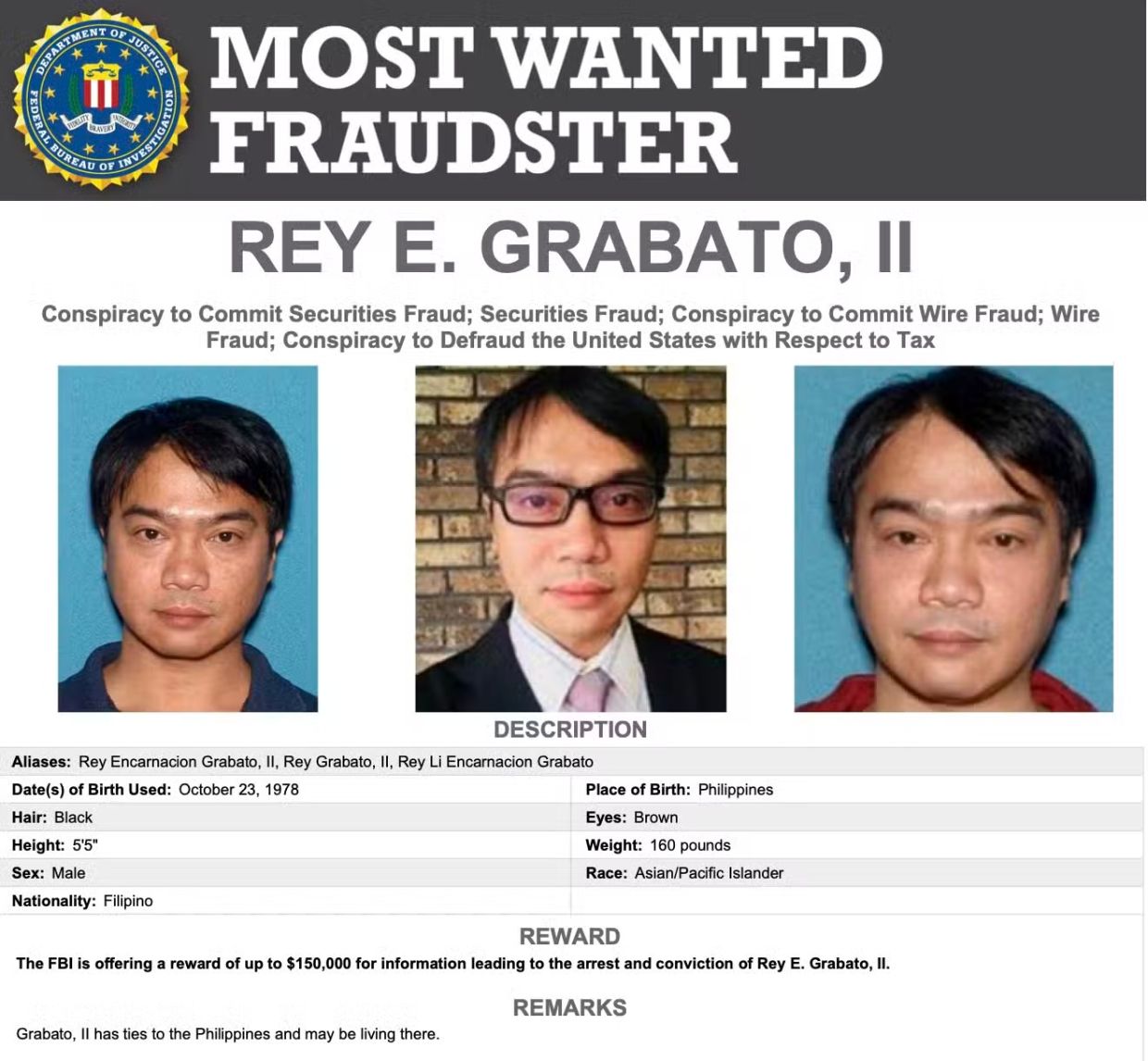
Rey E. Grabato II, whose father Rey P. Grabato serves as mayor of Mina in Iloilo province, has been added to the FBI's roster of most wanted fraud fugitives following charges related to a scheme that allegedly swindled more than 2,000 investors out of US$650 million. The designation marks a significant escalation in federal law enforcement efforts to track down high-profile financial criminals operating across international borders, underscoring how sophisticated fraud networks can exploit gaps between jurisdictions to operate with relative impunity.
Grabato's family has deep roots in Philippine municipal governance. His father currently serves as Mina's chief executive, while his mother, Lydia Encarnacion Grabato, previously held the same office, indicating the family's established political standing in the community. The prominence of Grabato's relatives in local politics adds another layer of complexity to the case, raising questions about the intersection of political influence and financial crime in the Philippines' provincial landscape.
The FBI is offering a substantial reward of up to US$150,000 for information that leads to Grabato's capture and subsequent conviction. Grabato previously served as president and principal stakeholder of National Realty Investment Advisors LLC, or NRIA, the entity through which the fraudulent operations allegedly occurred. Federal prosecutors have characterized the operation as a classic Ponzi scheme in which funds from new investors were channelled to earlier participants while the company generated minimal or nonexistent actual returns from legitimate business activities.
Grabato faces multiple serious federal charges, including securities fraud, wire fraud, and conspiracy to defraud the United States through tax-related offences. Alongside his alleged co-conspirator Thomas Nicholas Salzano, Grabato allegedly deployed deceptive marketing tactics to convince investors that NRIA represented a sound financial opportunity. The pair operated an extensive marketing apparatus spanning thousands of targeted emails alongside traditional media channels including television spots, radio advertisements, and billboards, coupled with direct investor presentations designed to build confidence in the scheme.
Between February 2018 and January 2022, the scheme specifically targeted approximately 2,000 investors, with several hundred victims concentrated in New Jersey, suggesting a deliberate focus on the significant Filipino-American population centres in the northeastern United States. Victims were misled into believing NRIA possessed financial stability and generated substantial returns through its primary vehicle, the NRIA Partners Portfolio Fund I LLC, ostensibly a real estate investment fund. In reality, federal prosecutors allege, the company relied almost entirely on continuously recruiting new investors to fund withdrawals by existing participants—the fundamental characteristic of unsustainable Ponzi structures.
Beyond the primary fraud, Grabato and his associates are accused of misappropriating millions of dollars belonging to investors, representing a compounding layer of criminal conduct. This allegation suggests not merely mismanagement or poor investment performance, but deliberate theft of client assets for personal enrichment. The scale of alleged misappropriation indicates systematic plundering of the investment pool rather than isolated instances of financial misadventure.
Federal prosecutors have also charged Grabato with participating in a separate scheme designed to obstruct the Internal Revenue Service's collection efforts against approximately US$26 million in accumulated unpaid tax obligations owed to the federal government. This scheme allegedly operated from November 2007 through August 2022, substantially overlapping with the primary investment fraud period and suggesting a comprehensive strategy to evade both civil and criminal financial accountability. The tax obstruction allegations indicate Grabato's alleged efforts extended beyond defrauding private investors to encompassing the US government itself.
A federal arrest warrant for Grabato was issued on October 12, 2022, following formal charges brought in the US District Court for the District of New Jersey in Newark. At the time of charging, prosecutors identified Grabato as residing in Hoboken, New Jersey, with connections to the Philippines, indicating his potential utilization of dual-location mobility to complicate apprehension efforts. While Grabato remained a fugitive following the charges, his alleged co-conspirator Salzano was apprehended in October 2022, suggesting divergent outcomes in the investigation.
Grabato has employed multiple name variations in his personal and business dealings, using Rey Encarnacion Grabato II, Rey Grabato II, and Rey Li Encarnacion Grabato across different contexts. Such name fluidity typically facilitates the compartmentalization of criminal enterprises and complicates law enforcement tracking across jurisdictions and financial institutions. The FBI's official documentation of these aliases represents an attempt to consolidate identification across the various identities under which he may continue operating.
The FBI's Most Wanted Fraudsters list, formally established in June 2026 to highlight major fugitives accused or convicted of significant fraud offences, now includes several individuals with Filipino connections or heritage. Michael Lizaso Marasigan, a Filipino-American dual citizen with ties to Guam and the Philippines, was previously convicted in May 2025 on charges involving illegal gambling, money laundering, and wire fraud. Additionally, married couple John Michael Dimitrion and Julieanne Baldueza Dimitrion, who pleaded guilty in 2009 to orchestrating a mortgage fraud operation in Hawaii, remain fugitives after failing to appear for sentencing in July 2010.
The emergence of multiple high-profile fraud cases involving individuals with Philippine heritage or connections reflects broader patterns in transnational financial crime. Sophisticated fraud networks increasingly exploit the geographic and regulatory gaps between the United States and Southeast Asia, leveraging diaspora communities and cross-border financial flows. The proliferation of such cases suggests that regional financial institutions and governments must enhance coordination and information-sharing capabilities to combat increasingly complex international schemes.
For Malaysian readers and Southeast Asian observers, the Grabato case illustrates vulnerabilities in cross-border financial systems that criminals routinely exploit. Similar schemes could potentially target investors across the region, particularly those participating in online investment platforms or foreign real estate funds. Authorities in Malaysia and neighbouring countries should examine their regulatory frameworks for comparable weaknesses and consider strengthening cooperation with American law enforcement agencies on fraud investigations involving transnational criminal networks.
The FBI continues seeking information regarding Grabato's whereabouts and ongoing activities. Individuals possessing relevant information are encouraged to contact their nearest FBI office or the closest US embassy or consulate. The case underscores how political prominence and family connections provide no immunity from federal prosecution, while also demonstrating the complexity of apprehending fraud fugitives who leverage international mobility and multiple jurisdictions.

