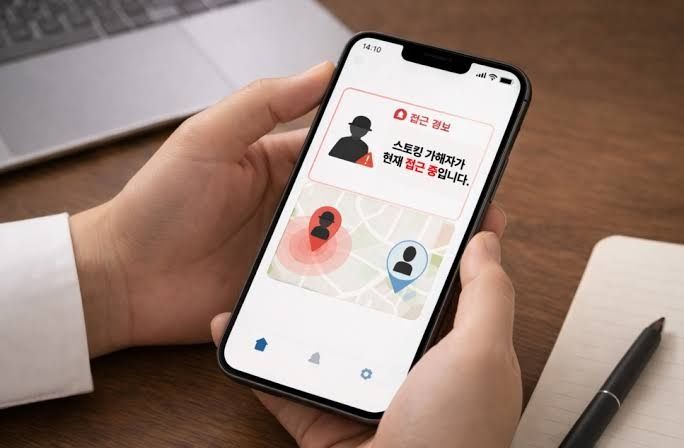
South Korea rolled out a pioneering mobile application on June 24 designed to fortify protections for victims of stalking through a groundbreaking real-time monitoring system. Operated by the Ministry of Justice, the new platform enables stalking victims to observe the precise location and movement trajectory of suspected stalkers fitted with electronic ankle monitors, marking a significant shift in how the nation approaches the increasingly serious problem of intimate partner harassment and persecution.
The technological initiative reflects mounting frustration with existing safety frameworks that have demonstrably failed to prevent tragic outcomes. Between 2021 and August 2025, a total of 23 stalking victims lost their lives or survived attempted murder attacks despite having been provided with smartwatch-style emergency alert devices, according to data cited by Representative Lee Gwang-hee of the ruling Democratic Party of Korea. These sobering statistics underscore the limitations of passive notification systems and highlight why authorities determined that enhanced situational awareness for victims had become essential.
Electronic monitoring of stalking suspects represented a relatively recent development within South Korean criminal justice. Beginning in 2024, courts began ordering certain high-risk cases to involve electronic ankle monitor placement on suspects, functioning as a supplement to the emergency alert devices that victims had accessed for several years prior. While this represented progress, the system lacked a crucial dimension—victims remained largely unaware of where their stalkers actually were or whether they might encounter them unexpectedly in public spaces or near their homes and workplaces.
The new mobile application bridges that gap by providing what authorities describe as actionable intelligence. Rather than simply knowing that an emergency alert device has been triggered, victims can now proactively monitor their suspected stalker's position and directional movements. This capability theoretically allows victims to avoid areas where a suspect is located, plan their daily routes with greater safety awareness, and potentially seek immediate assistance when a suspect moves into proximity of their residence or place of work. For victims living in constant fear, such real-time awareness represents a meaningful psychological and practical advantage.
The introduction of location-sharing technology naturally raised concerns about privacy protections for suspects awaiting trial or serving sentences. Recognizing this tension between victim safety and individual rights, the Justice Ministry undertook a comprehensive revision of regulations governing electronic monitoring systems in December 2025. These amended rules establish legal boundaries around how location data can be collected, stored, and accessed, attempting to ensure that technological tools designed for protection do not facilitate broader surveillance or misuse of suspects' personal information.
For Malaysian and Southeast Asian observers, the South Korean experience offers instructive lessons about the severity of stalking as a regional challenge. In Malaysia, intimate partner violence and harassment remain significant social problems, though comprehensive national statistics comparable to South Korea's are not consistently published. The South Korean approach—combining technological innovation, real-time data access, and regulatory safeguards—provides a potential model as the region grapples with how to protect vulnerable populations in an increasingly digital environment.
The Ministry of Justice has signalled that additional reforms are in preparation. In April 2027, South Korea intends to establish a system permitting stalking victims to submit court petitions for restraining orders without requiring law enforcement agencies to serve as intermediaries in the filing process. This reform addresses another identified gap in victim protection: the potential delays or obstacles that can occur when victims must rely on police cooperation to initiate legal proceedings. Enabling direct victim petitions to courts could accelerate protective orders and reduce situations where bureaucratic friction compromises victim safety.
The broader context reveals how stalking has evolved into a persistent challenge despite modernization and economic development. South Korea, one of Asia's most advanced economies with sophisticated law enforcement infrastructure, has struggled to prevent stalking-related fatalities despite earlier interventions like emergency alert devices. This pattern suggests that technological solutions alone are insufficient without accompanying cultural shifts, training improvements for police and judicial personnel, and potentially harsher penalties for repeat offenders.
Regional jurisdictions considering similar technological approaches should note that South Korea's government invested considerable effort in balancing victim protection with privacy concerns before deployment. The December 2025 regulatory amendments demonstrate that authorities recognised privacy safeguards as essential not only for ethical reasons but for public acceptance and legal sustainability of the monitoring programme. Any comparable system introduced in Malaysia or elsewhere in Southeast Asia would similarly require robust data protection frameworks to ensure public confidence.
The timeline for full implementation of South Korea's enhanced victim protection framework extends over several years, indicating that authorities recognise these complex challenges cannot be resolved through rapid deployment alone. The gap between the June 2024 introduction of electronic monitoring and the June 2025 launch of the real-time tracking application, followed by anticipated April 2027 reforms to the court petition process, reflects a measured approach to systemic change. This phased methodology may provide useful guidance for other regional governments developing victim protection infrastructure.
Ultimately, South Korea's initiative demonstrates recognition that stalking represents not merely a law enforcement issue but a public health and safety crisis requiring comprehensive, technology-enabled solutions. The real-time tracking application represents one component of that broader response, meaningful primarily when combined with revised regulations, accessible court processes, and continued commitment to preventing the tragic outcomes that prompted these reforms.

