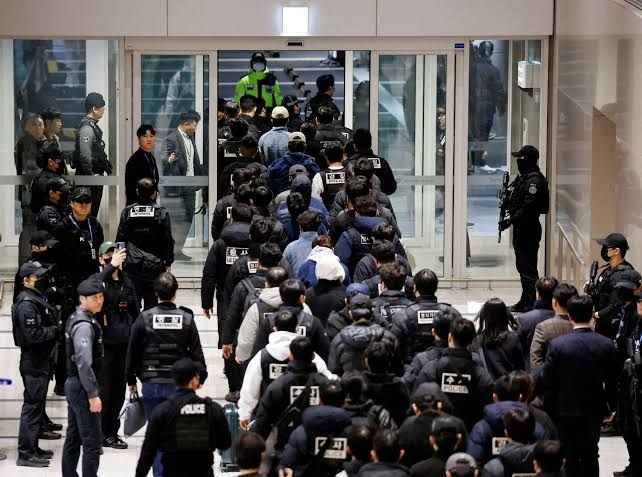
South Korea's national police have announced an extensive enforcement campaign beginning Monday to combat surging organised crime and transnational criminal activity, signalling a significant escalation in law enforcement efforts across the country. The operation, scheduled to run until the end of October, reflects mounting concern over the changing face of criminal enterprise in the nation, particularly the growing involvement of younger offenders in sophisticated financial schemes and cross-border illicit activities.
The Korean National Police Agency has identified financial crimes as a primary target during the campaign period. Organised fraud rings, unlicensed moneylending operations, illegal online gambling platforms, and money laundering schemes represent the most pressing concern for authorities, as these offences generate substantial criminal proceeds and cause widespread economic harm. The agency has acknowledged that younger criminals are increasingly gravitating toward these white-collar crimes rather than traditional street-level gang violence, marking a troubling evolution in the nature of organised criminal activity within South Korean society.
Beyond standard financial crime, the police strategy encompasses efforts to undermine criminals' ability to display and monetise their illegal gains through social media and online platforms. The enforcement operation recognises that the public flaunting of illicit wealth through digital channels not only generates fear and undermines social order but also serves as a recruitment tool for criminal organisations seeking to attract young members. By targeting these high-visibility displays and simultaneously freezing criminal assets, authorities aim to disrupt the financial ecosystems sustaining organised crime networks.
The international dimension of the crackdown reflects growing regional concerns about transnational criminal enterprise. The police agency has signalled particular attention to synthetic drug trafficking, especially substances like ketamine, which have proliferated across Asia and pose escalating public health risks. The operation will intensify intelligence gathering around foreign communities, workplace establishments, and nightlife districts where transnational organised crime networks operate, acknowledging that international criminal syndicates often exploit foreign worker populations and entertainment venues as bases for operations.
The timing of this comprehensive enforcement push follows alarming statistics from the first half of 2024, which revealed troubling trends in both organised crime and international criminal activity. Between March and June, police apprehended 1,185 individuals suspected of gang membership, representing a 9.7 per cent increase compared with the previous comparable period. Even more concerning was the 48.3 per cent surge in actual arrests made during investigations, indicating that authorities are not merely identifying suspects but successfully moving cases toward prosecution and conviction.
Demographic data from the enforcement roundups demonstrates the youth-centric nature of contemporary organised crime. Individuals aged 30 or younger constituted nearly two-thirds of all apprehended suspects, establishing young people as the dominant force within Korean criminal organisations. This generational shift carries significant implications for law enforcement strategy, as younger offenders may be more adaptable to technological innovation and more willing to engage in cyber-enabled crimes compared with traditional gang structures.
Fraud offences emerged as the dominant category within the criminal portfolios of younger suspects, accounting for 42.7 per cent of charges. This concentration highlights how contemporary organised crime has increasingly embraced deception and financial manipulation as core operational methods. The prevalence of fraud among youth offenders suggests that criminal organisations are investing in recruitment and training of digitally sophisticated members capable of executing complex schemes targeting vulnerable populations or exploiting financial system vulnerabilities.
International criminal activity demonstrated particularly acute growth patterns during the six-month enforcement period. Foreign nationals booked by police in the first half of 2024 totalled 18,130 individuals, reflecting a 9.1 per cent annual increase and indicating deepening involvement of transnational criminal networks in South Korea's criminal landscape. Drug-related offences specifically surged by 29 per cent, underscoring the escalating prevalence of narcotics trafficking as a major international crime category affecting the nation.
The police agency's commitment to enhanced intelligence gathering around foreign communities and international work environments reflects recognition that transnational criminal enterprises often operate through established immigrant networks and exploit the vulnerabilities of migrant worker populations. Nightlife districts, where international visitors and foreign residents concentrate, have historically served as operational hubs for smuggling, drug distribution, and human trafficking, making them logical focal points for the intensified enforcement initiative.
For Malaysia and other Southeast Asian nations, South Korea's enforcement response carries instructive implications regarding the regionalisation of organised crime. The rise of youth-led financial crime networks and the growing involvement of foreign nationals in Korean criminal enterprise mirror trends observed across Southeast Asia, where young offenders increasingly gravitate toward fraud, money laundering, and cyber-enabled crimes. The transnational dimension of drug trafficking and organised crime documented in South Korea's enforcement data reflects the interconnected nature of regional criminal markets, where syndicate operations span multiple countries and exploit porous borders.
The police agency's emphasis on asset freezing as a crime-disruption strategy aligns with emerging best practices in regional law enforcement and provides a model for enhanced coordination. By targeting criminal financing simultaneously with prosecuting individual offenders, authorities aim to degrade organisational capacity more effectively than enforcement strategies focusing solely on personnel apprehension. This financial approach may prove particularly relevant for Southeast Asian law enforcement agencies combating transnational syndicates whose operations depend on cross-border money flows.
The comprehensive nature of South Korea's enforcement operation underscores official determination to reverse the upward trajectory in organised and international crime. By combining immediate enforcement action through October with longer-term intelligence enhancement and asset-targeting measures, the police agency has constructed a multifaceted strategy acknowledging that traditional arrest-focused approaches prove insufficient against sophisticated, youth-led criminal networks operating across geographic and digital boundaries. Whether this intensive campaign succeeds in reversing recent crime trends will provide important insights for regional law enforcement agencies confronting similar organised crime challenges.

