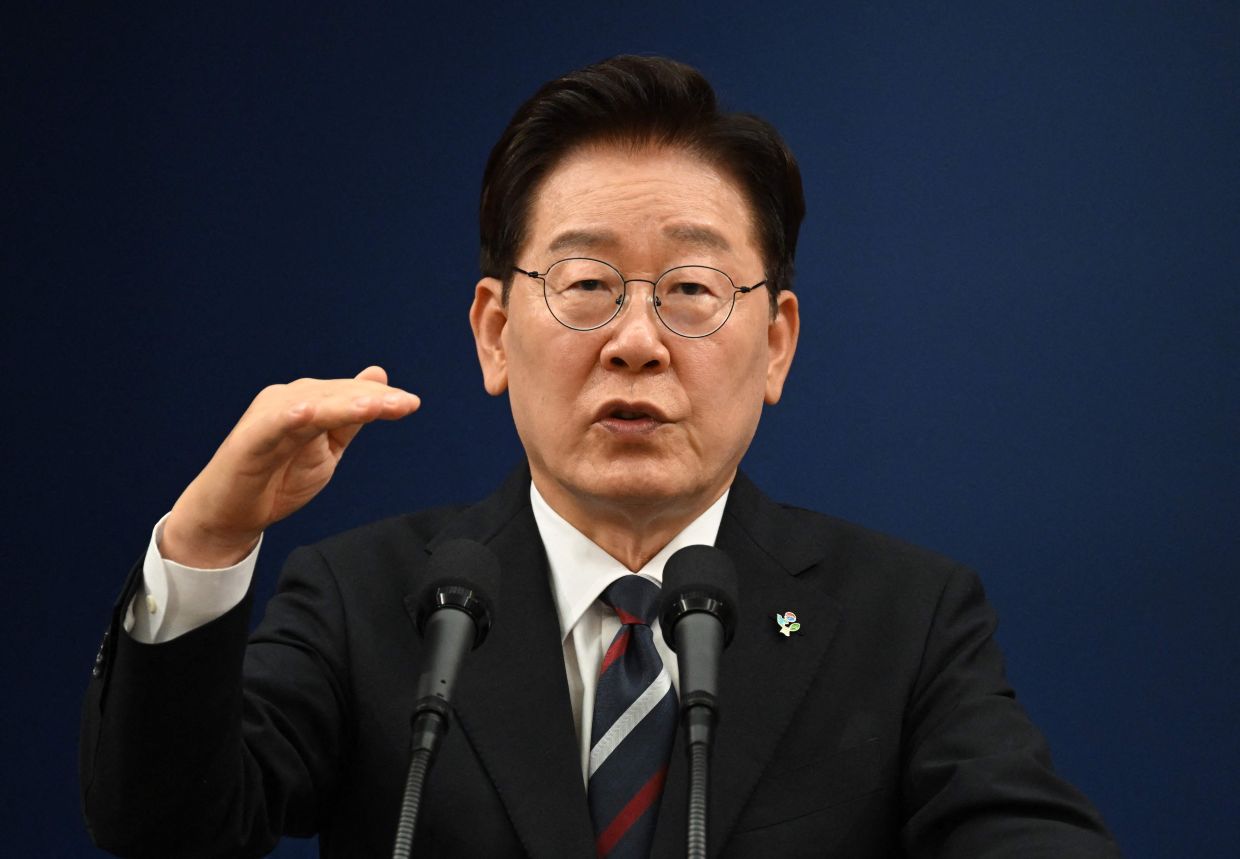
South Korean President Lee Jae Myung faces a significant political setback as his approval rating has dipped to 46.7 per cent according to a June 22 poll by Realmeter, marking his fifth consecutive week of declining support. The more troubling milestone, however, is that for the first time since his June 4, 2025 inauguration, those disapproving of his performance now outnumber supporters, with negative evaluations reaching 49.7 per cent. The shift reflects a dramatic erosion of confidence that contrasts sharply with the honeymoon period typically afforded to newly inaugurated leaders.
The downward spiral has been steep and unrelenting. Lee's approval rating stood at a commanding 60.5 per cent during the second week of May, but successive weeks saw steady declines that gathered momentum rather than stabilizing. The rating fell through 59.3 per cent and 59.1 per cent in subsequent measurements before dropping to 55.2 per cent and then 51.5 per cent in mid-June. The latest 46.7 per cent figure represents a 13.8 percentage-point collapse in just over a month, a velocity of decline that typically signals serious political turbulence.
Two interconnected crises appear to have triggered the public's loss of confidence in Lee's administration. The first stems from the June 3 local elections, which were marred by significant ballot shortages that raised questions about the competence of election management authorities and raised concerns about the integrity of the electoral process itself. The second involves intensifying factional warfare within Lee's Democratic Party of Korea as various factions position themselves ahead of an August 17 party convention to elect a new chairman. Rather than presenting a unified government, the ruling party has instead offered the electorate a spectacle of internal division and rivalry for power.
The geographic distribution of declining support reveals important fractures in Lee's political base. His approval rating experienced a particularly sharp collapse in Daegu and North Gyeongsang Province, traditionally conservative strongholds that should form his core constituency, dropping 9.9 percentage points to just 34.6 per cent. In the Greater Seoul metropolitan area—encompassing Seoul, Incheon, and Gyeonggi Province—the decline was nearly as steep, falling 7.6 percentage points in both Incheon and Gyeonggi to 44.8 per cent and plummeting to 39.8 per cent in Seoul itself. This pattern suggests that Lee's difficulties are not confined to opposition territory but have metastasized across the political map.
Among different ideological segments, moderate voters appear to be defecting most visibly. While liberals maintained relatively strong support at 80.4 per cent despite a marginal 3.2 percentage-point decline, and conservatives showed almost no movement downward with only a 0.7 percentage-point slip to 19.8 per cent, moderates represented the swing constituency most affected by recent events. Their approval fell 4.9 percentage points to 47.5 per cent, suggesting they are genuinely reassessing their support for the government. For a president whose victory often depends on capturing centrist voters, this erosion of moderate support carries particular significance.
Realmeter identified widening asset market disparities as a secondary factor contributing to the approval decline, particularly among moderate voters and residents of Greater Seoul. Economic anxiety, particularly concerning inequality and wealth distribution, has layered onto the immediate political crises to create a more broadly negative assessment of the administration's performance. This concern resonates particularly strongly in the capital region, where median asset values and awareness of inequality tend to be higher. The pollster also acknowledged some positive developments, including the perceived success of Lee's European diplomatic trip and the South Korean stock market's breakthrough above the 9,000-point level, yet these achievements proved insufficient to offset mounting dissatisfaction.
The comparison with Lee's predecessors provides historical context for understanding the severity of his current position. Former President Yoon Suk Yeol experienced a similar disapproval crossing-point, but only after six weeks in office—suggesting that Lee has sustained higher initial approval ratings than his immediate predecessor. Park Geun-hye's disapproval surpassed her approval roughly sixteen months into her term, while Moon Jae-in experienced the crossover point after nineteen months. Lee's crossing at approximately 2.5 weeks into his presidency, therefore, represents an unusually rapid deterioration compared to recent South Korean presidents.
The presidential office responded to the poll results with a carefully calibrated statement emphasizing humility and attentiveness. Cheong Wa Dae acknowledged the findings as legitimate reflections of public assessment regarding both economic conditions and broader state affairs management. The measured tone suggested an administration attempting to absorb the blow without becoming defensive, though such statements rarely reverse downward momentum once it gains sufficient force. The office's emphasis on future attentiveness rather than defending past decisions implicitly conceded that corrective action is necessary.
Beyond Lee's personal approval, the political landscape shows his Democratic Party of Korea gaining ground against the main opposition People Power Party, though the advancement appears fragile. Support for the Democratic Party rose 2.1 percentage points to 40.1 per cent, while the People Power Party slipped 2 percentage points to 42.3 per cent in a separate survey. Realmeter attributed the Democratic Party's relative strength to a temporary unity-focused crisis management phase following a bipartisan agreement to investigate the election administration failures. This suggests the party's rebound reflects procedural consensus rather than substantive policy achievement or restored public confidence.
The opposition People Power Party simultaneously faces its own pressures stemming from the same election administration controversies, as internal disputes over whether to conduct a full election rerun and abolish early voting have fractured its coalition. The party's approval rating declined across age groups, with particularly devastating losses among younger voters—dropping 10.5 percentage points to 48.6 per cent among those in their twenties and 5.1 percentage points to 47.4 per cent among those in their thirties. This generational defection from the conservative movement represents a longer-term threat to the party's future electoral prospects.
For Malaysian and Southeast Asian observers, Lee's predicament illustrates the acceleration of political volatility in contemporary democracies where digital connectivity and instant polling create short feedback loops between public sentiment and political stability. South Korea's relatively mature democratic institutions have produced sophisticated polling that captures rapid shifts in public opinion, enabling political actors to react quickly but also potentially amplifying volatility. The collision of election administration failures with internal party factional conflict demonstrates how multiple simultaneous crises compound rather than offset each other in the public consciousness. Leaders navigating such turbulent environments face the challenge of stabilizing confidence while addressing legitimate grievances—a balance that Lee's current trajectory suggests remains elusive.

