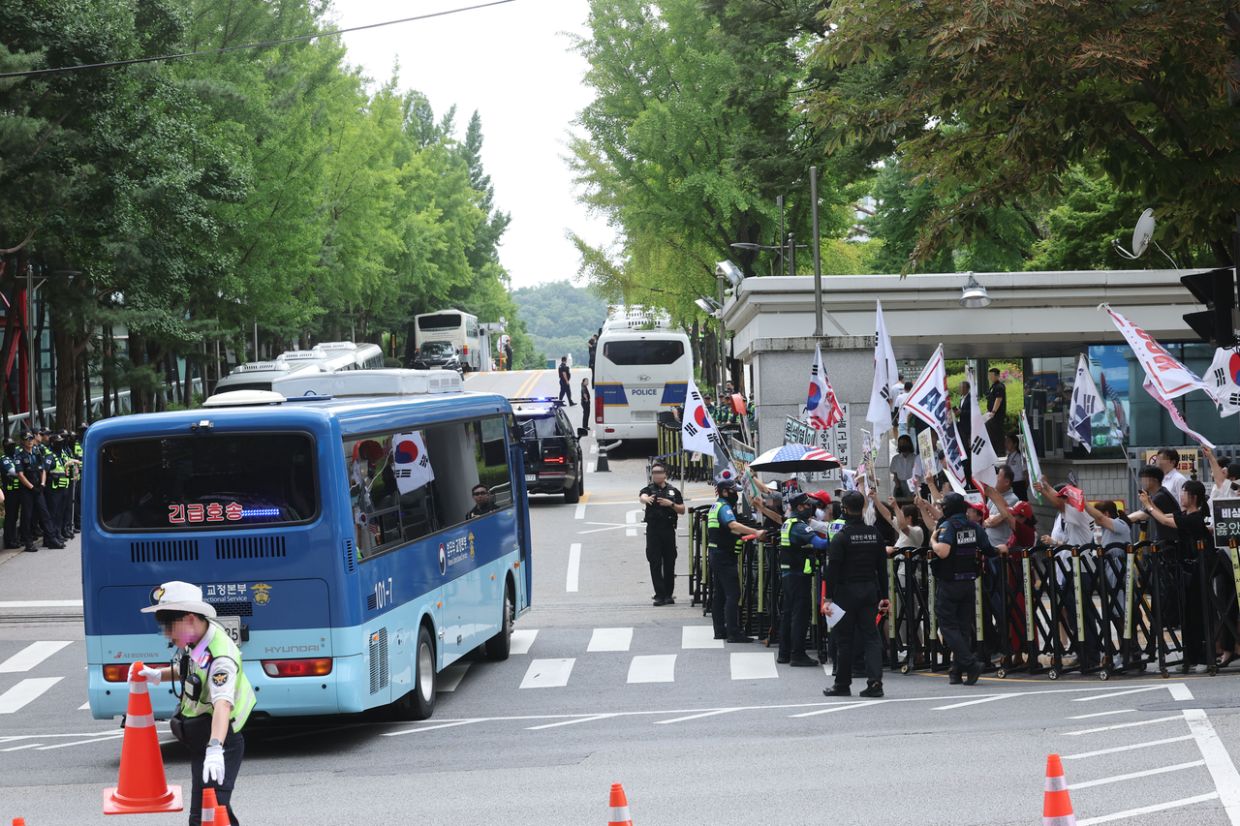
Former South Korean President Yoon Suk Yeol faces immediate imprisonment following his conviction for receiving complimentary polling services in violation of election finance regulations. The Seoul Central District Court imposed a two-year jail sentence on Monday, determining that Yoon had benefited from 14 opinion surveys valued at 27.92 million won provided by political broker Myung Tae-kyun without proper documentation or payment, constituting a breach of the Political Funds Act.
The court's determination centred on the systematic provision of polling data during Yoon's presidential campaign between June 2021 and March 2022. Rather than accepting prosecutors' broader allegations involving 58 surveys worth over 270 million won, the bench identified sufficient evidence for 14 instances where the candidate received quantifiable campaign advantages through unreported in-kind contributions. Judge Lee Jin-gwan emphasized that the financial valuation of these surveys at nearly 28 million won represented a material circumvention of campaign finance transparency requirements designed to protect electoral integrity.
Crucially, the court established that Yoon's wife, former First Lady Kim Keon Hee, played an active intermediary role in facilitating the arrangement with Myung. The evidence demonstrated that Kim had explicitly authorized the political broker to control essential polling parameters including timing, content, methodology, and publication decisions. Importantly, the court found that Yoon possessed knowledge of this arrangement and implicitly accepted the terms, establishing what judges characterized as a "successive and tacit agreement" binding all three parties to the irregular transaction.
The judicial reasoning reflected deeper concerns about democratic safeguards in South Korea's electoral system. Judge Lee articulated that polling data inherently shapes voter behaviour and public perception, making the credibility of survey research foundational to fair democratic competition. When political candidates receive such services outside regulated channels, the court reasoned, the resulting information asymmetry undermines the level playing field that elections require. The provision of unreported polling advantages risks systematically distorting public opinion formation itself, potentially compromising the legitimacy of electoral outcomes.
A quid pro quo arrangement involving former lawmaker Kim Young-sun's party nomination further complicated the case. Evidence indicated that Yoon had promised Myung assistance in securing Kim Young-sun's People Power Party nomination in exchange for continued polling access. Subsequently, Yoon apparently leveraged his influence through Chang Je-won, his then-chief of staff, to advance Kim Young-sun's candidacy within party selection processes. However, the court determined that establishing such explicit reciprocity was unnecessary for conviction under the Political Funds Act, as the undisclosed receipt of valuable services itself constituted the violation.
Myung Tae-kyun, the political broker central to the scheme, received an 18-month prison sentence and was remanded into custody immediately following Monday's proceedings. His lighter sentence compared to Yoon's reflects the court's assessment of differential culpability, though both men stand convicted of orchestrating the illegal campaign finance arrangement. The swift custodial remand underscores the judiciary's determination to enforce electoral finance regulations without delay.
A stark contrast emerged in the parallel case against Kim Keon Hee, who faced identical allegations regarding the same polling services. Lower courts at both trial and appellate levels acquitted the former First Lady of related Political Funds Act violations, finding that prosecutors had failed to demonstrate she received quantifiable financial benefit or that services were provided specifically to advance Kim Young-sun's nomination prospects. This divergence in outcomes between Yoon and his wife—despite shared involvement in the same underlying transactions—suggests the judiciary applied more stringent evidentiary standards in her case.
Judge Lee explicitly noted that "allegations concerning the opinion polls provided by Myung in Kim's case and those in Yoon's case cannot be regarded as identical," acknowledging the distinct factual foundations distinguishing the two proceedings. The lower courts' conclusion that Kim Keon Hee lacked the direct benefit or explicit quid pro quo linkage present in Yoon's situation created legal separation between their culpability. The Supreme Court is scheduled to deliver its definitive ruling in Kim's case on Thursday, potentially validating or overturning the acquittals.
The conviction carries profound implications for South Korean politics and rule of law. As the first recent ex-president to face imprisonment on campaign finance charges, Yoon's case signals judicial willingness to prosecute high-ranking officials without deference to former executive status. The decision reflects accumulated frustration within South Korea's legal establishment regarding recurring patterns of election finance violations among presidential candidates, a phenomenon that has plagued Korean democracy for decades.
For regional observers in Southeast Asia, the Yoon case illuminates contrasting approaches to electoral accountability. While countries like Malaysia grapple with campaign finance transparency and political integrity challenges, South Korea's judicial system has demonstrated capacity to investigate, prosecute, and convict sitting and former presidents on electoral finance violations. However, the divergent treatment of Yoon versus Kim Keon Hee raises questions about consistency in applying campaign finance standards, a concern familiar across the region where selective prosecution sometimes accompanies political transitions.
The immediate practical consequence involves Yoon's expected appeal through South Korea's appellate hierarchy toward the Supreme Court. During this process, he may obtain bail pending final adjudication, and conviction reversal remains possible on appeal. Nevertheless, the Seoul court's detailed analysis provides prosecutorial precedent for pursuing similar cases involving undisclosed campaign contributions, particularly those delivered through political brokers or intermediaries designed to obscure transaction trails.
The verdict also creates pressure on South Korea's conservative leadership to address campaign finance vulnerabilities that enabled the polling arrangement. Political parties face incentives to establish stricter internal compliance mechanisms and vetting procedures for candidate campaign activities. Democratic institutions benefit when such scandals prompt systemic reform rather than serving as isolated cautionary tales, a lesson applicable across Asia's developing democracies where campaign finance enforcement remains inconsistent.

