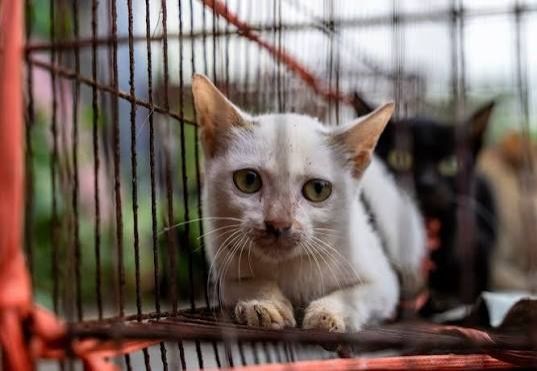
Vietnamese law enforcement has dealt a significant blow to an organized cat theft ring operating across southern Vietnam, recovering more than 400 live animals and around 80 carcasses preserved for sale as food. The operation, which spanned three years, culminated in the arrest of nine suspects last week in Ho Chi Minh City. Animal welfare organizations have hailed the police action as decisive intervention that prevented hundreds of stolen pets from reaching slaughterhouses, though the rescue has also exposed the vulnerabilities of pet owners across the region to organized theft networks.
The criminal enterprise operated with systematic precision, with gang members confessing to deliberately luring and trapping cats throughout southern Vietnam before transporting them to facilities for processing. Authorities discovered the scheme while investigating a surge in pet thefts plaguing Ho Chi Minh City residents, who had grown increasingly concerned about missing animals. The investigation ultimately uncovered the full scope of the operation, leading officers to multiple locations where they seized the living animals and processed carcasses. The discovery of 80 preserved cats on ice underscores the industrial scale of the enterprise, which treated animal theft and slaughter as a conventional business operation rather than isolated incidents.
Under Vietnamese law, the consumption of dog and cat meat remains legal, and numerous restaurants openly market such products to customers. However, vendors operating within the bounds of the law are required to obtain and display certificates verifying the legitimate origin of animals they sell. This regulatory framework theoretically prevents the trade in stolen pets, yet the successful three-year operation of this criminal ring suggests enforcement gaps persist. The gang's apparent disregard for documentation requirements indicates either inadequate oversight of meat suppliers or deliberate evasion of the limited checks in place. For potential consumers concerned about the source of such meat, the bust underscores the difficulty of verifying legitimacy in unregulated establishments.
The immediate aftermath of the rescue operation has brought partial relief to affected households. Humane World for Animals reported on Tuesday that at least 40 of the recovered cats have been successfully reunited with their owners, providing closure to families who had experienced the distress of pet abduction. However, the broader welfare picture remains sobering. Approximately 100 of the seized cats did not survive their ordeal, succumbing to trauma, malnutrition, or disease contracted during captivity. This attrition rate highlights the brutal conditions these animals endured during their confinement and transport, with many unable to withstand the physical and psychological toll of theft and incarceration.
The surviving cats now face an uncertain limbo as they remain in police custody, formally classified as evidence in the prosecution of the nine detained suspects. While the criminal investigation proceeds through the legal system, these animals depend entirely on external assistance for care. Karanvir Kukreja, representing Humane World for Animals, expressed particular concern about the welfare of cats held at the police station, noting that basic provisions remain inadequate for extended confinement. The organization has already donated food supplies and is coordinating delivery of ventilation equipment to mitigate heat stress, a critical concern given Ho Chi Minh City's tropical climate and the likelihood that police facilities lack climate control designed for animal housing.
The coordination between law enforcement and animal welfare groups demonstrates a collaborative approach to addressing both criminal activity and animal welfare simultaneously. Rather than viewing the rescue as a concluded operation, Humane World for Animals continues advocating for the cats' immediate needs while simultaneously working to identify and return additional animals to their families. The ongoing efforts to locate original owners highlight the challenge of matching recovered pets with their households when documentation is sparse and the volume of animals is substantial. Many of the cats may never be identified, leaving them dependent on adoption into new homes or long-term shelter placement.
From a Southeast Asian perspective, the bust illustrates how organized crime networks exploit regulatory ambiguities in food systems across the region. Pet theft for meat sales represents a convergence of animal welfare concerns, consumer protection issues, and public safety. The apparent sophistication of this operation—maintaining multiple facilities, preserving meat on ice, and spanning three years—suggests criminal groups view the trade as sufficiently profitable to justify sustained investment in infrastructure and personnel. Similar networks likely operate in neighboring countries where documentation requirements are equally loose or enforcement equally lax.
The incident also underscores tensions between cultural practices and changing urban attitudes toward pet ownership. As cities like Ho Chi Minh City become more prosperous and cosmopolitan, pet ownership has expanded significantly among middle-class households viewing animals as companions rather than commodities. This cultural shift creates friction with traditional practices and creates economic incentives for criminal networks to exploit the gap between supply and demand. The surge in pet thefts that prompted the police investigation reflects this tension directly, with organized criminals responding to easy targets among pet owners.
Looking forward, the prosecution of the nine suspects may establish important legal precedent for distinguishing between legitimate food animal commerce and criminal theft disguised as commerce. The requirement for origin certificates, while often dismissed as inadequate, becomes more relevant if courts impose substantial sentences on those unable to document their sources properly. For pet owners across Vietnam and Southeast Asia, the case serves as a cautionary reminder of the persistent vulnerability of companion animals to organized theft, particularly in urban areas where surveillance and community vigilance remain inconsistent. The reunion of 40 cats with their owners, while celebrated, represents perhaps only a fraction of the animals stolen by this network over its three-year operation.