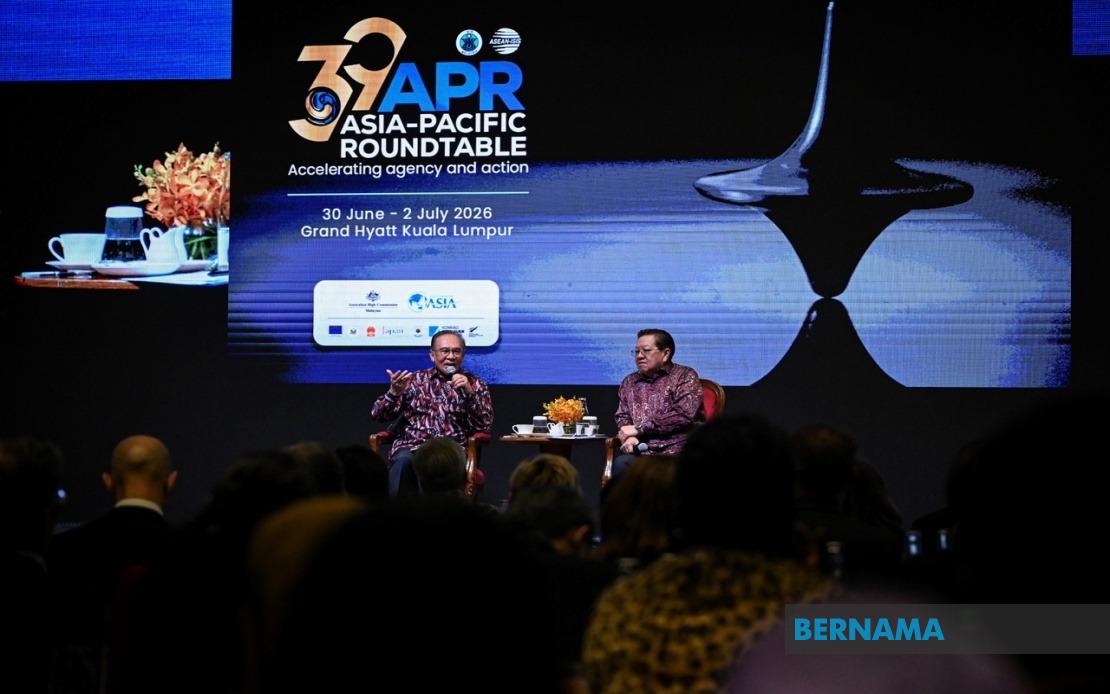
Prime Minister Datuk Seri Anwar Ibrahim has reaffirmed that Malaysia's principal obligation lies in consolidating governance standards at home, asserting that any meaningful role the nation plays in global affairs must be grounded in substantive internal reforms. Addressing participants at the 39th Asia-Pacific Roundtable in Kuala Lumpur on July 2, Anwar articulated a vision centred on domestic transformation before international projection, a stance that underscores the administration's recalibration of priorities following the transition of power.
The Prime Minister outlined an ambitious domestic agenda encompassing institutional strengthening, systematic elimination of corrupt practices, narrowing socioeconomic disparities, and guaranteeing universal access to quality education and healthcare services. This comprehensive framework reflects recognition that citizen expectations for improved living standards and transparent governance have become the defining measure of political legitimacy in Malaysia's contemporary landscape. By framing these initiatives as prerequisites for credible global engagement, Anwar positioned domestic accountability as foundational to the nation's international standing.
While Malaysia maintains its commitment to articulating principled positions on world affairs, Anwar underscored that the government's immediate bandwidth must concentrate on nation-building and demonstrating that a Muslim-majority democracy can simultaneously advance democratic institutions, practise moderation in public discourse, and foster genuine inclusivity. This messaging carries particular significance for Southeast Asia, where questions about reconciling Islamic governance with liberal democratic frameworks remain contested terrain. By emphasising Malaysia as a model of these complementary values, the Prime Minister implicitly addresses both domestic constituencies and international observers concerned about democratic backsliding in the region.
Anwar invoked a poignant reminder of his administration's core mission: ensuring that governmental power becomes an instrument for elevating ordinary citizens' circumstances rather than entrenching elite privilege. His emphasis on universal rights to foundational education and healthcare transcends rhetorical flourish, representing a deliberate pivot toward social equity metrics as measures of governmental success. For Malaysian readers, this formulation suggests that near-term governance assessments will focus on tangible improvements in public service delivery, educational outcomes, and health sector accessibility rather than foreign policy grandstanding.
The Prime Minister cautioned against interpreting contemporary global tensions through the reductive lens of civilisational conflict, a framing that has gained traction in recent geopolitical discourse. Instead, he attributed many international disagreements to mutual misapprehension and prejudice rooted in insufficient understanding. This analytical stance carries particular resonance in multiethnic and multireligious Malaysia, where similar dynamics historically fuel domestic discord. By applying this logic to international relations, Anwar suggested that combating ignorance through education and cultural exchange offers pathways to conflict reduction more constructive than confrontational ideology.
Drawing on the intellectual legacy of Edward Said, the Palestinian-American scholar renowned for critiquing orientalism and intercultural misunderstanding, Anwar reframed prevailing conflicts as fundamentally products of ignorance rather than irreconcilable civilisational difference. This invocation signals the Prime Minister's intellectual positioning within scholarly traditions questioning essentialist views of cultural identity. For the Malaysian context, the reference legitimises attempts to transcend rigid religious and ethnic categorisations in favour of nuanced, knowledge-based approaches to social cohesion.
The MADANI framework, which Anwar highlighted as central to his government's vision, embodies a deliberate synthesis of technological progress and humanistic values. This dual emphasis responds to anxieties across the region about technology's potential to erode social bonds and community trust. By insisting that Malaysia's development pathway integrate both digital advancement and ethical human dimensions, the government seeks to preempt the social fragmentation that unchecked technological adoption can produce in transitional societies.
Anwar's invocation of the Quranic concept of 'li ta'arafu'—a phrase traditionally translated as "so that you may know one another"—anchors his governance philosophy in religious and philosophical traditions indigenous to Malaysia's Muslim-majority population. The Prime Minister extended this principle beyond mere tolerance toward active comprehension and valuation of difference, a subtle but significant recalibration. For a nation grappling with polarisation across religious, ethnic, and political lines, this framework offers a theologically grounded rationale for interfaith and intercommunal engagement that transcends secular multiculturalism.
The emphasis on understanding rather than mere toleration carries profound implications for Malaysian policymaking. Tolerance often suggests grudging acceptance of the other's existence; understanding presumes genuine engagement with the other's worldview and concerns. This distinction becomes operationally significant when governments must craft policies affecting diverse populations holding fundamentally different values and interests. Anwar's articulation suggests his administration intends to move beyond conflict management toward substantive intercommunal dialogue and mutual recognition.
For a multiracial, multireligious nation like Malaysia confronting persistent questions about national identity and social cohesion, the Prime Minister's emphasis on domestic governance priorities addresses immediate anxieties about institutional credibility and equitable service delivery. The implicit message to citizens is that international prestige remains secondary to demonstrated competence in addressing local grievances, a pragmatic political positioning given widespread public scepticism about governmental effectiveness.
Anwar's remarks also carry strategic significance for Malaysia's regional positioning. By foregrounding domestic transformation over external activism, the government signals that its international voice will derive legitimacy from successful internal management rather than rhetorical assertiveness. This approach potentially enhances Malaysia's credibility as a thoughtful contributor to Southeast Asian conversations about governance, pluralism, and sustainable development—issues where practical experience carries more weight than ideological posturing.
The Prime Minister's framework ultimately reflects a fundamental recalibration of what constitutes national success in contemporary Malaysia. Rather than measuring achievement through territorial influence or international platform prominence, the administration proposes evaluating progress through governance quality, corruption reduction, inequality narrowing, and universal access to essential services. This reorientation toward citizen-centred metrics represents a significant departure from previous governance paradigms and signals sustained commitment to addressing root causes of public dissatisfaction with institutional performance.

