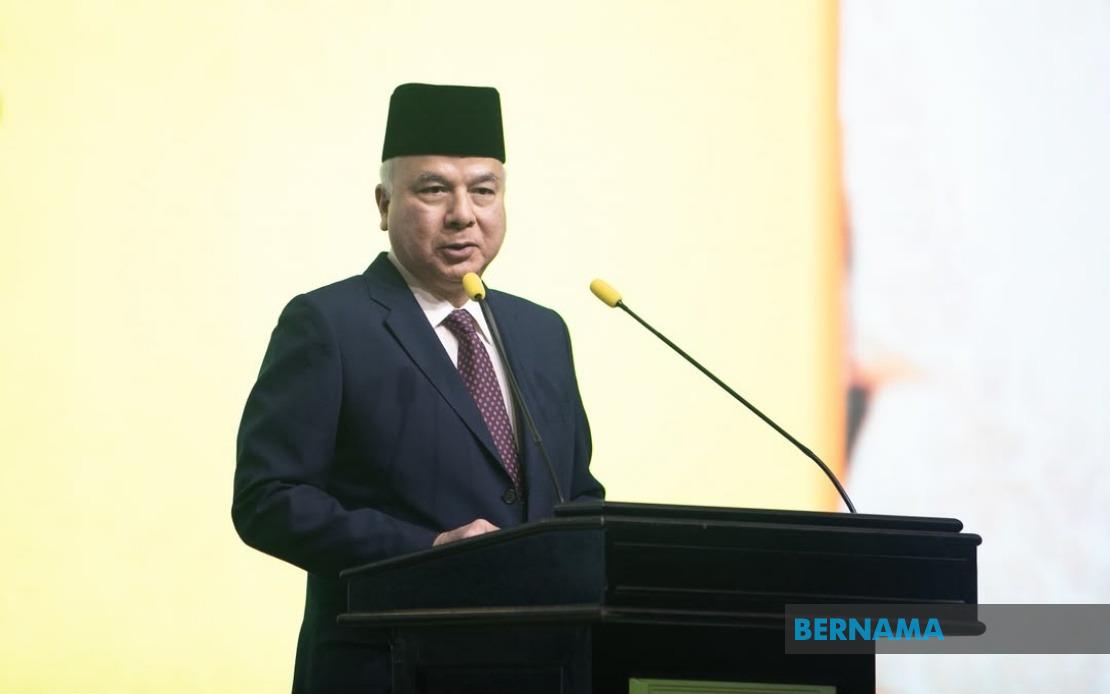
The Sultan of Perak, Sultan Nazrin Shah, has delivered a pointed reminder that material wealth and human capital alone cannot guarantee a nation's success. Speaking at the 8th World Conference on Islamic Thought and Civilisation in Ipoh, His Royal Highness argued that institutional weakness, leadership lacking accountability, and political cultures consumed by self-interest represent far greater threats to national prosperity than any shortage of resources or talent. The address, delivered before an audience including Deputy Prime Minister Datuk Seri Fadillah Yusof, Perak Menteri Besar Datuk Seri Saarani Mohamad, and Higher Education Minister Datuk Seri Dr Zambry Abd Kadir, offers a sober assessment of governance challenges facing developing economies across the Islamic world and Southeast Asia.
At its core, Sultan Nazrin's conception of effective governance rests on three pillars that transcend the specific cultural or religious context of any single nation. The first demands that public institutions possess sufficient durability to function independently of any individual leader or administration, ensuring continuity and preventing the personalisation of state power. The second requires genuine transparency in how governments raise revenue and allocate spending, creating the conditions under which citizens can believe their tax contributions genuinely serve collective interests rather than elite enrichment. The third mandates impartial application of legal standards such that neither wealth nor position exempts anyone from accountability, nor poverty nor powerlessness denies anyone its protection.
Sultan Nazrin expanded this framework by emphasising that political stability does not emerge from the suppression of disagreement, a misconception often used to justify authoritarian measures. Rather, many of the world's most stable democracies simultaneously rank among the most contentious, because their societies have constructed durable institutional channels through which disputes are resolved peacefully. When disagreements instead spill into streets or are settled through force, stability becomes merely temporary repression. The fundamental requirement, therefore, is not the absence of conflict but rather the maintenance of shared, legitimate rules by which conflicts are arbitrated.
This institutional perspective carries profound implications for Malaysia and its neighbours. Many Southeast Asian nations have experienced periods of instability precisely when trust in core institutions eroded—when electoral systems faced credibility crises, judiciaries appeared compromised, or public office became perceived as a commercial transaction rather than a public trust. Sultan Nazrin's framing suggests that populist rhetoric promising quick solutions often obscures the deeper institutional atrophy that created the crisis conditions in the first place. Building back these institutions requires sustained, unglamorous work across civil service reform, judicial independence, and electoral administration.
The Sultan's observation that institutional failure first harms society's most vulnerable populations has particular resonance in Southeast Asia's plural societies. When government stops functioning impartially, marginalised communities—whether defined by ethnicity, religion, or economic status—lose the protections that law and bureaucracy provide. This dynamic has repeatedly destabilised the region's multiethnic nations, making institutional impartiality not merely a technical governance matter but a prerequisite for interethnic peace.
Sultan Nazrin reframed government budgets as moral documents, a perspective that challenges purely technocratic approaches to public finance. How governments allocate resources reveals their actual priorities far more honestly than their rhetoric. A state that speaks of poverty alleviation while directing resources toward prestigious megaprojects, or that proclaims commitment to education while underfunding rural schools, faces a credibility deficit that no communication strategy can overcome. This framing particularly applies to Malaysian policymakers as the nation debates resource distribution across developed urban centres and lagging rural areas.
On the question of civil service impartiality, Sultan Nazrin identified the bureaucracy as the concrete embodiment of state unity. A civil service that delivers services without regard to the political affiliation, ethnicity, or religion of applicants performs the essential work of nation-building more effectively than any nationalist slogan. Yet this ideal remains elusive throughout Southeast Asia, where patronage networks, ethnic preferences, and political appointees often compromise meritocratic administration. Malaysia's ongoing civil service reforms thus carry implications extending well beyond administrative efficiency into the broader project of building genuinely inclusive state institutions.
The Sultan's treatment of economic development introduced a sophisticated argument about the relationship between openness and autonomy. He rejected both the protectionist impulse that isolates economies from beneficial external currents and the naive openness that creates dependency on foreign capital or technology. Instead, he advocated for intentional engagement with global trade, investment, and knowledge flows while simultaneously building domestic capacity and resilience. This formulation offers a middle path between the nationalism that led some Southeast Asian economies toward stagnation and the globalisation that left others vulnerable to external shocks.
Sultan Nazrin's extended discussion of Islamic finance's untapped potential presents a particular opportunity for Malaysian leadership. Malaysia has indeed established itself as the world's premier hub for sukuk issuance, takaful products, and Syariah-compliant asset management. Yet, the Sultan suggested, the sector remains largely confined to compliance—ensuring that financial instruments avoid prohibited practices—rather than realising the philosophical distinctiveness of Islamic finance. An authentic Islamic finance system, properly understood, emphasises risk-sharing, asset-backing, and equitable participation in economic returns, principles that diverge fundamentally from conventional finance's risk-shifting mechanisms.
This theological argument carries practical consequences for Southeast Asia's development challenges. Islamic finance, properly mobilised across OIC member states, could theoretically direct patient capital toward infrastructure investment, small and medium enterprise financing, and long-term projects addressing renewable energy, water security, and other regional imperatives. Malaysian institutions, given their technical sophistication and regional influence, could lead in translating these philosophical principles into concrete financial mechanisms. The failure to realise this potential represents not merely a missed economic opportunity but a betrayal of the intellectual foundations upon which Islamic finance rests.
Sultan Nazrin's insistence that leaders should govern with humility, listening before legislating and recognising that their authority is temporarily borrowed rather than personally owned, challenges prevailing leadership cultures across the region. Southeast Asia has historically witnessed extensive personalisation of political power, with individual leaders dominating their parties and nations in ways that neglect institutional development. This pattern undermines long-term institutional capacity and creates dangerous succession crises. The Sultan's framework suggests that true leadership strength lies not in concentration of personal authority but in building institutions resilient enough to outlast any individual occupant of office.
The broader context of Sultan Nazrin's remarks—delivered at a conference dedicated to Islamic thought and civilisation—connects these governance principles explicitly to Islamic intellectual traditions. The emphasis on consultation, justice, stewardship, and accountability to a higher authority reflects classical Islamic political philosophy, suggesting that robust modern governance institutions need not represent a secular imposition on Muslim-majority societies but rather an expression of values indigenous to Islamic civilisation. This framing could help counter narratives in some Southeast Asian contexts that present institutional strengthening as Western-derived or culturally alien.
For Malaysian policymakers and civil society observers, Sultan Nazrin's address offers both diagnosis and prescription. The diagnosis identifies governance deficits—whether in institutional independence, transparency, or impartial administration—as the fundamental obstacles to national development, more fundamental than resource constraints or external circumstances. The prescription demands sustained commitment to building durable, autonomous, professional institutions capable of functioning effectively regardless of which political coalition happens to occupy executive office at any given moment. This work necessarily spans multiple election cycles and partisan changes, making it less visible and politically rewarding than grand infrastructure projects, yet its importance for national resilience remains paramount.

