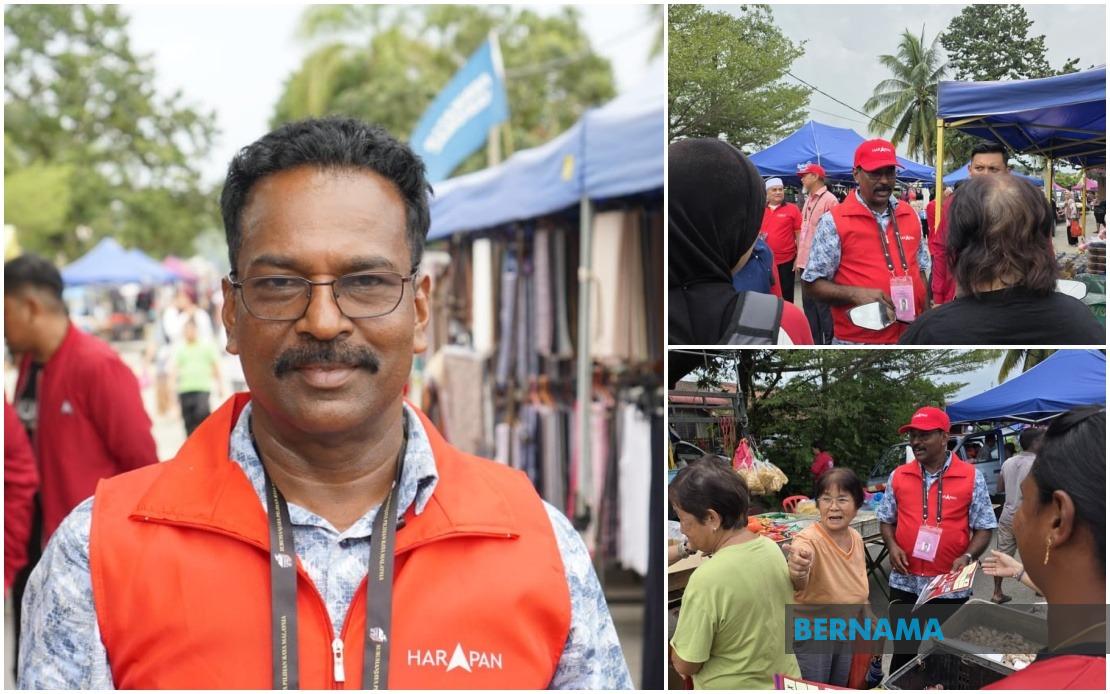
C. Subramani, the Pakatan Harapan candidate contesting Bukit Kepong in the 16th Johor state election, is banking on a groundswell of sentiment favouring political change to deliver an upset result in the three-cornered contest. Speaking in Pagoh, the PKR chief expressed confidence about his prospects, having registered what he characterises as positive momentum during the state campaign. His optimism rests partly on his claim that constituents are actively seeking an alternative to the incumbent representation, a signal he says distinguishes this election from previous contests in the constituency.
Subramani's campaign strategy pivots on a central premise: that strengthening coordination between Johor's state government and the federal administration in Putrajaya would unlock faster resolution of local problems. This messaging reflects a recognised weakness in Malaysian governance—the friction and duplication that often arise when state and federal authorities operate independently or at cross-purposes. By emphasising administrative alignment, Subramani is positioning himself as a bridge between two levels of government, a framing that could resonate with voters frustrated by bureaucratic delays or contradictory policies affecting their daily lives. Education matters, irrigation and drainage schemes, and issues requiring federal agency involvement would all benefit from smoother inter-governmental channels, his argument goes.
The Pagoh native has invested considerable effort in community engagement, visiting multiple Orang Asli settlements to map development deficits and socioeconomic constraints. This methodical approach to identifying constituent needs marks a departure from more generic campaign rhetoric. His visits to indigenous communities underscore the diverse demographics within the Bukit Kepong electorate and acknowledge that marginalised groups often face distinct infrastructure and service delivery challenges. By highlighting specific interactions with Orang Asli residents, Subramani is signalling attentiveness to voices frequently excluded from mainstream electoral politics in Malaysian states.
Subramani's development priorities reflect both immediate grievances and longer-term economic vision. Street lighting deficiencies and substandard bridge infrastructure are tangible issues affecting daily safety and mobility, particularly in rural areas where such amenities are often neglected. His proposal to convert the Bukit Kepong Gallery into a historical tourism hub targets the constituency's latent economic potential, suggesting that heritage and cultural assets can anchor sustainable livelihood opportunities for local residents. Concurrently, his commitment to affordable housing for the B40 income segment addresses a perennial electoral concern—residential security and the capacity of lower-income households to secure stable shelter.
This contest represents the second attempt at elected office for Subramani, who previously stood for the Buloh Kasap seat during the 2022 Johor state election. His earlier candidacy provides him with prior experience navigating electoral dynamics, constituent expectations, and campaign mechanics in the Johor context. That prior exposure, he suggests, has honed his political acumen and deepened his connections within the electorate, potentially differentiating him from first-time candidates in the field.
The Bukit Kepong race unfolds within a broader electoral landscape. The 16th Johor state election involves 172 candidates competing for 56 assembly seats, with approximately 2.7 million registered voters eligible to participate. The three-way contest between Pakatan Harapan, Barisan Nasional, and Perikatan Nasional reflects the fragmented state of Malaysian electoral politics, where no single bloc commands overwhelming dominance. In 2022, the incumbent, Datuk Dr Sahruddin Jamal from Perikatan Nasional-Bersatu, secured the Bukit Kepong seat with a majority of 710 votes—a narrow margin that invites challenge and suggests the constituency remains competitive.
Subramani's assertion that he is "not worried" about competition from rival parties carries undertones of psychological confidence-building, common in campaign messaging. Yet the actual competitiveness of the seat depends on whether his grassroots engagement translates into vote mobilisation and whether floating voters and erstwhile Barisan supporters view Pakatan Harapan as a credible alternative. The slimness of the 2022 victory margin indicates that dissatisfaction with the incumbent administration may be present but requires effective channelling toward Subramani's candidacy rather than splinter toward Barisan.
The alignment narrative Subramani promotes carries particular salience given ongoing tensions between Johor's Menteri Besar administration and the federal government. In Malaysian federalism, state-level political alignment with the federal centre can materially influence resource allocation, infrastructure prioritisation, and the speed at which policy proposals gain approval. A constituency represented by someone aligned with the federal ruling coalition—as Pakatan Harapan is—theoretically enjoys advantages in securing budgetary allocations and expedited bureaucratic processing. This structural incentive underpins Subramani's pitch to voters.
However, Subramani faces the standard headwind confronting Pakatan candidates in Johor. The state has historically leaned toward either Umno-led Barisan or, more recently, Perikatan Nasional, with Pakatan struggles to establish deep organisational roots. His reliance on a change narrative and better governance positioning, while appealing to some voters, may insufficient in a contest where party brand loyalty and machinery typically dominate outcomes. The three-way dynamic adds unpredictability, as vote-splitting between major blocs could theoretically favour an outsider candidate, yet equally could compound Pakatan's weakness if dissatisfied Barisan voters drift toward Perikatan rather than the opposition.
Subramani's campaign ultimately hinges on whether Bukit Kepong residents prioritise the transformative promise of better state-federal coordination and targeted development over established party affiliations. His emphasis on indigenous community engagement, tangible infrastructure shortcomings, and economic diversification through tourism attempts to transcend national-level polarisation by grounding politics in constituency-specific grievances and aspirations. Whether that ground-level positioning proves sufficient to overturn an incumbent enjoying nominal party machinery and organisational advantage will depend on voter turnout patterns, the effectiveness of Pakatan's campaign machinery, and the degree to which change sentiment translates into electoral choice.

