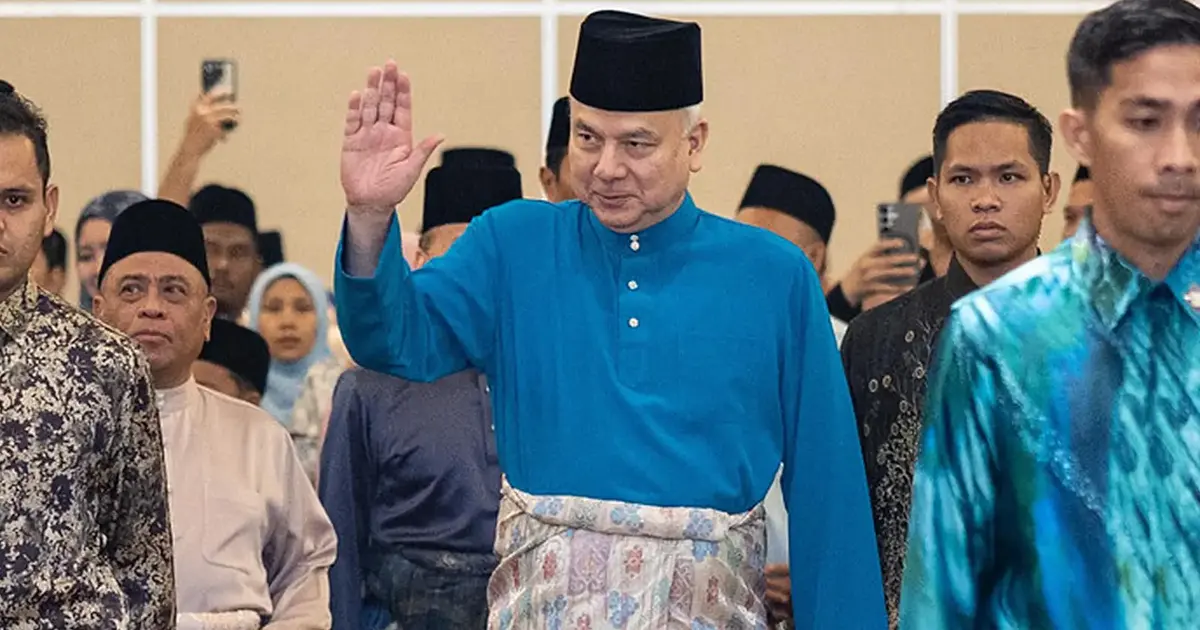
Sultan Nazrin Shah, the Deputy Agong, has delivered a pointed message to Malaysia's leadership ranks: decisions made in haste and driven by emotion rarely serve the nation's interests. The warning comes as the country navigates multiple domestic challenges and seeks to strengthen its democratic institutions, with the Sultan emphasising that measured governance and rational deliberation must supersede momentary pressures or personal frustrations.
The Deputy Agong's remarks underscore a fundamental principle that underpins stable governance—that leaders at all levels, whether in government, the judiciary, business, or civil society, bear responsibility for maintaining public confidence through thoughtful action rather than reactive measures. In a nation as diverse and complex as Malaysia, where regional sensitivities, religious considerations, and competing interests often intersect, the distinction between prudent leadership and impulsive governance carries profound consequences. Sultan Nazrin's intervention suggests concern about a pattern or tendency that may have caught the attention of the institution he represents.
Central to the Deputy Agong's message is the proposition that national success ultimately depends not on any single leader, policy, or institution, but rather on the collective willingness of citizens and their representatives to work together constructively. This cooperative impulse has always been part of Malaysia's founding compact—the social contract underpinning the Federal Constitution that binds together communities from different ethnic, religious, and cultural backgrounds. When that commitment erodes, replaced by zero-sum competition or tribal loyalty, the foundations of stability and progress weaken accordingly.
Respect amongst leaders and between institutions forms the second pillar of Sultan Nazrin's prescription for national health. Malaysia's system of constitutional monarchy, parliamentary democracy, and federalism is deliberately designed to distribute power and create checks and balances. These mechanisms function effectively only when key actors—from the Prime Minister and Cabinet to state rulers, judges, and opposition leaders—regard one another as legitimate participants in a shared enterprise, even when they disagree on policy. Without such baseline respect, institutional friction becomes destructive rather than productive.
The call for harmonious living extends beyond elite politics to encompass the broader social fabric. Malaysia's diversity, long celebrated as a source of cultural richness, requires ongoing investment in intercommunal understanding and the management of historical grievances. Political leaders whose rhetoric inflames rather than soothes, or who exploit grievances for short-term electoral advantage, undermine the delicate equilibrium that allows such a plural society to function. Sultan Nazrin's emphasis on harmony implicitly cautions against this form of divisive leadership.
The timing of these remarks carries weight within Malaysia's political calendar. The nation continues to process the outcomes of recent electoral cycles and shifts in coalition politics, whilst also contending with economic pressures, inflation concerns, and questions about institutional reform. In such periods, the temptation for leaders to act decisively and swiftly—to demonstrate strength or respond to perceived challenges without lengthy consultation—can become overwhelming. The Deputy Agong's intervention serves as a reminder that speed and decisiveness are not inherent virtues in governance if they come at the expense of legitimacy, consensus-building, or careful consideration of consequences.
For Malaysia's regional standing, the message also carries implications. Southeast Asia's stability depends partly on each member state's internal cohesion and the predictability of its institutions. Nations wracked by political turbulence or institutional conflict project weakness outward and invite external interference or competitive pressure. Conversely, governments that maintain internal consensus, however hard-won, project stability and command greater respect in regional forums and international engagements. Sultan Nazrin's emphasis on cooperation and harmony thus has implications beyond Malaysia's borders.
The Sultan's position as Deputy Agong gives his words particular resonance. As the constitutional head of state's designated successor, he represents continuity in the institution tasked with safeguarding Malaysia's fundamental law and serving as ultimate arbiter in moments of constitutional crisis. When such a figure warns against hasty decision-making, it carries implications for how other branches of government might behave, particularly during periods when political pressures mount or constitutional questions arise. The monarchy's ability to influence through moral suasion rather than direct power depends substantially on its perceived wisdom and impartiality.
Respect and cooperation also form the foundation for addressing substantive policy challenges. Whether tackling corruption, reforming public institutions, managing religious affairs, or economic restructuring, progress requires broad-based buy-in rather than narrow victories imposed through procedural manoeuvres or political dominance. Leaders who understand this reality are more likely to build coalitions capable of implementing and sustaining reform, whereas those pursuing victory at any cost often discover that their gains prove ephemeral or generate backlash.
Sultan Nazrin's warning carries a particularly important message for younger politicians and technocrats ascending to positions of influence. Shaped by different times and less encumbered by the institutional memories of earlier generations, they may lack intuitive understanding of why patience and consensus-building, though slower and more frustrating than unilateral action, ultimately serve national interests better. The Deputy Agong's intervention serves as a gentle but firm reminder that Malaysia's political experiment succeeds precisely because its actors have, more often than not, prioritised stability and legitimacy over fleeting victories.
Looking forward, Sultan Nazrin's counsel suggests that Malaysia's leadership would benefit from stepping back from the constant tactical manoeuvring that characterises much contemporary politics, instead recalibrating around longer-term institutional health and social cohesion. This requires resisting the immediate pressures that often drive decision-making and adopting a temperament more attuned to the complex requirements of governing a diverse, federal, multi-confessional democracy. The Deputy Agong's message, in essence, is that such restraint and wisdom constitute not weakness but the highest form of leadership.