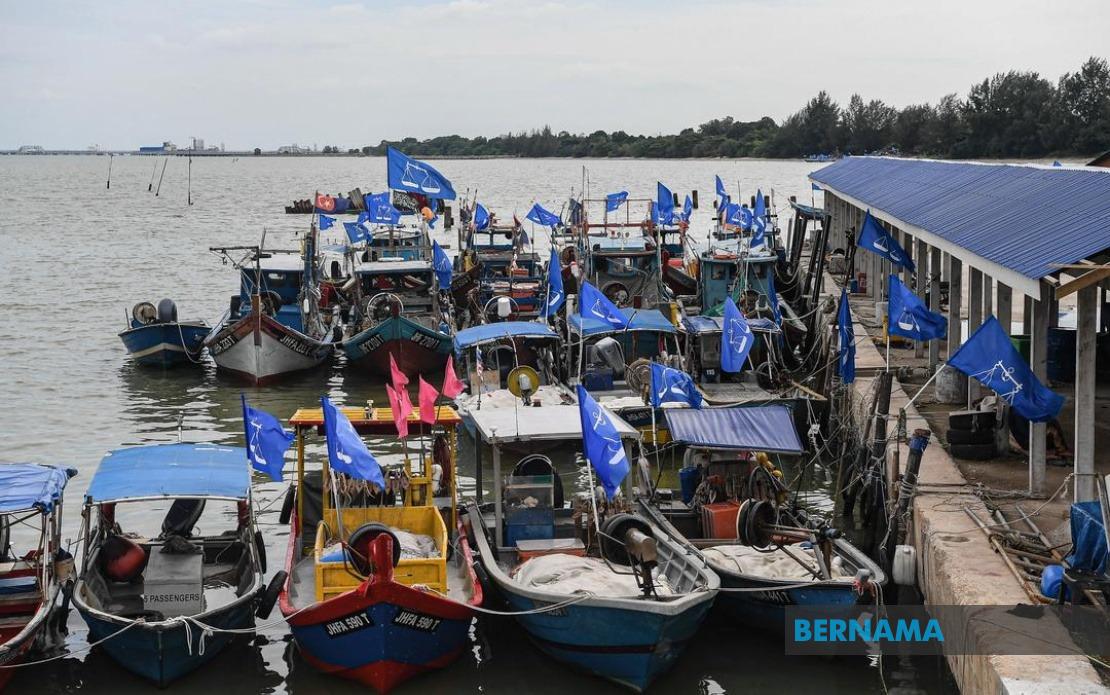
The coastal enclave of Sungai Rengit in Kota Tinggi faces mounting pressure to resolve infrastructure shortfalls and security vulnerabilities that have plagued the trading and fishing communities for years. With the 16th Johor state election drawing near, residents in this corner of the Tanjung Surat constituency are looking to the next assemblyman to finally deliver the improvements that successive administrations have deferred or delayed. The area, which serves as a crucial commercial hub for workers and residents connected to the sprawling Pengerang Integrated Petroleum Complex, has become a test case for responsive governance in the state's electoral cycle.
The traders operating from Medan Selera Sungai Rengit occupy a precarious position. Nearly ten years have passed since their original location was designated for redevelopment, forcing relocation to what was initially promised as a temporary site. That makeshift arrangement has become permanent in practice, with the food court remaining little more than a collection of canopy-covered stalls fronted by plywood walls. The psychological toll of this prolonged limbo extends beyond the physical discomfort of working in substandard conditions; it reflects a systemic pattern in which local authorities have either failed to follow through on promised transitions or lacked the resources and political will to complete infrastructure projects.
Beverage trader Lai Swee Hong, who has operated in the sector for three decades, articulated the specific geographic and commercial handicaps facing merchants. Although local authorities eventually identified an alternative site for permanent relocation, the proposed location suffers from critical deficiencies that would compound existing difficulties. Limited parking availability and the location's positioning on a one-way road create friction between customers seeking convenient access and traders attempting to maintain steady turnover. For Lai and her peers, these factors translate directly into lost revenue and diminished commercial viability, raising questions about whether the proposed relocation truly addresses the underlying problem or merely displaces it geographically.
The extended temporariness of their situation has created a vicious cycle of disinvestment and decay. When traders operate under the assumption that their tenure at a location is provisional, they have little incentive to invest in upkeep or improvements. Conversely, when authorities lack clarity about permanent solutions, routine maintenance becomes deprioritized. The physical deterioration visible in the stalls mirrors the institutional neglect that has characterized the site's management. Lai's observation that stalls lack even basic doors—rendering them vulnerable to theft and exposure to inclement weather—points to an almost shocking absence of fundamental security infrastructure that would be expected in any established commercial space.
The crime dimension adds urgency to traders' demands. Food merchant Wini Fasiha Zawawi documented a pattern of thefts that accelerated through the previous year, with stolen kitchen appliances and other goods eroding already modest profit margins. While her losses have not reached the thousands of ringgit, the cumulative impact across multiple traders creates a collective economic drain that discourages long-term commitment to the site. Most troublingly, despite police reports filed and notifications to local authorities, the security situation has not materially improved, suggesting a gap between procedural responsiveness and concrete preventive action. Police patrols occur, but they appear insufficient to deter theft or reassure merchants of meaningful protection.
The fishing community articulates distinct but overlapping concerns rooted in operational economics. Vessels operating from Sungai Rengit face rising costs for fuel, equipment maintenance, and labor at sea, while commodity prices for their catch remain subject to volatile market forces beyond their control. Fisherman Sin Hock Hwee, representing a generation that has built entire careers around marine livelihoods, emphasized the critical importance of existing fuel subsidies in maintaining the economic viability of small-scale fishing operations. These subsidies represent a direct policy lifeline that shields fishermen from the full impact of global fuel price fluctuations, yet their permanence remains uncertain and contingent on political decisions that fishing communities themselves lack influence over.
Younger fishermen such as Hidayat Isa articulate a forward-looking vision that extends beyond immediate material assistance. While acknowledging the value of direct subsidy and welfare support, Isa emphasizes the need for upgraded jetty facilities and, more broadly, political attention to the voices of the younger generation entering the fishing profession. This suggests that the fishing community's concerns transcend conventional welfare issues and reflect broader questions about sectoral renewal, intergenerational knowledge transfer, and whether coastal communities will receive strategic investment in their long-term viability. The prospect of designating Kampung Sungai Rengit as an adopted village for the incoming assemblyman indicates a desire for sustained, prioritized engagement rather than episodic attention during electoral cycles.
The Tanjung Surat state seat is contested between Faizul Abdul Ghani of Pakatan Harapan and incumbent Aznan Tamin of Barisan Nasional, a head-to-head matchup within a broader contest spanning 56 state seats across Johor. This competitive context means that both candidates should, theoretically, be responsive to documented grievances in their constituency. The specificity of traders' and fishermen's demands—upgraded temporary facilities or accelerated relocation, enhanced security measures, continuation and expansion of fuel subsidies, jetty improvements—provides a clear benchmark against which the elected representative's performance can be measured in subsequent years.
Sungai Rengit's predicament reflects wider challenges facing secondary commercial and fishing centers across Malaysia's regions. Infrastructure projects often extend far beyond their projected timelines, temporary arrangements calcify into semi-permanent conditions, and constituencies with smaller political profiles receive lower priority in state-level budget allocation and development planning. The traders and fishermen here are not making demands for grandiose new facilities; they are seeking basic functional infrastructure—secure stalls, adequate parking, maintained jetties—that would be taken for granted in urban commercial zones or more politically prominent constituencies.
The convergence of trading and fishing sector concerns in Sungai Rengit also reveals the interdependence of local economic ecosystems. Fishermen require accessible markets for their daily catch; traders depend on steady supply of seafood and the purchasing power of fishermen themselves. Improvements benefiting one sector generate beneficial spillovers for the other, yet planning and implementation often proceed in silos without recognizing these connections. An elected representative sensitive to this integrated economic reality might design interventions that address both communities simultaneously—for instance, coordinating jetty upgrades with improved market facilities and transportation links.
The question facing Tanjung Surat voters is whether the incoming assemblyman will treat the infrastructure and security promises outlined during campaigning as binding commitments or as rhetoric soon forgotten after election day. The traders and fishermen have articulated concrete, measurable objectives: completion of relocation with properly designed facilities, visible security improvements, sustained or enhanced fuel subsidies, and upgraded jetty infrastructure. These are not intangible or vague demands; they can be tracked, reported on, and evaluated. In a political environment increasingly attentive to performance accountability, Sungai Rengit's communities have positioned themselves to hold their representative to account through ongoing monitoring of progress against these clearly defined benchmarks.
The 16th Johor state election on July 11, with early voting on July 7, arrives at a moment when economic pressures on small traders and fishermen have intensified across the nation. Rising operational costs, inflationary pressures on consumer purchasing power, and competition from larger commercial operators create a challenging environment for those operating at Sungai Rengit's modest scale. Against this backdrop, the willingness and ability of the elected assemblyman to deliver tangible improvements in infrastructure, security, and targeted support becomes not merely a local matter but a test of whether state government remains responsive to the concerns of economically vulnerable communities in less politically dominant areas.

