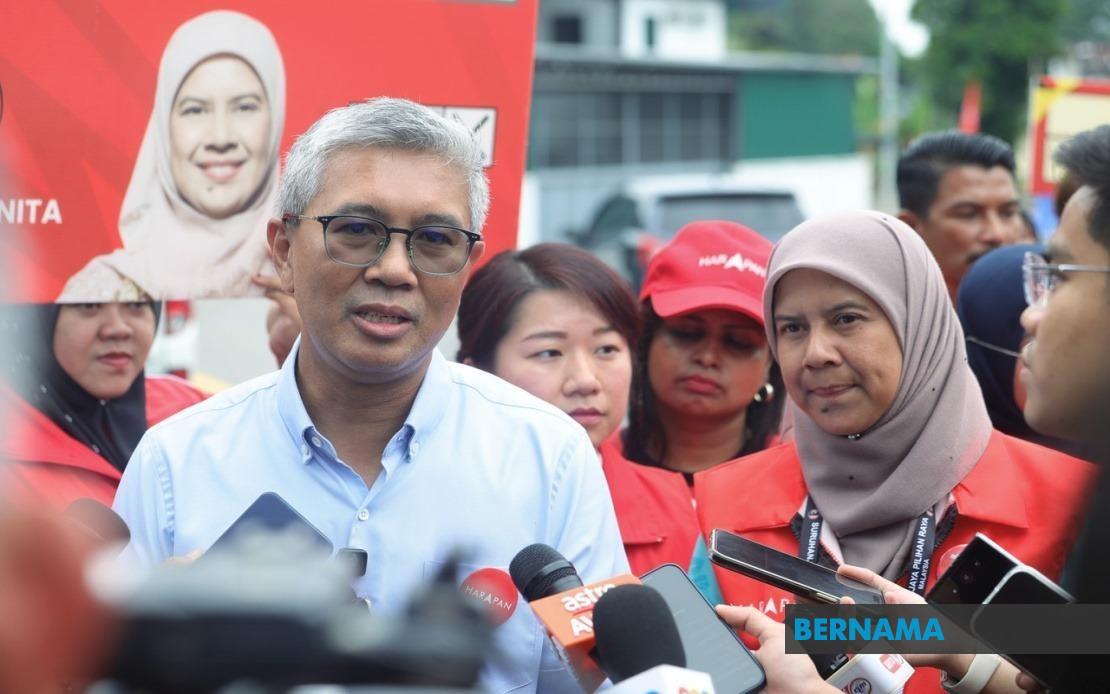
With campaigning well underway in Negeri Sembilan's state election, Pakatan Harapan's political machinery is expressing confidence in the Pilah constituency, buoyed by what party officials describe as exceptionally positive responses from voters. Senior Political Advisor to the Prime Minister Tengku Datuk Seri Zafrul Tengku Abdul Aziz attributed this sentiment to the coalition's established governance performance and the sustained grassroots activism of incumbent state assemblyman Datuk Noorzunita Begum Mohd Ibrahim, who is seeking re-election.
The assessment comes after PH's internal surveys and community feedback-gathering exercises across the central Negeri Sembilan seat. According to Tengku Zafrul, residents have demonstrated clear appreciation for the tangible assistance and development initiatives that Noorzunita Begum has channelled into the constituency during her current term. However, he cautioned against any sense of electoral certainty, emphasizing that sustained campaigning and service delivery remain essential regardless of polling predictions. Retaining the Pilah seat, he stated, would require continued commitment until voters cast their ballots on August 1.
During a walkabout campaign in Kuala Pilah, Tengku Zafrul and Noorzunita Begum engaged directly with constituents, moving through neighborhoods and traditional villages to discuss local infrastructure needs, hear community grievances, and understand residents' priorities for future development. Such ground-level interaction represents a deliberate strategy to ensure that all demographic layers—from young professionals to retirees—feel heard by the ruling coalition.
Tengku Zafrul highlighted Negeri Sembilan's economic indicators as validation of the incumbent administration's stewardship. The state has attracted RM19 billion in total investments and accumulated reserves exceeding RM1 billion, figures that the PH official linked directly to the governance model established under Menteri Besar Datuk Seri Aminuddin Harun. This economic stability argument forms a key part of PH's broader pitch to voters: that political continuity translates into fiscal health and development opportunities.
Yet beneath the headline economic figures lies a more granular concern that emerged during the campaign trail engagement. Tengku Zafrul identified job creation, particularly professional-track employment suitable for Generation Z, as a critical priority for Kuala Pilah and similar constituencies. The implication is clear: rural and semi-rural Negeri Sembilan faces a brain drain risk if young residents cannot access career pathways without relocating to Kuala Lumpur or Selangor. This reflects a broader Malaysian challenge where economic opportunities remain concentrated in major urban centers, pushing younger generations away from their communities.
In response, Tengku Zafrul outlined government strategy to narrow the economic disparity between developed urban nodes and traditional villages. While acknowledging that economic spillover to peripheral areas often occurs indirectly, he stressed that PH administrations are actively formulating approaches to attract fresh investment and ensure that economic growth reaches constituencies like Pilah more equitably. The framework being described aligns with the MADANI Government's stated commitment to inclusive development across Malaysia's regions.
Noorzunita Begum's campaign operation, now eight days into the contest, has achieved near-comprehensive ground coverage across the constituency. By the campaign period's middle stage, her machinery had reached most residential areas, with the following week dedicated to more intensive engagement with traditional villages. This phased approach ensures that the campaign's message—centred on development vision and continued advocacy for public welfare—penetrates different community clusters systematically. She has particularly stressed commitment to youth employment, education services, and support for senior citizens.
The incumbent candidate reported substantial youth interest in professional job opportunities during her doorstep interactions, validating the employment concern that Tengku Zafrul had articulated. This convergence between grassroots feedback and high-level political messaging suggests that economic anxiety among younger voters represents a significant issue in the contest. For PH, addressing this concern credibly is essential to consolidating support, particularly given that Pilah's workforce demographics increasingly feature Gen Z populations seeking meaningful career prospects.
The Pilah state seat, one of five constituencies within the Kuala Pilah parliamentary division, encompasses 18,034 registered voters according to the Election Commission's June 4 electoral roll. The electorate divides into 17,775 ordinary voters and 259 police personnel and immediate family members. Gender distribution remains virtually balanced, with 8,925 male voters representing 49.49 percent of the roll and 9,109 female voters accounting for 50.51 percent. This demographic parity may influence campaign strategies, as neither gender comprises a decisive plurality.
Pilah's geographic position in central Negeri Sembilan, situated between Seremban and Bahau, positions it as part of a broader regional zone where connectivity and economic linkages to the Klang Valley play increasingly significant roles. This location means that development priorities must balance internal constituency needs against the broader regional economy's gravitational pull toward Kuala Lumpur's commercial center. For an incumbent seeking re-election and a coalition seeking to strengthen its Negeri Sembilan foothold, demonstrating tangible local benefits becomes correspondingly vital.
The contest features a straight two-way fight between Noorzunita Begum representing Pakatan Harapan and Barisan Nasional candidate S. Leza Md Yasin. Early voting for the 16th Negeri Sembilan State Election takes place on July 28, with the main polling date scheduled for August 1. The stakes extend beyond a single constituency, as Negeri Sembilan represents important political territory for both PH and BN, making Pilah one of several closely watched seats that will shape the state's electoral composition.

