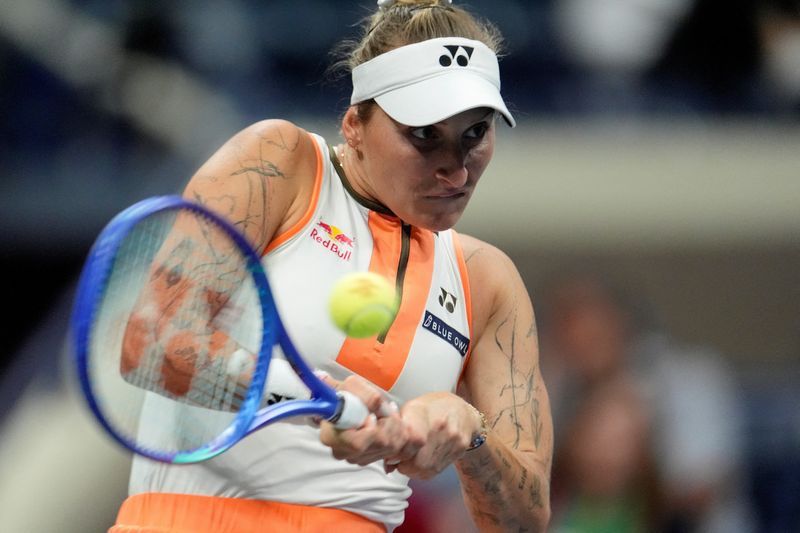
The suspension of former Wimbledon champion Marketa Vondrousova for four years has reignited debate over how tennis polices its anti-doping regime, with the sport's player association now pushing for a restructured system that grants athletes meaningful participation in shaping the rules they must follow. The Czech player received her ban on Monday from the International Tennis Integrity Agency after declining to provide a sample during an out-of-competition test at her home in December, an incident she has since described as a traumatic invasion of her personal space that left her feeling unsafe.
Vondrousova's case arrives at a moment of significant tension within professional tennis, where the handling of anti-doping violations has drawn repeated criticism for what many perceive as inconsistent application. The sport has faced considerable backlash following instances in which top-ranked players including Jannik Sinner and Iga Swiatek escaped lengthy suspensions despite testing positive for prohibited substances, lending credence to accusations that enforcement depends partly on player status. The Professional Tennis Players Association seized upon Vondrousova's punishment to highlight what it views as a fundamental imbalance: athletes must comply with regulations they have virtually no voice in designing or modifying.
In a statement responding to the ban, the PTPA emphasised that while it supports rigorous testing to maintain competitive integrity, the disparity between Vondrousova's four-year suspension and the lenient treatment afforded higher-ranked players warrants serious reflection. The association particularly stressed the severity of punishing a player who has never returned a positive test result, arguing that the decision contradicts proportionate justice. What troubled the PTPA most profoundly was the circumstances surrounding the test attempt itself: an unidentified official arriving at her residence at 8:15 p.m., demanding immediate compliance, and the player's subsequent refusal to open her door due to legitimate safety concerns rooted in her sport's history of violence.
Vondrousova had previously disclosed her emotional and psychological distress, stating in April that she had reached a breaking point following months of mounting pressure and anxiety. She connected her refusal to answer the door to the traumatic 2016 knife attack on her compatriot Petra Kvitova at her home, a documented incident that illustrates the real dangers faced by professional female athletes. The player's hesitation represented not defiance of testing protocols but rather a rational assessment of personal security, yet the system treated non-compliance as a violation warranting the maximum possible sanction.
Since aligning its anti-doping framework with the World Anti-Doping Agency code applied across international sport, tennis has adopted standardised procedures intended to ensure consistency and fairness regardless of an athlete's profile, ranking, or nationality. The ITIA maintains that determinations are made purely on factual and evidentiary grounds, with no consideration given to an individual's status within the sport. This standardisation theoretically eliminates bias, though the track record suggests otherwise. The PTPA, recognising these stated principles, also filed a lawsuit last year against tennis's governing bodies, asserting that random out-of-competition testing violates players' fundamental privacy rights and that current protocols require substantial revision.
Karen Moorhouse, the ITIA chief executive, defended the testing regime while acknowledging player frustrations. She explained that testing remains uncomfortable and burdensome for athletes already operating under intense professional demands and public scrutiny, yet characterised such discomfort as a necessary cost of protecting fair competition and clean sport. Moorhouse emphasised that testers undergo thorough training, present identification upon request, and ensure that witness gender matches the player's, measures intended to mitigate safety concerns. She further noted that all testing personnel carry credentials verifiable through multiple means, allowing players to authenticate identities before permitting entry.
Despite these assurances, the fundamental tension persists: female athletes in particular remain vulnerable to intrusion and potential threat, as Kvitova's attack starkly demonstrated. Testing protocols developed without meaningful athlete input may satisfy regulatory requirements without adequately addressing the lived reality of players who must open their homes to strangers or forfeit their careers. Moorhouse stated that an independent tribunal ultimately endorsed the principle that unpredictable testing constitutes an essential safeguard for competitive integrity, and she framed Vondrousova's case as a reminder that athletes can face testing anywhere, anytime, with significant penalties for refusal.
The implications for Southeast Asian professional athletes warrant consideration. As regional tennis develops and the sport attracts greater talent and investment across countries including Malaysia, Thailand, and Indonesia, harmonising anti-doping regulations with international standards will become increasingly important. However, this alignment must account for varying cultural attitudes toward privacy, safety, and gender dynamics. Southeast Asian female athletes may face even more acute vulnerability than their European counterparts when subjected to unannounced home testing, particularly in contexts where home intrusions carry heightened social or physical risk.
Vondrousova's case exemplifies how rigid, athlete-excluding regulatory frameworks can produce outcomes that appear unjust even if technically compliant with stated rules. The disparity between her suspension and the lenient treatment of higher-ranked players who actually tested positive suggests that the current system lacks internal consistency, undermining the ITIA's claims that determinations rest solely on objective criteria. The PTPA's call for restructured governance acknowledges that procedural fairness requires not merely the absence of explicit bias but also the presence of athlete voices capable of identifying and correcting systemic flaws before they harden into unjust precedent.
Looking forward, Vondrousova retains the right to appeal her ban to the Court of Arbitration for Sport, a process that may reconsider both the proportionality of her punishment and the adequacy of the testing procedures involved. Her case may ultimately prove pivotal in forcing tennis to reconcile its commitment to clean sport with its obligation to protect player safety, privacy, and rights. The pressure from the PTPA suggests that meaningful reform is no longer optional but increasingly urgent if the sport wishes to maintain the trust and cooperation of its athletes.

