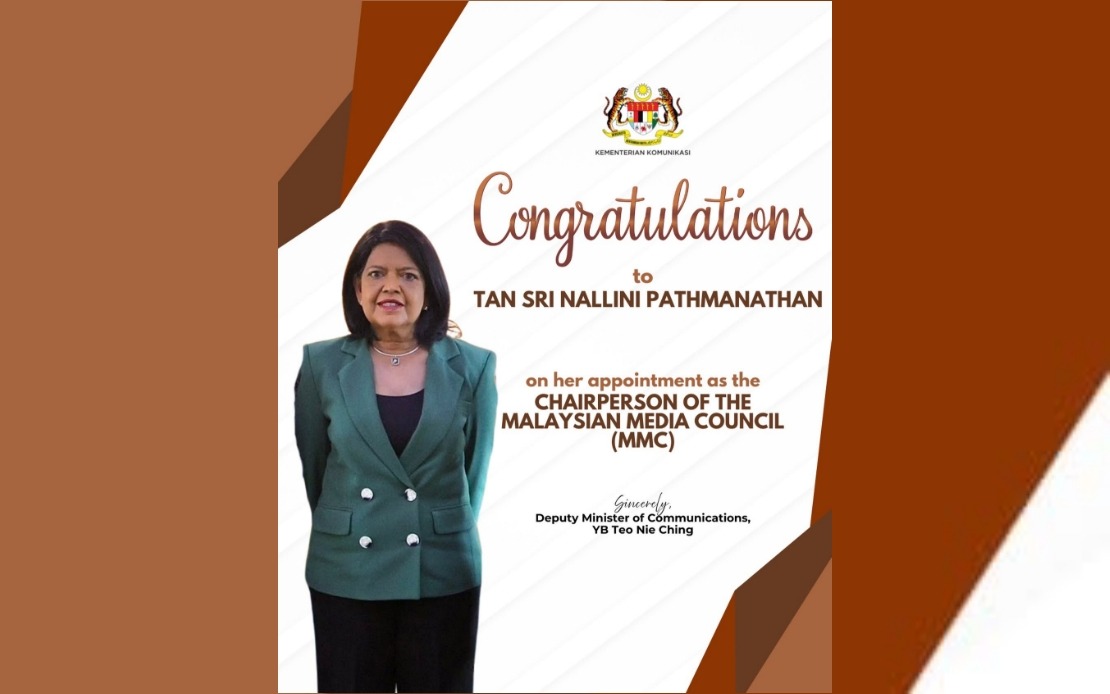
Malaysia's newly appointed Media Council chairperson brings a formidable track record on constitutional rights and press freedom, according to Deputy Communications Minister Teo Nie Ching, who publicly endorsed Tan Sri Nallini Pathmanathan's leadership of the self-regulatory body this week. Teo's endorsement carries particular weight as a government official with direct oversight of media affairs, signalling official confidence in Nallini's ability to steer the Malaysian Media Council (MMC) through its critical formative years.
Nallini's elevation to the chairperson role comes nearly five decades after Malaysia first began pursuing the concept of a self-regulatory media body. The establishment of the MMC in 2025, following the passage of the Malaysian Media Council Act, represents a watershed moment for the journalism sector and broader questions about how the country manages the relationship between press freedom and regulatory oversight. The MMC Board unanimously endorsed Nallini's appointment at a meeting on May 26, reflecting consensus among its members that she represents the right leadership for this pivotal institution.
Teo's public backing of Nallini drew specifically on the judge's dissenting opinions as evidence of her judicial philosophy. In a closely divided 4-3 Federal Court decision regarding citizenship rights for children born to Malaysian fathers and foreign mothers, Nallini penned a dissent advocating for a purposive and compassionate reading of constitutional law. This judgment signals her willingness to interpret the law in ways that protect individual rights rather than defaulting to restrictive readings. For a media council charged with balancing industry interests against public accountability, such judicial temperament matters significantly.
Another case Teo highlighted involved an online news portal facing potential liability for comments posted by subscribers. Nallini's dissenting judgment ruled against holding the portal responsible for user-generated content, a position that has direct implications for digital media platforms operating across Malaysia and Southeast Asia. As online journalism increasingly dominates news consumption in the region, her stance on intermediary liability provides important context for how the MMC might approach regulatory questions facing digital publishers and social platforms that host news content.
The significance of Nallini's appointment extends beyond her individual qualifications. The very existence of a self-regulatory body insulated from direct government control represents a significant structural choice for managing press freedom in Malaysia. Teo's remarks underscore why this independence matters: any council perceived as answerable to state authorities would inevitably be seen as a mechanism for suppressing rather than protecting media freedom. Self-regulation, by contrast, allows the industry to maintain credibility with journalists, publishers, and the public by operating according to standards the sector itself has established.
Teo characterised journalists as democracy's fourth estate, acknowledging their unique constitutional role in holding power accountable and informing the citizenry. This framing reflects evolving international consensus about media's institutional importance. In Malaysia's context, where questions about media independence have occasionally surfaced amid changing political administrations, the creation of an independent media council offers a potential buffer against politicisation. Nallini's judicial background and documented commitment to constitutional protections of individual rights suggest she understands these stakes.
The five-decade journey toward establishing the MMC reveals how contested the path has been. Successive advocacy campaigns, petitions, and policy discussions finally culminated in legislative action only in 2025, indicating significant disagreement about whether Malaysia needed such a body and, if so, how it should function. Nallini inherits an institution born from this long deliberation, which likely means stakeholders have invested considerable expectations in its success. Her role involves not merely managing complaints and disputes, but building the MMC's credibility as an independent arbiter that both protects media from improper interference and holds journalists accountable to professional standards.
Regional context matters here as well. Throughout Southeast Asia, media councils exist in various forms, with mixed records in protecting press freedom versus enabling state control. Malaysia's model, as articulated through Teo's remarks, emphasises industry self-governance explicitly to avoid state capture. How Nallini implements this principle during the council's early years will likely influence media freedoms across Malaysian newsrooms and potentially shape discussions in other Southeast Asian nations considering similar institutions.
The appointment also signals a deliberate choice to place a judge with documented sympathy for individual constitutional rights at the helm of a media regulatory body. This differs from appointing industry veterans or government figures, suggesting the MMC's architects wanted someone with judicial credibility and interpretive authority to set the council's early precedents. Nallini's dissenting judgments show she thinks carefully about the tensions between competing rights and interests—precisely the skill needed when media councils must balance press freedom against other public interests.
For Malaysian newsrooms navigating an increasingly complex regulatory environment, Nallini's appointment offers some reassurance about the MMC's orientation. Journalists often express concern about regulatory bodies that might prioritise industry reputation over protecting editorial independence. Teo's emphasis on Nallini's backward-looking record on press freedom and forward-thinking constitutional reasoning attempts to address these concerns, though the real test will come as the council develops its procedures, hears complaints, and establishes patterns of decision-making that either vindicate or undermine hopes for genuine self-regulation.
The MMC's establishment also occurs amid broader global discussions about media accountability and the legitimacy of journalistic institutions. In many democracies, trust in media has declined, raising questions about how editorial standards should be enforced. Malaysia's choice to create an independent, industry-led council rather than relying on government regulation or market forces alone reflects particular assumptions about how accountability can be achieved without undermining press freedom. Whether this model succeeds depends substantially on leadership like Nallini's, where demonstrated constitutional commitment to individual rights provides reassurance that the council will prioritise media freedom alongside professional responsibility.