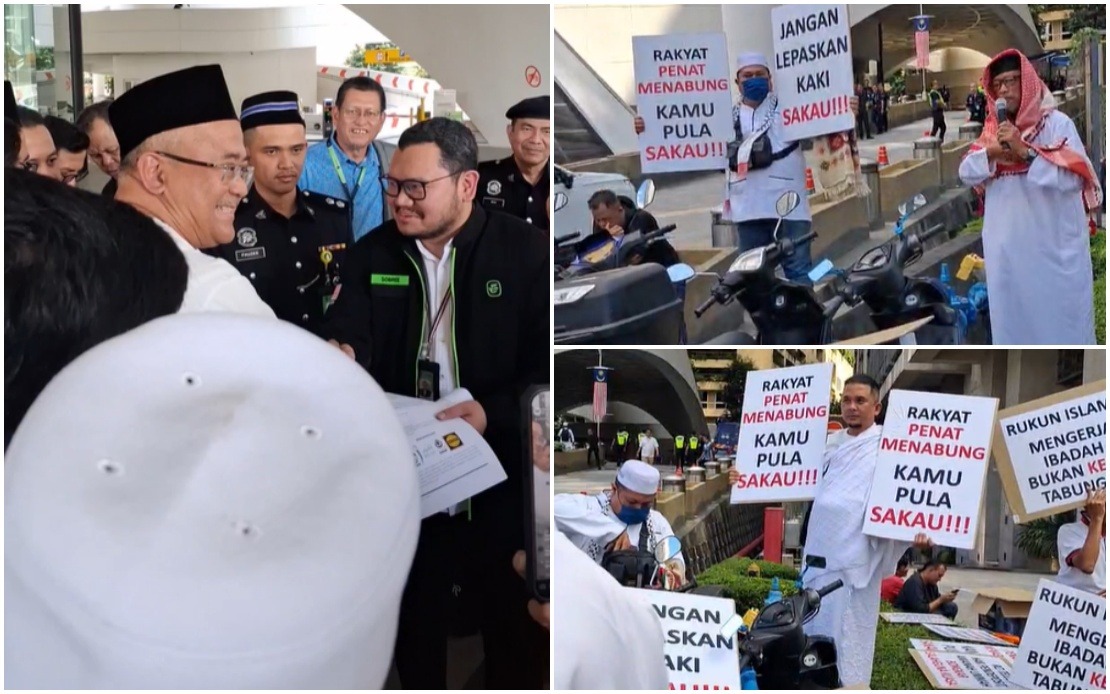
The Daie MADANI coalition is insisting that authorities investigating findings from the Royal Commission of Inquiry (RCI) into Lembaga Tabung Haji management must operate with complete transparency and free from any form of interference. Coalition chairman Amir Zuhair Abdull Khalid made the remarks during a solidarity gathering held outside Menara TH in Kuala Lumpur on August 7, underscoring the critical importance of maintaining institutional independence throughout the investigative process.
The RCI report, which examined TH's operations across the period from 2014 to 2020, uncovered significant findings that demand systematic legal intervention. Amir Zuhair expressed the coalition's support for the Prime Minister's commitment to pursuing accountability while simultaneously warning against any attempts to compromise the investigation's integrity. He explicitly called upon relevant authorities, particularly the Malaysian Anti-Corruption Commission, to proceed unimpeded in their work, emphasizing that the process must follow established legal protocols without deviation or pressure from external actors.
The stakes involved extend far beyond conventional political disputes, according to coalition leadership. The management of Lembaga Tabung Haji touches upon the financial security of millions of Muslim depositors who have entrusted their savings to the institution. Any mismanagement or misconduct therefore carries profound implications for public confidence in religious institutions and government-linked entities responsible for managing community assets. This elevated significance demands that the investigative response matches the seriousness of the underlying concerns, which Amir Zuhair emphasized must be treated as a matter of institutional integrity rather than factional point-scoring.
The RCI's examination identified troubling patterns, including allegations that political considerations influenced governance decisions and the selection of board members during the period under review. These findings, if substantiated through formal legal proceedings, would represent a fundamental breach of fiduciary duty and proper corporate governance standards. Amir Zuhair stressed that determining culpability remains exclusively within the purview of the judiciary, following comprehensive investigation and formal prosecution where warranted. He rejected the notion that preliminary denials of wrongdoing should carry legal weight, insisting instead that only courtroom proceedings under established evidentiary standards can render authoritative judgments regarding guilt or innocence.
The coalition's position reflects a broader concern about maintaining the separation of powers and preventing political manipulation of law enforcement mechanisms. By explicitly urging all parties to refrain from exerting pressure on investigators, Daie MADANI is signaling that the legitimacy of eventual legal outcomes depends entirely on the independence of the process leading to those outcomes. Without such independence, any convictions would carry the taint of political persecution, while acquittals would be viewed with justified skepticism about whether investigations genuinely pursued the evidence wherever it led.
Supporting the coalition's push for institutional independence, a coalition of Islamic non-governmental organizations comprising the Malaysian Islamic Movement Coalition (HIKAM) has submitted a comprehensive ten-point agenda to government leadership. These demands include immediate initiation of legal proceedings against responsible parties, recovery of funds and assets that were misappropriated or lost through poor management, full implementation of the RCI's detailed recommendations regarding future operational safeguards, and sustained governance reforms under the MADANI administration's stated development framework. This multi-organization approach demonstrates that concerns about TH management transcend individual political groupings and reflect genuine public anxiety about institutional accountability.
HIKAM itself encompasses four significant Islamic civil society organizations: Persatuan Wadah Pencerdasan Umat Malaysia (WADAH), Pertubuhan IKRAM Malaysia (IKRAM), Pertubuhan Lepasan Institusi Pendidikan Malaysia (HALUAN), and Angkatan Belia Islam Malaysia (ABIM). The involvement of these established organizations lends substantial weight to the demands being placed before government and enforcement authorities. Their participation signals that religious community leadership is taking direct responsibility for ensuring that Muslim depositors' interests receive appropriate protection through rigorous institutional reform and accountability mechanisms.
The timing of these calls for investigative independence carries particular significance given the MADANI government's explicit commitment to strengthening governance standards and rooting out institutional corruption. Daie MADANI's public statements can therefore be read as both support for and pressure on the administration to live up to its campaign promises, demonstrating that civil society organizations intend to monitor whether the government follows through on anti-corruption rhetoric with sustained institutional action. This accountability from the grassroots Islamic community will likely prove instrumental in determining whether the RCI's findings translate into meaningful legal consequences or become merely another report gathering dust in government files.
For Malaysian readers, particularly Muslim depositors who maintain Tabung Haji accounts, the outcome of these investigations carries direct personal and financial implications. The institution was created specifically to enable Malaysian Muslims to accumulate savings for hajj pilgrimage while maintaining investment returns, representing a unique bridge between religious obligation and contemporary financial management. Any erosion of institutional integrity through mismanagement or governance failure directly undermines the trust framework upon which the organization depends. Therefore, ensuring that investigations proceed credibly and result in genuine accountability serves not merely abstract principles of good governance but protects the concrete interests of millions of ordinary Malaysians who depend on TH's financial stewardship.
The broader regional context also matters in understanding these governance concerns. Across Southeast Asia, debates about corruption and institutional accountability have become increasingly central to political discourse as citizens demand greater transparency from government-linked entities. Malaysia's handling of the TH investigation will likely serve as a regional benchmark for how seriously ASEAN democracies treat financial institution governance. Success in holding responsible parties accountable would send powerful signals throughout the region about the possibility of meaningful accountability, while failure would reinforce perceptions that connected individuals enjoy immunity from consequences.
Looking ahead, the actual implementation of the RCI's findings will determine whether these calls for transparent investigation translate into substantive institutional change. The coalition's emphasis on both legal consequences for wrongdoing and structural reforms points toward a comprehensive approach to TH rehabilitation that addresses both past misconduct and future safeguards. This dual-track strategy—simultaneously pursuing justice for past wrongs while preventing their recurrence—represents the most constructive path forward for rebuilding institutional credibility and depositor confidence.

