Thai law-enforcement agencies have arrested a husband-and-wife pair in Loei province as investigators broaden their inquiry into what appears to be a sophisticated transnational drug distribution network. The expanded operation stems from the arrest of a Thai Airways flight attendant in Melbourne, where Australian customs discovered roughly one kilogram of heroin concealed in her luggage, prompting Thai authorities to identify the source and organisers of the smuggling chain.
The two suspects, identified as 43-year-old Athit and 42-year-old Thatsaphon, were apprehended following a coordinated effort by officers from Chiang Khan Police Station and specialists from the Office of the Narcotics Control Board (ONCB). Initial intelligence suggested the couple maintained a residence in Pak Tom subdistrict of Chiang Khan district, yet when investigators arrived on July 2, the suspects were not present. This tactical oversight highlighted how such operations often rely on distributed networks and mobile operatives to evade detection.
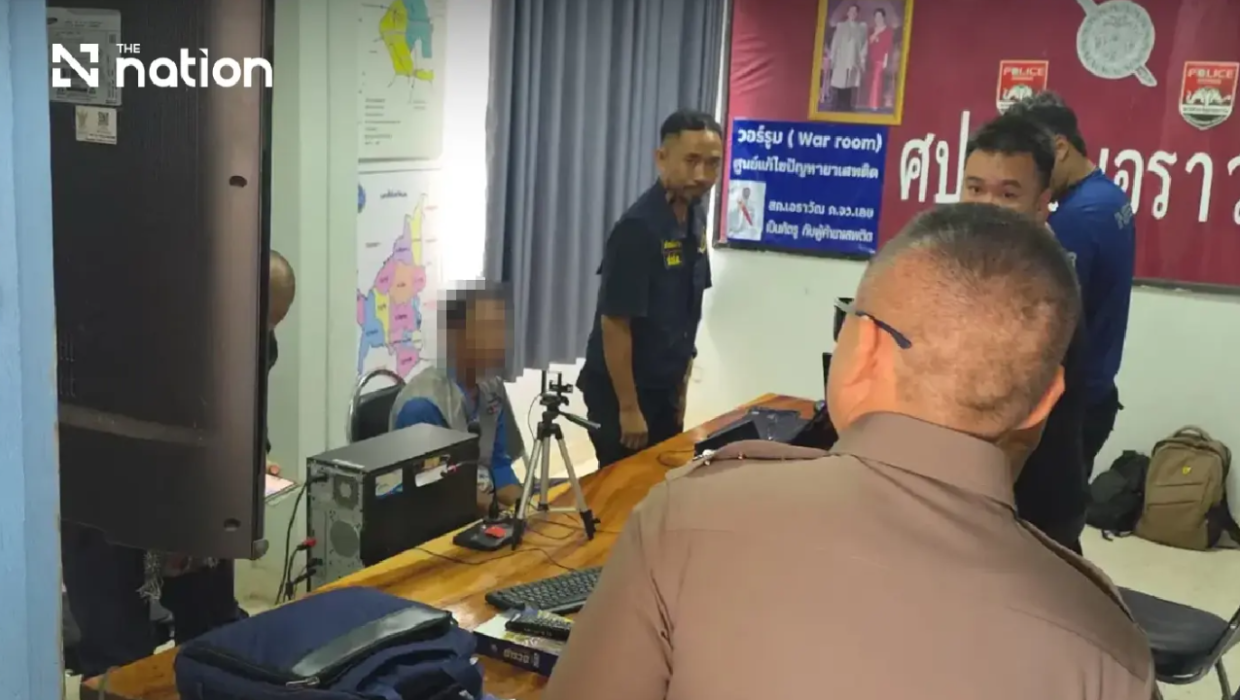
Authorities eventually traced Athit to a temple construction site in Wang Saphung district, where he was employed as a labourer working on repairs to a temple roof. His arrest at Wat Tham Pha Mak Ho in Sri Songkhram subdistrict and subsequent detention at Erawan Police Station marked a significant breakthrough in unravelling the network's operational structure. During preliminary questioning, Athit provided a confession that proved instrumental to the investigation's trajectory. He acknowledged accepting payments to dispatch parcels to Bangkok on six separate occasions, with each delivery compensated at 8,000 baht, equivalent to approximately US$240.
The logistics of the operation reveal a deliberately compartmentalised approach designed to obscure accountability and complicate law-enforcement tracking. Three of the parcels transited through a commercial parcel service operating from Chiang Khan, two originated from Ban That in That subdistrict, and one was dispatched from Erawan district. The most recent shipment left on June 28, 2026, suggesting the network maintained an active operational tempo at the time of the investigation. This geographic distribution across multiple subdistricts and service points indicates deliberate efforts to avoid concentration of suspicious activity at any single location.
Thatsaphon, identified as a Laotian national and Athit's wife, was apprehended separately after police discovered a black Mitsubishi Triton pickup bearing Loei registration parked within a rubber plantation in the Pha Nang-Pha Koeng locality of Pha In Plaeng subdistrict in Erawan district. The vehicle's strategic placement in a remote agricultural area suggests the network utilised rural hideaways for staging and coordination purposes. Upon interrogation at Erawan Police Station, Thatsaphon denied participation in or awareness of the alleged smuggling activities, though authorities continued their investigation to establish her precise involvement in the operation.
The network's pay structure and apparent coordination with a Laotian national provide insight into the transnational dimension of the operation and reveal how cross-border criminal organisations leverage economic disparities and geographic proximity to facilitate drug movements. The compensation offered to Athit—8,000 baht per parcel—represents substantially more than typical labouring wages in rural Loei, reflecting the economic incentives that criminal networks exploit to recruit operatives in economically disadvantaged regions. The involvement of a Laotian co-conspirator underscores Thailand's strategic position as a transit and coordination hub for narcotics originating from or destined for markets across Southeast Asia and beyond.
Investigators are pursuing the investigation through the ONCB's formal questioning mechanisms, with particular focus on identifying individuals who commissioned the operation, provided financial support, or facilitated logistics at higher organisational levels. Thai law-enforcement officials have indicated that the case exemplifies sophisticated methodologies employed by international drug syndicates, which deliberately fragment operations across multiple actors and geographic locations to insulate senior figures from direct accountability and evade comprehensive law-enforcement interdiction.
The ONCB secretary-general has characterised the case as demonstrating the evolving modus operandi of transnational narcotics networks that strategically position operatives at different organisational tiers and geographic locations to maximise operational resilience and complicate investigation pathways. This compartmentalisation strategy—where lower-level couriers and facilitators possess limited knowledge of broader network activities—creates investigative challenges for authorities attempting to establish full criminal complicity and organisational structures. The successful identification of Thai-based links in the supply chain represents a tactical victory for cooperative international law-enforcement efforts, particularly through intelligence coordination between Thai and Australian authorities.
Coordination between Thai and Australian law-enforcement agencies proved essential in tracing the Melbourne arrest back to Loei-based organisers and facilitators. This collaborative approach enabled investigators to construct a supply-chain narrative that connects airport-based movement with domestic staging and operational coordination. The ONCB has committed to intensifying investigation efforts to prosecute individuals at every level of the alleged operation, from low-wage couriers to higher-ranking coordinators and financiers.
The agency has signalled intentions to strengthen bilateral and multilateral cooperation frameworks with international counterparts to systematically intercept transnational drug movements, dismantle trafficking routes, and suppress financial channels supporting narcotics distribution networks. These enforcement strategies align with Thailand's broader commitment to the government's drug-suppression policy, which prioritises supply-chain disruption and financial investigation alongside traditional prosecution approaches. For Malaysia and other Southeast Asian nations, the case underscores the persistent challenge posed by cross-border narcotics networks exploiting regional transit corridors and illustrates the ongoing necessity for deepened law-enforcement coordination mechanisms.

