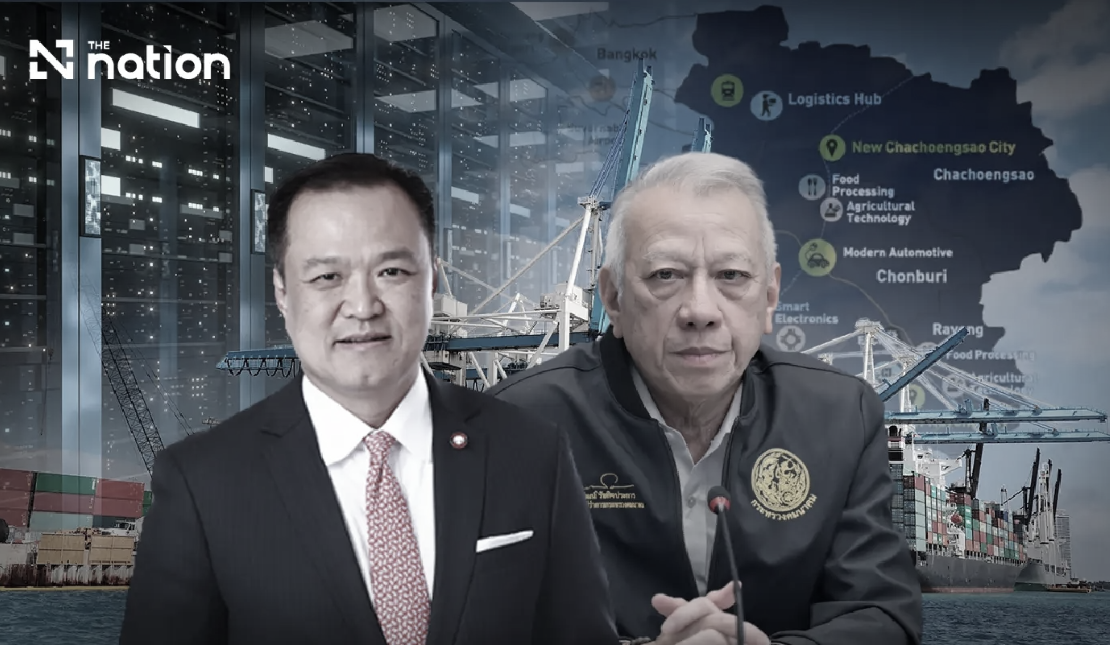
Thailand's Prime Minister Anutin Charnvirakul has assumed direct personal oversight of the Eastern Economic Corridor, reasserting his control over one of the nation's most ambitious development initiatives in a strategic repositioning that signals a significant shift in how Bangkok intends to market the region to international investors. The move came after Deputy Prime Minister Phiphat Ratchakitprakarn relinquished his authority over the Eastern Economic Corridor Office and his position as chairman of the EEC Policy Committee, with Cabinet orders taking effect on June 15. According to Government House sources, the decision follows discussions between the two senior officials and carries no suggestion of political tension within the ruling coalition.
The restructuring represents more than a simple administrative reshuffle. By placing himself at the helm of the EEC leadership team—effectively positioning himself as Thailand's chief investment salesman for the corridor—Anutin is signalling that the eastern region will receive elevated strategic importance. The Prime Minister intends to fundamentally rebrand how the EEC is presented to the global investment community, moving away from its historical identity as primarily a manufacturing and heavy industrial zone. Instead, the government now views the corridor through a distinctly different economic lens, one shaped by contemporary global pressures and emerging market opportunities.
Central to this reinvented strategy is positioning the Eastern Economic Corridor as a crucial node in global food security networks. Thailand's eastern region possesses considerable natural advantages in this domain, with established strength across livestock production, fisheries, agriculture, fruit cultivation, and horticulture. For many nations grappling with supply chain vulnerabilities and food sovereignty concerns—a concern that has intensified since the pandemic and geopolitical disruptions—such integrated agricultural capabilities represent a compelling investment proposition. By framing the EEC around these sectors, Bangkok hopes to unlock new capital flows from foreign investors seeking reliable access to agricultural products and value-added food processing infrastructure.
Equally significant is the government's determination to develop the corridor into a regional data centre hub, a sector that has become strategically vital as artificial intelligence adoption accelerates globally and companies seek geographically dispersed server infrastructure. This pivot acknowledges that heavy industry's traditional foundation for the EEC has become constrained by fundamental resource limitations. Both electricity and water availability in the eastern region present serious bottlenecks for energy-intensive manufacturing, with procurement costs for these essential inputs having risen substantially and threatening the corridor's competitiveness for conventional industrial investment.
Data centres, by contrast, require enormous electrical capacity and reliable water supplies for cooling systems, making them resource-hungry but potentially more economically efficient users of infrastructure than traditional heavy manufacturing. The Thai government recognises that attracting this sector demands sophisticated coordination across multiple agencies, given the critical importance of electricity supply consistency and quality. In anticipation of this new direction, the Energy Ministry is preparing to introduce a new electricity user category designated Type 9, specifically designed for data centre operators. This classification would mandate higher power tariffs than other consumer categories, reflecting the exceptional demand these facilities place on the national grid while ensuring they bear appropriate costs for their exceptional infrastructure requirements.
Phiphat's withdrawal from direct EEC oversight came without advance notification, a fact the deputy prime minister made publicly known when Cabinet orders were read for acknowledgement rather than advance discussion. His comments to reporters suggested some surprise at the development, though he categorically denied that the decision represented either a reduction in his government role or any fracture within his Bhumjaithai Party. Government sources subsequently provided explanation for Phiphat's apparent acceptance, attributing his proposal to Anutin to chronic institutional friction between the EEC Office and the Board of Investment. According to this account, the Deputy Prime Minister felt uncomfortable working amid such persistent confrontation and therefore suggested that Anutin assume direct supervisory responsibility.
Official statements have worked deliberately to disconnect this portfolio shuffle from other contentious issues affecting Phiphat's portfolio, particularly the long-stalled high-speed rail project linking Don Mueang, Suvarnabhumi, and U-Tapao airports. This megaproject, whose concession was signed in 2019 with the CP Group-linked Asia Era One, remains mired in contractual disputes and has yet to enter the construction phase years after initial signing. Phiphat took a notably hardline stance against amending the original payment structure, which obligates the private partner to complete construction before receiving state compensation. The Deputy Prime Minister resisted shifting toward a "build-and-pay" model that would tie government disbursements to construction progress milestones, viewing the original framework as essential protection for public interests.
Government sources have explicitly stated that Anutin himself ordered that no contract amendments proceed on the airport rail project, with the Prime Minister personally declining to assume the political and financial risks associated with altering the original agreement. This statement effectively positions Anutin and Phiphat as aligned on this contentious issue, thereby undermining suggestions that the EEC reassignment stems from disagreement over railway project strategy. The decision to withdraw the contract amendment from an EEC Policy Committee meeting scheduled for May 20, 2026, while negotiations with Asia Era One continued quietly, further suggested that transportation infrastructure disputes did not drive the EEC leadership change.
Additional details regarding Anutin's questioning of a proposed Disneyland development within the EEC suggest a broader recalibration of the corridor's strategic vision. When Anutin inquired about Phiphat's Disneyland proposal and its timeline for advancement, he pointedly noted the absence of feasibility studies demonstrating that projected returns would justify the substantial investment required. This line of questioning signals that the Prime Minister intends to implement more rigorous economic scrutiny of proposed EEC projects, privileging initiatives with clear revenue models and transparent development timelines over projects with uncertain financial fundamentals or extended development horizons.
The broader significance of this restructuring extends beyond Thai borders and holds particular relevance for Malaysian policymakers and regional investors. Thailand's recalibration of the EEC toward food security and data centre development reflects a strategic reckoning occurring across Southeast Asia. As regional economies compete for foreign investment in an era of reshoring and supply chain diversification, governments are increasingly targeting sectors that address global structural needs—whether food security, digital infrastructure, or manufacturing diversification away from China. Malaysia's own development corridors, from the Northern Corridor to the East Coast Economic Region, operate within a similar competitive landscape where strategic repositioning based on emerging global economic trends becomes essential to maintaining investor interest.
The elevation of data centre development as a core EEC strategy carries particular significance for Southeast Asia given the region's emerging centrality to global artificial intelligence infrastructure. With major technology companies seeking geographically distributed server locations and Thailand offering established investment frameworks, competitive electricity pricing compared to developed economies, and increasingly sophisticated digital governance infrastructure, the EEC's pivot toward this sector represents a plausible and well-calibrated economic strategy. For Malaysia and other regional economies similarly positioned to attract data centre investment, Thailand's explicit commitment to developing institutional frameworks specifically designed for this sector—including the new Type 9 electricity classification—demonstrates the level of specificity and coordination that attracts major technology investors.
Anutin's personal assumption of EEC leadership also reflects a broader Southeast Asian pattern where senior political figures directly oversee flagship investment initiatives to signal their strategic importance and to ensure rapid decision-making in response to international investor inquiries. By positioning himself as the public face of Thailand's investment recruitment efforts, Anutin creates a direct channel between foreign investors and Thailand's highest political authority, potentially accelerating negotiations and demonstrating governmental commitment. For Malaysian observers, this approach underscores how regional governments are increasingly personalising investment pitches, with senior leaders serving as active participants in capital recruitment rather than delegating these responsibilities entirely to technocratic agencies.
The structural repositioning of the EEC from heavy industry toward food security and data centres also reflects pragmatic assessments of resource constraints that resonate across Southeast Asia. The recognition that electricity and water limitations constrain traditional heavy industrial expansion in Thailand's eastern region applies with equal force to other regional economies. Thailand's explicit embrace of sectors that either leverage agricultural comparative advantage or involve service delivery rather than resource-intensive manufacturing offers a template that other Southeast Asian governments may emulate. For Malaysian planners evaluating the future direction of development corridors, Thailand's experience suggests that honest assessment of resource constraints, combined with strategic alignment of investment recruitment with demonstrated regional advantages and global economic trends, may prove more sustainable than attempting to perpetuate industrial models that face inherent geographical limitations.