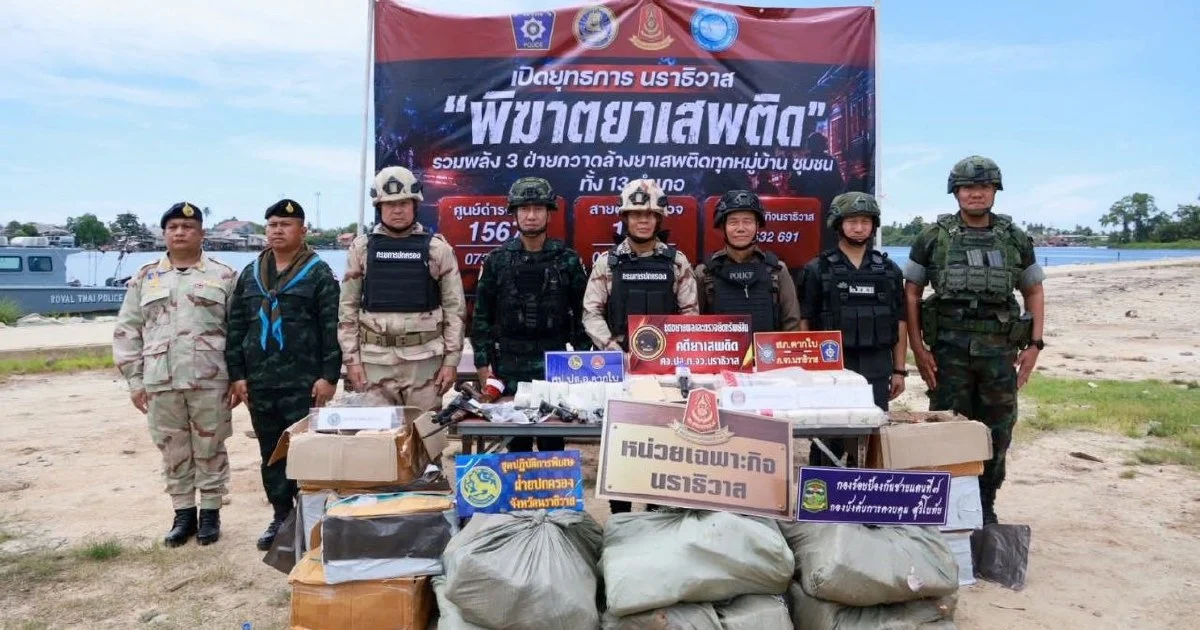
Thai law enforcement has dismantled a significant portion of a transnational drug trafficking network operating across the border region, with authorities in Narathiwat province announcing the arrest of 233 suspects during an intensive month-long counter-narcotics operation. The scale of the enforcement action underscores the growing sophistication and reach of smuggling operations that exploit the porous boundaries between Thailand and Malaysia, a route that has become increasingly attractive to criminal syndicates seeking to move illicit substances through Southeast Asia's supply chains.
Investigators have established that a number of the detained individuals maintain active connections to Malaysian trafficking networks, suggesting a coordinated cross-border operation rather than isolated criminal activity. This finding is particularly significant for Malaysian law enforcement agencies, as it confirms long-held suspicions about the depth of integration between Thai and Malaysian drug markets. The collaboration between these groups typically involves sophisticated logistics, including the use of courier networks, hidden compartments in vehicles, and occasionally corrupted officials at border checkpoints.
The operation recovered a substantial haul valued at RM1.2 million, reflecting the commercial scale at which these syndicates operate. The recovered materials include various narcotics, though authorities have not yet disclosed a detailed breakdown of the substances seized. The value of the seizure demonstrates that the networks being targeted are major players in the regional drug trade, not peripheral operations. For context, seizures of this magnitude typically indicate wholesale-level trafficking rather than retail-level distribution, suggesting these groups were coordinating supply from production regions in the Golden Triangle toward consumption markets in Malaysia and beyond.
The Narathiwat province has long served as a critical junction for drug trafficking routes flowing between Myanmar, Thailand, and Malaysia. Its geographic position near Malaysia's northern border, combined with terrain that facilitates illicit crossings and historically lower law enforcement capacity in certain areas, has made it a preferred corridor for traffickers. Thai authorities have intensified operations in the region in recent years, responding to both domestic drug abuse problems and international pressure to combat transnational criminal activity.
The month-long nature of the crackdown suggests a coordinated intelligence-driven operation rather than routine patrol activities. Such sustained operations typically involve sophisticated surveillance, infiltration of criminal organisations, and coordination with international partners. Thai authorities often work with Interpol and regional agencies to trace the origins of narcotic shipments and identify trafficking hierarchies, allowing them to target organisers rather than merely apprehending street-level dealers or couriers.
For Malaysian authorities, the disclosure of these arrests carries implications for domestic enforcement strategy. Cross-border trafficking networks often operate with Malaysian operatives handling distribution within the country while Thai and other regional contacts manage supply and transit operations. Understanding the structure of these organisations helps Malaysian police target the supply chain at multiple points, disrupting both the inflow of narcotics and the outflow of money laundering proceeds. The involvement of Malaysian nationals in trafficking rings based in or operating through Thailand represents a persistent challenge for PDRM's narcotics division.
The phenomenon of Malaysian involvement in Thai-based operations reflects deeper economic and social factors in border communities. Poverty, limited legitimate economic opportunities, and the proximity to profitable criminal markets create conditions where individuals may be recruited as couriers or logistics coordinators. Additionally, language and cultural familiarity facilitate recruitment—individuals from bordering states like Kedah, Perlis, and Terengganu often have family or social ties across the border that traffickers exploit.
Regional drug control efforts have evolved to address this transnational dimension more systematically. Agencies in Thailand, Malaysia, and other ASEAN nations have expanded information-sharing protocols and established joint task forces to monitor trafficking trends. However, implementation remains uneven, with capacity constraints in some jurisdictions and occasional diplomatic friction affecting coordination. The success of the Narathiwat operation suggests that when intelligence and enforcement resources are adequately mobilised, significant impacts are achievable.
The recovery of RM1.2 million in narcotics represents only a snapshot of trafficking volumes through the region. Authorities estimate that interdicted seizures typically represent a small percentage of overall flows—perhaps five to fifteen percent depending on the route and substance. This implies that substantially larger quantities continue reaching Malaysian markets, feeding addiction, generating criminal revenue, and destabilising communities. Understanding the scale of the hidden market informs both the urgency of enforcement action and the necessity of addressing demand-side factors through treatment and prevention.
Looking forward, the arrests announced by Thai authorities will likely trigger secondary investigations in Malaysia as investigators attempt to identify local contacts and distribution networks of the detained individuals. PDRM's Commercial Crime Investigation Department and Narcotics Criminal Investigation Division will presumably cross-reference the names with existing intelligence files and conduct follow-up operations targeting Malaysian nodes of the disrupted networks. Such cascading enforcement actions often yield significant results, as the arrest of Thai-based operatives creates gaps in supply chains that Malaysian investigators can exploit to identify key players.
The operation also highlights the vulnerability of border regions to criminal exploitation. While legitimate cross-border commerce and movement are essential for regional prosperity, they create cover for illicit activities. Addressing this tension requires not only enhanced enforcement but also improved institutional capacity, corruption control, and targeted development of border communities to reduce the appeal of criminal recruitment. Regional cooperation mechanisms must simultaneously respect national sovereignty and facilitate the information-sharing and joint operations necessary to combat sophisticated transnational criminal enterprises effectively.

