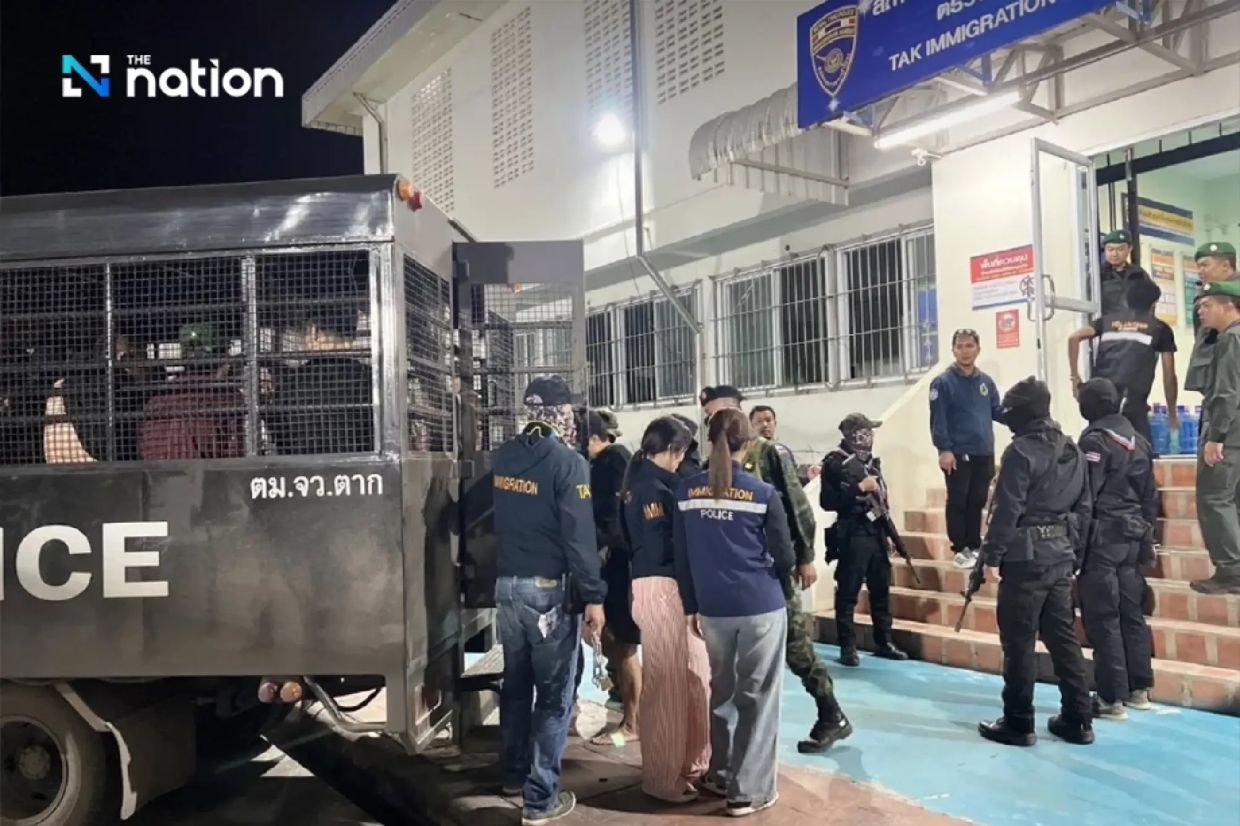
Thailand's government is undertaking a significant overhaul of its immigration legislation to streamline and expedite the deportation process for foreign nationals involved in criminal activity, responding to escalating concerns about transnational crime networks exploiting the kingdom as an operational base. The initiative represents a shift in policy focus from speed of tourist arrivals toward security considerations, with Deputy Prime Minister Pakorn Nilprapunt assigned to lead efforts in revising relevant sections of the Immigration Act of 1979 in consultation with the Royal Thai Police, Immigration Bureau, and Interior Ministry.
The urgency behind this reform stems from a growing recognition that existing legal frameworks have created significant delays in removing foreign offenders from Thai territory. Many foreign detainees remain in state custody for extended periods while their cases navigate appeals procedures, court processes, and embassy coordination mechanisms. This bottleneck has prompted authorities to identify specific legislative obstacles, particularly Sections 54 and 55 of the 1979 Immigration Act, as targets for reform to enable faster and more flexible removal while maintaining compliance with international human rights standards.
A critical catalyst for this crackdown emerged from Thailand's 60-day visa exemption policy, introduced in July 2024 under the previous Srettha Thavisin administration for visitors from 93 countries and territories. The scheme fundamentally altered Thailand's security screening architecture by eliminating the requirement for advance visa applications, which meant Thai diplomatic missions could no longer conduct background checks on criminal records or financial status before entry. This enforcement gap inadvertently created conditions for certain foreign nationals to establish semi-permanent residency through repeated border runs, effectively resetting their legal stay without proper documentation.
Intelligence assessments indicate that these loopholes have facilitated various criminal enterprises across Thai territory. Foreign nationals have leveraged the permissive entry environment to engage in illegal employment within hospitality, entertainment, and tourism sectors, directly competing with Thai workers for positions in restaurants, resorts, and nightlife venues. More alarmingly, authorities have documented involvement in sophisticated transnational schemes including call-centre scams targeting victims across Southeast Asia, complex money laundering operations, and grey-capital networks that operate through nominee business arrangements and property acquisition schemes that circumvent foreign ownership restrictions.
Problem areas have clustered in major tourist destinations and retirement communities, with particular concentrations reported in Pai within Mae Hong Son Province, Pattaya in Chonburi, Koh Phangan in Surat Thani, and various Bangkok neighbourhoods. These geographical patterns suggest that foreign criminals have deliberately targeted zones with established expatriate communities and weak social oversight, where they can operate with relative anonymity. The situation reflects a broader Southeast Asian challenge of transnational criminal mobility, whereby individuals fleeing enforcement in their home countries migrate to jurisdictions perceived as offering administrative laxity.
The Anutin Charnvirakul government elevated tackling transnational crime to a formal security priority, directing the Immigration Bureau, Royal Thai Police, and allied agencies to strengthen screening mechanisms and enforcement protocols. Four principal measures were introduced to address identified vulnerabilities: implementing heightened scrutiny of travellers entering and exiting Thailand with unusual frequency and without transparent justifications, intensifying background screening for high-risk nationality groups, integrating Interpol and international criminal record databases more thoroughly with domestic security agencies, and restructuring visa arrangements to eliminate overlapping entry rights that facilitate visa-shopping tactics.
A watershed moment arrived when the Cabinet approved cancellation of the 60-day visa exemption scheme on May 19, 2026, reverting to country-by-country bilateral arrangements with most visitors facing a maximum 30-day stay. This policy reversal reflects an explicit reassessment of Thailand's tourism strategy, with government officials contending that the exemption scheme failed to deliver proportionate increases in tourist arrivals or visitor spending while simultaneously expanding the nation's exposure to security risks. Rather than pursuing volume-driven tourism metrics, authorities have signalled a preference for higher-value, lower-risk visitor demographics that generate greater economic benefit per capita without straining law enforcement resources.
Despite intensified enforcement operations involving military, police, and administrative personnel that have resulted in escalating arrests of foreign offenders, the system remains clogged with detainees awaiting resolution. Some remain incarcerated indefinitely due to inability to finance repatriation costs, requiring Thai authorities to coordinate with foreign embassies for financial assistance—a process frequently stalled by bureaucratic inertia. Others exploit existing appeal mechanisms embedded within the Immigration Act of 1979, which permit foreign nationals to challenge deportation orders within 48 hours of notification, typically resulting in automatic postponement of removal while appeals proceed through the legal system.
Additional complications arise from Thailand's extensive commitments to international human rights frameworks. The kingdom holds membership in the United Nations Human Rights Council and remains party to eight major international human rights treaties encompassing civil and political rights, economic and social rights, protection from torture, disability rights, and prevention of enforced disappearance. These obligations create legitimate grounds for detainees to petition courts for temporary release or to oppose removal on humanitarian grounds, further extending timelines and complicating enforcement operations. Pol Lt Gen Trairong Phiwpan, the Royal Thai Police spokesman, acknowledged that these human rights considerations represent mandatory procedural components in every case, reinforcing the tension between expeditious removal and legal robustness.
The deportation architecture itself presents compounding layers of complexity. When Thailand maintains extradition treaties with foreign governments, the attorney-general must evaluate cases before referral to courts, which then issue formal extradition orders. Absent such treaties, the Foreign Ministry must submit requests through diplomatic channels, requiring the attorney-general's approval before judicial intervention. Each pathway involves distinct timeframes and procedural requirements, and detainees retain the right to challenge removals or request temporary stays through court petitions, effectively freezing deportation proceedings pending judicial consideration.
Prime Minister Anutin has articulated that existing arrest and prosecution rates, while demonstrating tangible security results, remain insufficient without corresponding acceleration of deportation mechanisms. He emphasised that the lengthiness of current procedures permits some offenders to resume quasi-normal existence while cases remain pending, creating unacceptable risks of recidivism and continued criminal activity. The government's messaging has sought to balance strict law-enforcement positioning with reassurance toward legitimate business investors and tourism stakeholders, with Anutin stating that Thailand enthusiastically welcomes foreign nationals engaged in honest travel, investment, and commerce while reserving decisive legal consequences for those engaging in lawbreaking or behaviour damaging national interests.
Police spokesman Trairong indicated that policy reforms should concentrate on compressing procedural timelines, eliminating redundant steps, and minimising bureaucratic delays while preserving judicial capacity to assess the gravity of individual cases. Proposed refinements might distinguish between straightforward visa violations and serious transnational criminal matters, potentially accelerating removal of lower-risk detainees whilst maintaining rigorous scrutiny of complex cases. He acknowledged that uniform timeframes cannot realistically apply across diverse circumstances, given the variable exercise of legal rights across different extradition treaty frameworks and the individuated nature of human rights considerations.
The government's broader reform initiative occurs within a distinctly Southeast Asian context where borders remain porous and transnational criminal networks exploit regulatory fragmentation across the region. Thailand's experience mirrors patterns observable in Cambodia, Laos, and Philippines, where foreign criminals have exploited visa policies and weak institutional coordination to establish operational bases. Regional implications of Thailand's legislative reforms may influence neighbouring governments to reassess their own entry screening mechanisms and deportation procedures, potentially triggering broader harmonisation of Southeast Asian security protocols.
Deputy Prime Minister Pakorn is expected to conduct comprehensive consultations with the Interior Ministry, Royal Thai Police, and additional stakeholder agencies to gather operational data and evaluate implementation impacts across multiple institutional dimensions. These discussions will likely focus on identifying specific bottlenecks within the current system, assessing the feasibility of proposed amendments, and developing transitional protocols that maintain rule-of-law compliance whilst achieving measurable improvements in deportation velocity. The outcome of this review process will substantially influence Thailand's capacity to address transnational crime pressures and may establish a template for other Southeast Asian nations confronting comparable security challenges.

