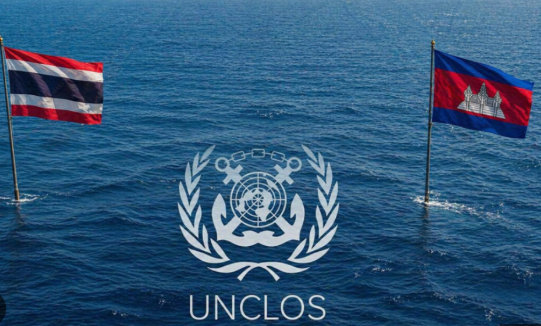
Thailand has formally agreed to participate in a compulsory conciliation process with Cambodia to address their long-standing maritime boundary dispute in the Gulf of Thailand, though Bangkok has taken care to emphasise that the mechanism will not function as a court case and cannot produce legally binding decisions. The Thai Ministry of Foreign Affairs confirmed it submitted its formal response to Cambodia on June 19, two and a half weeks after Phnom Penh transmitted its notification on June 2. This acceptance marks a significant procedural step in a dispute that has simmered for decades and touches on valuable hydrocarbon reserves beneath the gulf's waters.
The conciliation framework operates under the 1982 United Nations Convention on the Law of the Sea, or Unclos, which Thailand and Cambodia both ratified to gain access to maritime rights and ocean governance mechanisms. Thailand's approach to the proceedings reveals a deliberate strategy to contain the dispute's scope and preserve its freedom of action. Bangkok has explicitly stated that the conciliation should be restricted exclusively to maritime delimitation—essentially the technical drawing of boundary lines in the sea—and should not extend into provisional arrangements for joint development of resources or other resource-sharing mechanisms that Cambodia may have hoped to address.
To manage Thailand's participation, Deputy Prime Minister and Foreign Minister Sihasak Phuangketkeow has been appointed as the nation's Agent in the proceedings, giving the country's top diplomat direct oversight. Supporting him is Songchai Chaipatiyut, Thailand's ambassador to Kuwait and a former senior official at the Department of Treaties and Legal Affairs, who takes the Deputy Agent role and brings institutional knowledge of Thailand's legal positions on maritime matters. Thailand has also selected two respected international figures to serve as conciliators: Judge Albert J Hoffmann of South Africa and Judge Rudiger Wolfrum of Germany, both described by Thai officials as internationally recognised experts in the law of the sea.
The conciliation structure itself involves a two-stage process. The four conciliators already appointed by both Thailand and Cambodia have thirty days from Thailand's formal response to jointly select a fifth conciliator who will chair the entire commission. Once constituted, the five-member body will have approximately twelve months to prepare its report and recommendations, though both countries may mutually agree to extend this timeline. Thai officials have been careful to educate the public about what conciliation actually entails, stressing that it differs fundamentally from litigation and that conciliators function as neutral facilitators rather than advocates for either side. Their role is to listen carefully to both parties, understand the historical and political context surrounding the disagreement, and help identify solutions that both governments might find acceptable.
The critical distinction Bangkok wishes to maintain is that any conclusions or recommendations produced by the commission will take the form of a non-binding report that merely provides a foundation for continued bilateral negotiations. This position directly mirrors language in Unclos Annex V, which explicitly states that conciliation commission reports do not bind the parties involved. Thailand's insistence on this point reflects a broader diplomatic preference to keep ultimate decision-making authority within bilateral channels rather than ceding it to international mechanisms. The ministry has signalled that conciliation should serve as a framework to facilitate negotiations rather than supplant direct government-to-government discussions.
The underlying dispute concerns overlapping maritime claims in a section of the Gulf of Thailand believed to contain significant natural gas deposits and other hydrocarbon resources. The disagreement has historically intertwined two related but separable issues: the technical question of where maritime boundaries should be drawn, and the practical question of how to cooperate in exploiting energy resources located in areas both countries claim. Thailand's narrow framing of the conciliation scope suggests Bangkok wishes to address boundary delimitation independently, potentially keeping resource-sharing discussions separate or removed from international proceedings. This approach contrasts with Cambodia's apparent desire to bundle these issues together within the conciliation framework.
The dispute's roots extend back decades, but recent developments have intensified the procedural engagement. In May, Thailand's Cabinet formally terminated the 2001 memorandum of understanding with Cambodia—domestically referred to as MoU 44—which had provided a bilateral framework for managing overlapping continental shelf claims. Prime Minister Anutin Charnvirakul characterised the termination as a pragmatic response to twenty-five years of stagnation rather than a hostile act toward Cambodia, framing it instead as a necessary adjustment to the cooperation framework. Thai officials assured that cancelling the 2001 agreement did not signal an intention to cease negotiations or damage bilateral relations; rather, Bangkok indicated it would continue maritime discussions with Cambodia using Unclos as a shared reference point, given that both nations are now formal convention parties.
Cambodia responded by initiating the compulsory conciliation process, citing a commitment to peaceful resolution grounded in international law. This move applied procedural pressure on Thailand to engage, since Unclos conciliation is compulsory once one party requests it, meaning Bangkok had limited choice but to participate. However, Thailand's acceptance has come with careful rhetorical positioning designed to limit the process's scope and emphasise that meaningful outcomes ultimately depend on direct negotiation rather than international proceedings. For Malaysia and other Southeast Asian states watching this dispute, the conciliation process offers a useful case study in how regional neighbours balance respect for international law with preservation of national sovereignty and negotiating flexibility.
The next phase will unfold over the coming months as the five-member conciliation commission takes shape and begins its work. Both countries face pressure to present coherent legal arguments and historical evidence supporting their respective boundary claims. Thailand's appointment of senior officials and internationally recognised legal experts signals serious engagement, though the nation's repeated disclaimers about non-binding recommendations demonstrate that Bangkok views conciliation as a tool for facilitating negotiation rather than as a means to resolve the dispute definitively. For Cambodia, participating in this international process represents an effort to elevate the dispute beyond bilateral dynamics and introduce expert, neutral analysis into a longstanding disagreement.

