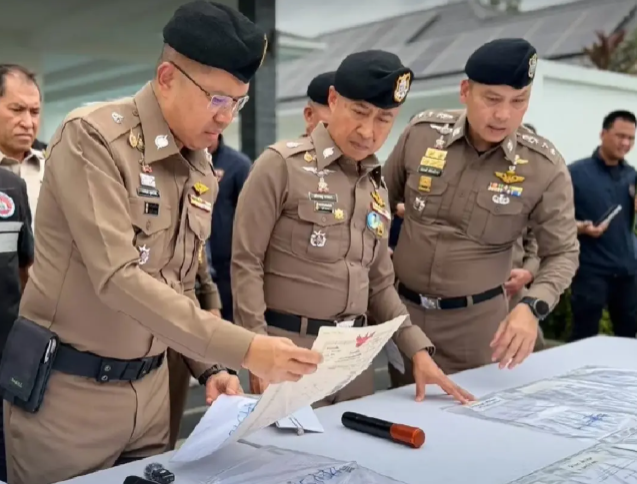
Thailand's law enforcement agencies have intensified their assault on a widespread property-holding scheme involving foreign nationals, arresting 13 foreign individuals across the resort town of Hua Hin during the sixth instalment of a nationwide crackdown that exposes vulnerabilities in the kingdom's ownership regulations. The coordinated operation, which took place on Monday across 15 locations in Prachuap Khiri Khan province, involved more than 200 police officers and government officials targeting 33 companies believed to be using Thai proxy shareholders to circumvent foreign ownership restrictions on property.
The arrested individuals included three British nationals, four Chinese citizens, and one each from Italy, France, the Netherlands, Austria, the Philippines, and the United States. Notably, courts had previously issued arrest warrants for an additional 45 foreign nationals in connection with the investigation, while Thai authorities summoned 39 Thai nationals for questioning regarding their roles as nominee shareholders. The suspects currently under custody have not yet faced formal charges, remaining instead in investigative custody as authorities compile evidence.
The operation zeroed in on an upscale residential development in Thap Tai subdistrict containing detached houses and luxury pool villas, each commanding prices between 10 and 20 million baht. Within this single development alone, police identified six companies allegedly operating as front entities, with four connected to the first phase of the scheme and two to a subsequent iteration. The aggregate property holdings under investigation across all 33 companies reaches approximately 300 million baht, indicating a substantially organized network rather than isolated violations.
The investigation reveals how foreign nationals have been systematically advised by law and accounting firms on structuring their Thai property acquisitions through corporate entities. According to police statements, these foreign buyers believed they were engaging in legal transactions by establishing companies with Thai nationals serving as registered shareholders. However, the evidence gathering suggests these arrangements constituted deliberate circumvention of Thai constitutional provisions restricting foreign land ownership, which permit foreign nationals to own only condominium units and only up to 49 percent of any single project.
Thailand's nominee property scheme represents a significant regulatory challenge for Southeast Asia's tourism-dependent economy, where foreign investment in real estate remains a contentious issue balancing national sovereignty with economic development. For Malaysian investors and property professionals, understanding these enforcement trends carries important lessons about how neighbouring jurisdictions are tightening controls over foreign ownership structures. The Thai crackdown signals a broader regional shift toward stricter asset ownership verification and beneficial ownership transparency, patterns that could eventually influence policies across Southeast Asia.
The Thai nationals identified as nominee shareholders painted a revealing picture of the scheme's mechanics during police questioning. These individuals claimed they had never personally funded the share purchases, received no dividends or management involvement, and remained unfamiliar with any financial documentation related to the companies. Many asserted they were unaware of the companies' actual activities or business operations, suggesting they served purely as legal fronts rather than genuine business participants. This pattern indicates a deliberate hollowing out of corporate structures designed to mask foreign control while maintaining superficial Thai ownership.
Law enforcement seized extensive documentation during the raids, including company registration papers, accounting records, computer systems, mobile devices, and electronic data repositories. Investigators plan to conduct detailed financial tracing to identify transaction flows and uncover additional participants, including overseas beneficiaries and networks operating outside Thailand. The inquiry will also examine whether any government officials facilitated the schemes through corruption or improper assistance, suggesting concerns about complicity within bureaucratic or legal circles.
The Hua Hin operation represents merely the latest escalation in what authorities describe as a systematic campaign against unlawful foreign business structures. Five preceding phases have targeted different regions across Thailand's tourism sector, beginning with investigations on Koh Phangan in Surat Thani and expanding to Phuket, Phang Nga, Krabi, and Chonburi. Most recently, Phase 5 focused on 31 companies and 29 land plots in Chiang Mai worth approximately 633 million baht. Cumulatively, the first five phases examined 233 land parcels and buildings covering more than 160 rai (25.6 hectares) with a combined estimated value exceeding 2.539 billion baht.
The enforcement effort has already yielded substantial legal consequences, with courts approving 133 arrest warrants from the previous five operational phases. Notably, 20 cases have already resulted in criminal convictions, suggesting prosecutors have successfully navigated the complexities of proving beneficial ownership and fraudulent nominee arrangements. This track record demonstrates that Thai courts are willing to pursue these cases aggressively, establishing legal precedent that may discourage future attempts at property law circumvention.
For regional business communities and real estate professionals, these operations underscore the importance of full compliance with foreign ownership restrictions rather than seeking technical workarounds. Thai authorities have explicitly distinguished between their campaign against unlawful nominee schemes and legitimate foreign investment that operates within legal frameworks. The distinction matters particularly for Malaysian investors active in Thailand, where transparent structures and proper registration protect assets far more effectively than attempting concealment through complex corporate arrangements. The ongoing investigation signals that Thailand intends to maintain vigorous enforcement of these provisions indefinitely.
Thailand's authorities have established multiple reporting channels for public participation in identifying suspected illegal foreign business activities, including local police stations and a nationwide hotline at 1599 operating continuously. This approach reflects both law enforcement's recognition that community vigilance enhances detection capacity and the scale of the suspected network operating across Thai tourist destinations. For Malaysian investors seeking legitimate opportunities in Thai property and business, the enforcement environment increasingly rewards transparency and proper legal structuring while systematically targeting opacity and concealment.

