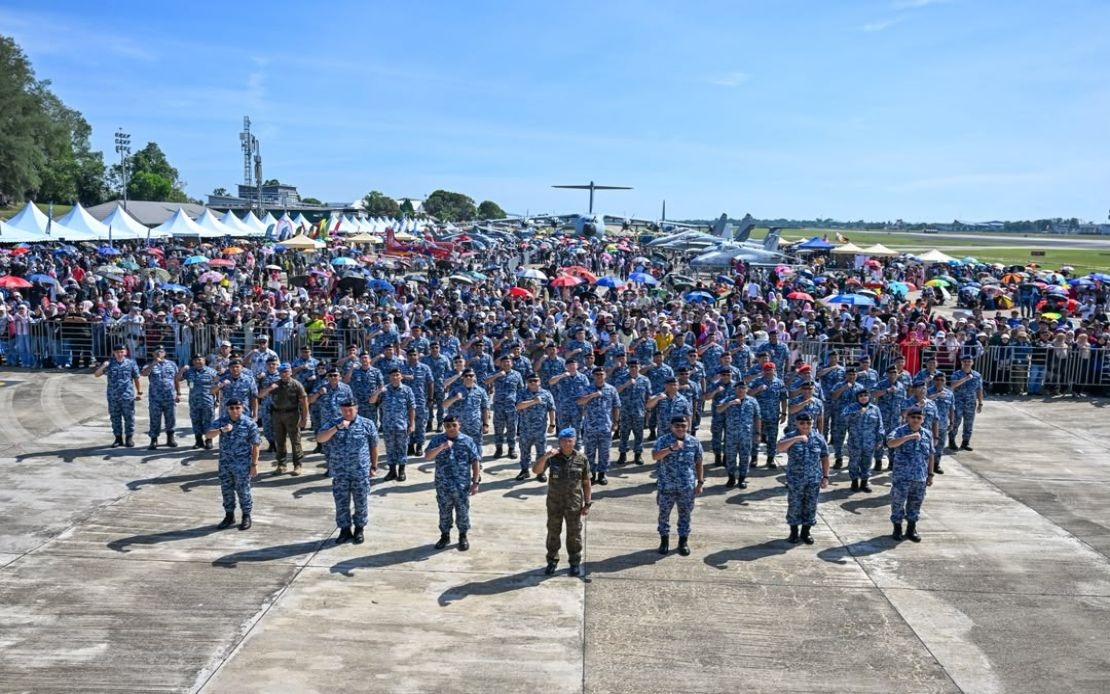
Persistent heat could not dampen public enthusiasm as the Royal Malaysian Air Force (RMAF) welcomed thousands of visitors to Kuantan Air Base over two days in June for its latest open day celebration. The event, held in tandem with commemorations of the RMAF's 68th founding anniversary, drew people from across Malaysia—including families with young children and elderly attendees—all determined to experience close-up views of military aircraft and meet air force personnel in an unusually accessible setting.
RMAF Chief General Tan Sri Muhamad Norazlan Aris acknowledged that this year's programme operated within tighter budgetary constraints reflecting the government's broader fiscal discipline measures. Despite the leaner approach, he stressed that the force remained committed to maintaining public engagement and demonstrating the capabilities underpinning Malaysia's air defence posture. The open day served a dual purpose: satisfying civilian curiosity about military operations while allowing defence personnel to articulate the RMAF's operational scope and modernisation trajectory to an informed audience.
Central to the RMAF's strategic messaging is the conviction that digital platforms alone cannot adequately convey the complexity of military capabilities or the professionalism of air force personnel. By hosting the open day, the RMAF created conditions for direct dialogue between service members and the public—a channel through which Malaysians could pose questions about recruitment, technical capabilities, and future acquisition plans without breaching operational security. General Muhamad Norazlan emphasised that such transparency, when carefully calibrated, builds public confidence in institutional competence and defence readiness.
The airfield's two-day programme showcased an impressive roster of platforms integral to Malaysia's air defence architecture. Spectators witnessed live flight demonstrations piloted by the Sukhoi Su-30MKM multi-role fighter, the twin-engine F/A-18D Hornet, the modern Airbus A400M tactical airlifter, and the venerable Lockheed C-130H Hercules transport. Helicopter assets—including the European-manufactured EC725AP/H225M and AW139—also performed, while airborne specialists from the RMAF's elite PASKAU (Special Forces) executed insertion and extraction drills and parachute demonstrations that underscored the force's unconventional warfare credentials.
On static display across the apron sat additional aircraft including the Beechcraft Hawk trainer and the Indonesian-manufactured Gauss CN235 transport variant. Complementing these platforms were ground-based air defence systems, power generation vehicles, and emergency response equipment—a tangible representation of the logistical apparatus sustaining air operations. Such exhibitions provide civilian audiences with a visceral sense of modern airpower's technological depth and the human expertise required to sustain it.
A particularly innovative element proved to be the RMAF Runway Run 2026, scheduled for the event's second day. This activity permitted members of the public to traverse the actual operational runway—an extraordinary privilege normally restricted to authorised military and civilian air traffic personnel. Nearly 3,000 individuals had registered in advance, though organisers indicated that walk-up participation remained welcome. For most Malaysians, such proximity to operational military infrastructure remains inaccessible, rendering the runway run a distinctive draw that elevated the event beyond conventional air shows.
One attendee, 24-year-old Mohd Al Muaimin Khairul Amir from Arau in Perlis, captured the emotional resonance of the occasion. Attending for the first time, he was joined by his mother, Rosnani Itam, 67, who navigated the event in a wheelchair. The multigenerational outing—enabling his elderly parent to experience fighter jets and helicopters in proximity—created a family memory unlikely to fade. For Muaimin, witnessing RMAF aircraft perform live rather than glimpsing them on social media proved transformative, underscoring how physical presence and sensory experience generate engagement that digital media cannot replicate.
Beyond the flying displays, the RMAF structured the open day as a broad cultural and educational experience. The RMAF Central Band and specialised drumline units delivered performances, while the Air Force Arts Group showcased creative talents. Career exhibitions enabled young Malaysians to explore recruitment pathways, while aircraft simulators allowed civilians to grasp the cognitive demands placed on pilots and systems operators. These peripheral activities extended the event's reach beyond pure hardware enthusiasts to encompass families seeking wholesome, patriotic entertainment.
The 68th anniversary milestone itself warrants context for Malaysian readers unfamiliar with the RMAF's institutional trajectory. The air force has evolved substantially since independence, transitioning from Cold War–era platforms to contemporary systems reflecting Malaysia's security doctrine in Southeast Asia. The RMAF's fleet modernisation—evidenced by the presence of Sukhoi and Hornets—reflects strategic decisions to maintain credible deterrence against peer competitors while sustaining maritime surveillance and rapid-response capabilities across the archipelago's vast territories.
For regional observers, the Kuantan event exemplifies broader trends across Southeast Asian militaries. Nations including Indonesia, Thailand, and Vietnam have similarly expanded public access to military assets as a means of strengthening civil-military relations and building support for defence expenditure. In an era of fiscal constraint and competing budgetary priorities, institutional legitimacy increasingly hinges on public perception of competence and transparency. The RMAF's carefully curated open day thus reflects shrewd political calculation alongside genuine commitment to public education.
The event also carries implications for Malaysia's defence industrial aspirations. By showcasing platforms like the A400M and highlighting local expertise in operating sophisticated systems, the RMAF sends signals to the government and defence contractors about areas where Malaysia might deepen indigenous capability. The emphasis on future acquisitions—a topic General Muhamad Norazlan indicated personnel could discuss—subtly advances the case for sustained or elevated defence spending as threats evolve across the Indo-Pacific.
Looking ahead, the success of the 2026 open day suggests that public interest in military affairs remains robust when access barriers lower. For the RMAF, leveraging such grassroots enthusiasm into long-term institutional support will require sustained engagement rather than episodic open days. The runway run innovation, in particular, established a precedent likely to feature in future celebrations. As Malaysia navigates increasingly complex regional security dynamics, maintaining public confidence in the RMAF's capacity to defend national airspace becomes strategically invaluable—and events like Kuantan's open day prove instrumental in that undertaking.

