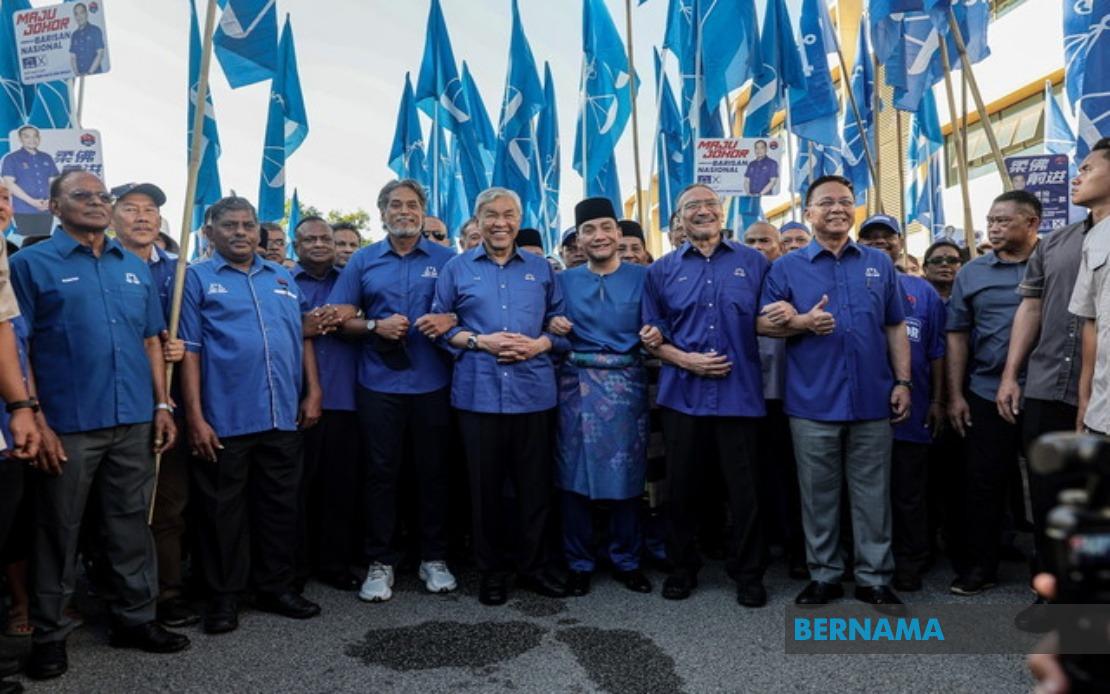
Johor's political machinery shifted into high gear on June 27 as Datuk Onn Hafiz Ghazi, the state Barisan Nasional chairman and incumbent Machap assemblyman, formally submitted his nomination papers for the upcoming state election. The submission took place at 9.10 am at the Muafakat Hall of the Simpang Renggam District Council, marking a significant moment in what promises to be a keenly contested electoral battle for control of Johor's state assembly.
The prominent turnout of senior party figures underscored the high stakes surrounding Onn Hafiz's candidacy and the broader political contest unfolding in Malaysia's southern bastion. UMNO president Datuk Seri Dr Ahmad Zahid Hamidi made the trip to Simpang Renggam to personally witness the filing, sending a clear signal of the national leadership's backing for the Johor BN campaign. His presence carried symbolic weight, reflecting UMNO's commitment to maintaining its foothold in a state where Barisan Nasional has traditionally enjoyed electoral dominance.
Also lending their support were two other heavyweight figures from the federal political establishment. Sembrong MP Datuk Seri Hishammuddin Tun Hussein, a seasoned politician with significant influence within UMNO's rank-and-file, accompanied Onn Hafiz to the nomination centre. Joining them was Khairy Jamaluddin, the former minister whose career trajectory represents the evolving generational dynamics within UMNO. The assembly of such prominent national-level figures at what might ordinarily be a routine administrative proceeding highlighted the strategic importance Kuala Lumpur's political leadership has assigned to securing Onn Hafiz's position as the BN standard-bearer in Machap.
Former Johor Menteri Besar Datuk Seri Hasni Mohammad was equally present at the venue, extending his backing to the incumbent assemblyman. Hasni's attendance carried particular significance given his historical prominence in Johor politics and his continued influence within state-level BN circles. The presence of a former chief minister at the nomination filing reinforced the message of party unity and establishment consolidation behind Onn Hafiz's candidacy, suggesting that despite any underlying factional considerations that typically characterise Malaysian politics, the party's top echelons are presenting a unified front for the state election campaign.
The scene at Simpang Renggam District Council reflected the energised atmosphere surrounding the 16th Johor state election. Party faithful had congregated in the vicinity of the nomination centre, visibly demonstrating their allegiance through traditional campaign methods. Supporters dressed in their respective party colours created a vibrant display of political mobilisation, while banners and flags adorned the surrounding area. This grassroots mobilisation, coupled with the elite-level endorsements offered by senior party leadership, painted a picture of an organisation gearing up for a full-scale electoral campaign with the necessary organisational machinery in place.
Onn Hafiz's entry into the formal electoral process represents a critical juncture for Barisan Nasional in Johor. As Machap's sitting state assemblyman, he brings the advantage of incumbency and an established presence in his constituency. His candidacy as BN's state-level leader carries implications that extend beyond Machap itself, signalling the coalition's readiness to defend its traditional stronghold. The consolidation of support from senior figures across the national and state levels suggests that BN strategists believe Onn Hafiz represents their best prospect for maintaining legislative control following the polling.
The timing and staging of this nomination submission also serves a broader political communication function. In Malaysian state elections, the nomination and campaigning period has become increasingly important as a window for parties to project competence, unity, and organisational strength to the electorate. The parade of senior party figures through Simpang Renggam sends messages not only to voters in the Machap constituency but to the broader electorate across Johor. The image of national and state-level leadership converging to support a candidate becomes itself a political message about that candidate's standing and the party's confidence in its campaign prospects.
The coordination required to assemble such a high-profile group of political figures at a single nomination centre reflects careful strategic planning by BN's campaign machinery. Each attendee brought their own constituency base and sphere of influence to bear on the occasion. Ahmad Zahid Hamidi commands the loyalty of much of UMNO's federal apparatus, Hishammuddin maintains significant influence among parliamentarians from the party's eastern coast strongholds, while Khairy represents a particular faction and generational cohort within UMNO's complex internal politics. Their unified appearance suggested that factional considerations had been set aside in favour of a coordinated push to ensure victory in what is clearly viewed as an important electoral contest.
For Malaysian observers of political developments, the focus on Johor remains particularly significant. As one of Malaysia's largest states with substantial economic output and a historically important role in national politics, the outcome of the Johor state election carries implications that reverberate beyond the state's boundaries. BN's performance in Johor becomes a crucial data point in assessing the coalition's broader political trajectory and its capacity to retain control in major state governments. The visible commitment of senior national leadership to backing Onn Hafiz's nomination suggests that Kuala Lumpur's political establishment views the maintenance of BN control in Johor as a priority item on its agenda.
The nomination process also marks the formal opening of what will likely be an intensive campaign period. With senior figures already deploying to the grassroots level in support of BN's candidates, both the coalition and its opponents can be expected to escalate their campaign activities across the state. The mobilisation of supporters visible at Simpang Renggam provides a glimpse of the organisational intensity that voters across Johor will likely experience in the coming weeks as the state moves toward polling day. The convergence of party heavyweights around Onn Hafiz's nomination represents both a show of strength and an attempt to set the tone for what BN hopes will be a victorious campaign narrative in the state.

