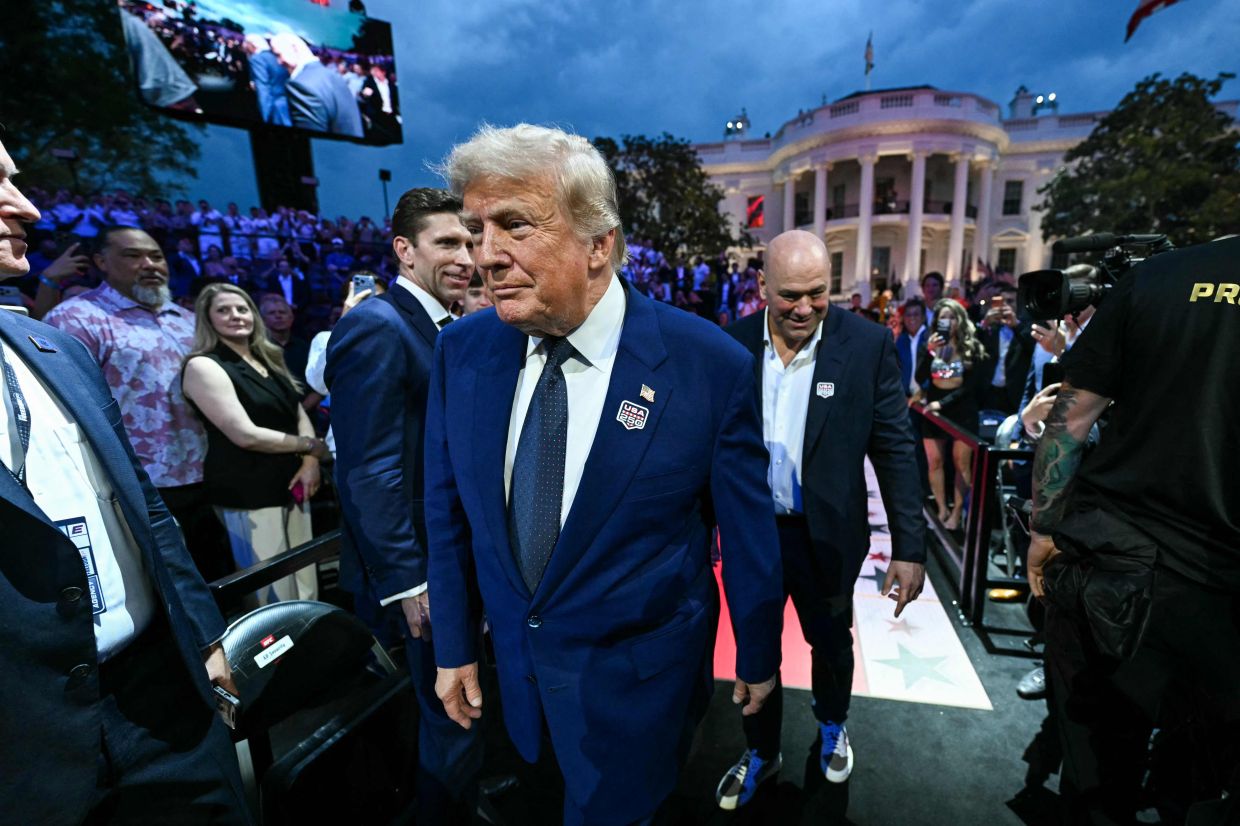
Donald Trump rang in his 80th birthday on Sunday evening with an unconventional celebration that underscored the entertainment-politics nexus defining his current tenure: a full-scale Ultimate Fighting Championship event held on the South Lawn of the White House. The gathering represented both a personal indulgence and a calculated political gesture, bringing together elements of sport, spectacle, and alliance-building in a display that pushed the boundaries of presidential traditions. Yet even as crowds gathered and fighters prepared, the event had already become emblematic of deeper divisions over how the White House should be used and at whose expense.
The UFC card kicked off just before 8:30pm on the South Lawn, with Trump and Dana White, the legendary UFC president and longtime personal ally, making a ceremonial entrance through the White House itself before emerging to the arena. Weather concerns initially threatened the proceedings, with lightning and thunder rolling across Washington forcing a brief delay. When the fights finally commenced beneath the imposing shadow of a nearly 100-foot-tall structure dubbed "the Claw"—a custom-built cage venue that eclipsed the White House itself in height—the spectacle had acquired an almost cinematic quality. The arena configuration accommodated 4,300 seated spectators, yet the true scale of the gathering extended far beyond those immediate seats, with organisers distributing lottery-allocated free tickets that brought an estimated additional 120,000 people to the Ellipse.
The guest list reflected Trump's current orbit and alliance-building priorities. Meta CEO Mark Zuckerberg, Paramount Skydance CEO David Ellison, Treasury Secretary Scott Bessent, and various family members occupied prominent positions. Podcast host Joe Rogan, whose audience of young male listeners represented a crucial demographic in Trump's 2024 electoral coalition, provided live commentary throughout the matches. Military personnel occupied significant portions of the audience, with the broadcast cutting to watch parties at bases across the globe, including in Okinawa, demonstrating how the event transcended mere domestic spectacle to acquire military-strategic dimensions.
The event management reflected careful attention to ceremonial symbolism and political messaging. Medal of Honor recipients and first responders escorted fighters into the arena, lending gravitas to proceedings that might otherwise be dismissed as pure entertainment. The news conference preceding the event, held at the Lincoln Memorial—arguably America's most iconic democratic monument—became a theatre where fighters exchanged insults and predictions in the shadow of Abraham Lincoln. Fighters like Michael Chandler framed their participation as patriotic duty, casting the experience as performing "the best version" of themselves "on the White House lawn for America's 250th birthday." This rhetorical framing attempted to elevate mixed martial arts from sporting diversion to patriotic expression.
The financial architecture underlying the event revealed substantial institutional commitments. The UFC invested over US$60 million in staging the spectacle, with White publicly suggesting it would ultimately result in losses for the organisation. More strikingly, court filings indicated that more than seven federal agencies had "allocated significant resources and manpower" to facilitating the event. The Trump family's World Liberty Financial venture injected an additional US$250,000 in bonus payments for top performers, blurring lines between family business interests and presidential hospitality. Corporate sponsors—Crypto.com and Dodge Ram among them—gained unprecedented White House association through their involvement.
The political calculus underlying Trump's decision to host the event proved unmistakable. The UFC's core demographic of young, male enthusiasts represented a significant voting bloc whose support proved instrumental in the 2024 election victory. By hosting the championship event, Trump simultaneously rewarded a loyal constituency, strengthened relationships with the organisation's leadership, and created high-engagement content for social media platforms favoured by that demographic. The State Department and Federal Bureau of Investigation had already signed partnership deals with UFC, signalling institutional embrace of the organisation at the highest levels of government.
Public reception, however, remained decidedly mixed. A YouGov poll released on June 5 revealed that 51 percent of Americans surveyed disapproved of the White House event, while only 27 percent expressed approval. Legal challenges mounted as well, with the Public Integrity Project filing suit and characterising the spectacle as a "volcano of corruption." The litigation proved unsuccessful in preventing the event from proceeding, but it reflected underlying concerns about the militarisation of presidential spaces and the appropriation of government resources for entertainment purposes aligned with specific political constituencies.
The venue transformation itself sparked considerable commentary. The White House South Lawn, traditionally reserved for the Easter Egg Roll, the Congressional Picnic, and other staid official ceremonies, had been reconfigured into a combat sports arena. While the Biden administration had erected a temporary ice rink on the same grounds, the Claw's scale and permanence suggested a more fundamental reimagining of presidential space. Trump himself playfully suggested the structure might remain indefinitely, invoking comparison to the Eiffel Tower in a TikTok video before walking back the comments. Court filings committed to disassembling the structure beginning at 10am Monday, yet Trump's rhetorical gesturing suggested ambivalence about relinquishing the structure.
The geographic and temporal dimensions of the event extended beyond the immediate White House grounds and Sunday evening timeframe. Trump framed the UFC spectacular as part of a broader celebration of America's 250th anniversary, which would include a commemorative gold coin bearing his likeness, a massive fair on the National Mall, and an IndyCar race through Washington's streets in August. This multi-month celebration positioned Trump as the curator and beneficiary of national commemoration, personalising the bicentennial-and-a-half through his own image and entertainment preferences.
As the fights concluded, Trump prepared to depart for France, where contentious discussions with Group of Seven leaders awaited. He departed the White House carrying a UFC championship belt provided by the organisation—a symbolic trophy that literalised his alignment with the sport and its values. The combination of the White House UFC event followed by international diplomatic engagement illustrated Trump's simultaneous command of entertainment spectacle and geopolitical theatre. Yet the event's polarising reception and substantial resource expenditure raised persistent questions about the appropriate uses of presidential power, public funds, and historic governmental spaces. For Malaysian observers accustomed to more circumscribed exercises of executive authority, the spectacle offered a striking glimpse into how political power intersects with popular culture and corporate interests in contemporary American democracy.