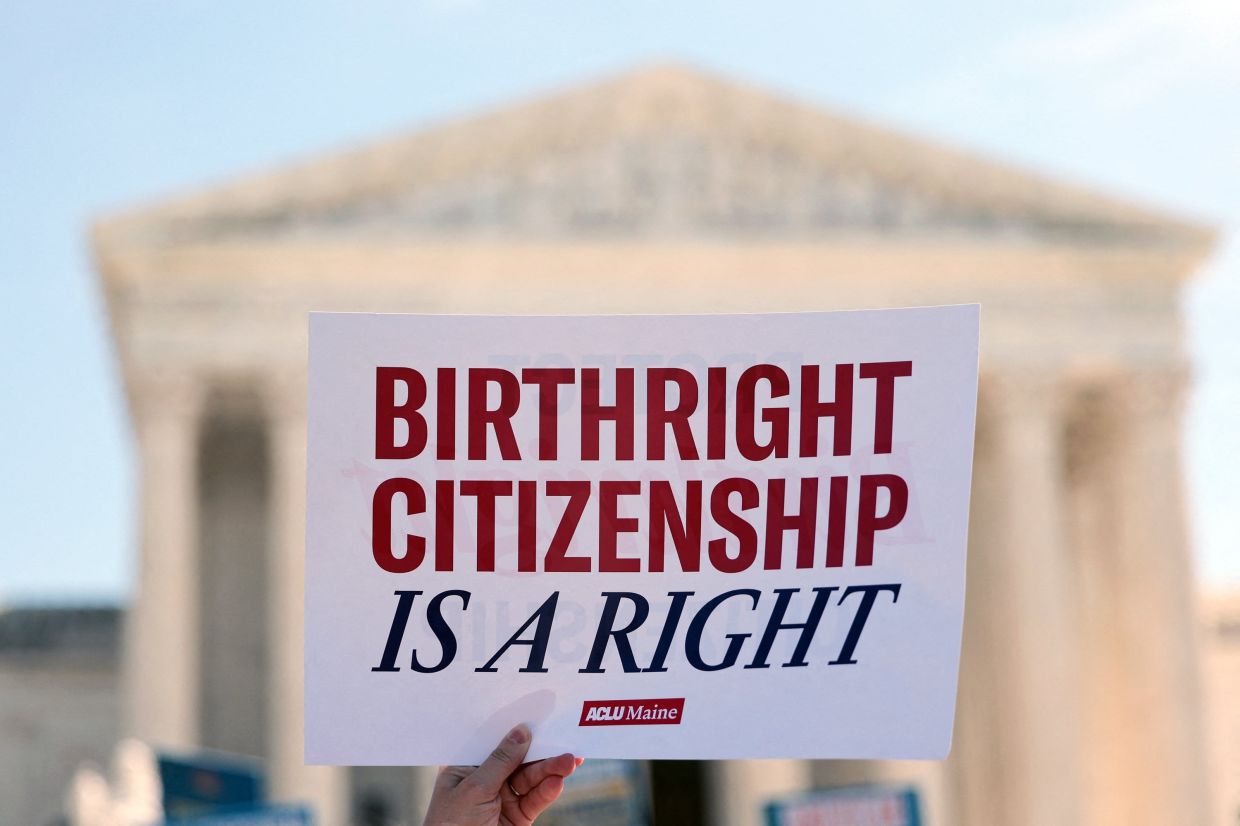
President Donald Trump's initial attempt to restrict birthright citizenship through executive order faced a legal wall when the Supreme Court rejected his constitutional challenge. Rather than accepting this setback, the administration has recalibrated its approach, redirecting focus toward birth tourism enforcement and adopting China as a central rhetorical villain in the debate. Trump's sarcastic congratulations to President Xi on what he termed China's citizenship policies signaled this strategic shift, followed swiftly by Department of Justice directives to federal prosecutors to prioritise birth tourism investigations and congressional moves toward legislative remedies.
The administration's new enforcement posture represents a pivot from its initial framing of the birthright citizenship debate around undocumented immigrants and temporary visa holders. By elevating China as the primary concern, Trump and his allies have reoriented the political narrative around foreign nationals who allegedly enter the United States specifically to secure citizenship for their children through live birth. This rhetorical maneuver carries particular weight in contemporary American discourse, where China features prominently as a geopolitical adversary, lending urgency and national security undertones to what immigration lawyers and demographers characterize as an extremely limited phenomenon.
The Department of Justice justification for expanded investigations rests on claims that organized birth tourism schemes constitute fraud and abuse of the immigration system. Officials argue that thousands of foreign nationals enter the country under false pretenses, with businesses orchestrating their arrivals and births. The Justice Department's National Fraud Enforcement Division cited historical cases, including a 2020 prosecution of Chao "Edwin" Chen, who operated a business claiming to serve over 500 birth tourism cases and maintained a 100-person operation based in China. Such prosecutions typically proceed under visa fraud, conspiracy, money laundering or related statutes rather than specific birth tourism crimes, since giving birth on US soil while holding a valid visa remains legal.
However, the empirical foundation supporting intensified enforcement remains tenuous. Federal data tracking birth tourism specifically are nonexistent, creating a knowledge gap that political actors have filled with speculation and alarming claims. Government Accountability Institute President Peter Schweizer asserted during congressional testimony that approximately one million US citizens are being raised in China today due to birth tourism, a figure legal scholars have dismissed as wildly inflated. Peter Spiro, an American legal expert, characterized available evidence as suggesting birth tourism constitutes "a non-trivial phenomenon" that has increased modestly over recent decades, but hardly the crisis depicted in administration rhetoric.
Statistics from the National Centre for Health Statistics paint a markedly different picture from political claims. In 2023, Chinese-born mothers accounted for 27,476 births across all categories, representing roughly 3.2 percent of births to foreign-born mothers and less than 0.75 percent of all US births. More strikingly, only 113 births in 2023 involved mothers identified as non-US residents from China, down from 267 in 2018. These figures suggest not an escalating crisis but rather a declining or stable trend. The Northern Mariana Islands, frequently cited as a birth tourism hotspot, recorded merely two births to foreign-resident mothers in 2023, compared to 697 in 2018, further undermining the scale of the alleged problem.
Several Southeast Asian and other countries beyond China have faced similar birth tourism allegations, though China has become the administration's focal point. Turkey, Russia and Mexico have all featured in documented cases, yet receive comparatively minimal political attention. This selective emphasis reflects deliberate political messaging rather than proportional allocation of actual documented cases. The concentration on China serves multiple rhetorical purposes simultaneously: it nationalizes immigration enforcement around great power competition, it mobilizes anti-Chinese sentiment among key constituencies, and it provides cover for immigration policies that might face resistance if framed purely as restrictions on undocumented immigration or visa overstays.
Trump's broader claims about American exceptionalism in birthright citizenship law also lack empirical support, though they feature prominently in administration messaging. According to Pew Research Centre analysis, thirty-two other countries maintain birthright citizenship laws substantially similar to the United States, including immediate neighbors Canada and Mexico. This contradiction between claimed American uniqueness and documented legal reality suggests the rhetoric operates more as political mobilization than accurate policy framing. The president's assertion that the United States is uniquely foolish in granting birthright citizenship misrepresents both comparative international law and the constitutional foundations of American citizenship itself.
Congressional Republicans have adopted this China-focused framing with enthusiasm, viewing birth tourism restrictions as a politically viable avenue after the Supreme Court blocked direct attacks on the Fourteenth Amendment. Representative Chip Roy articulated this position explicitly, framing birth tourism in terms of national sovereignty threatened by "foreign adversaries like the Chinese Communist Party." This security-inflected language transforms an immigration enforcement question into a national defense imperative, potentially broadening political coalition support beyond traditional immigration restrictionists to hawkish lawmakers concerned with Chinese influence. House Speaker Mike Johnson signaled legislative activity addressing pregnant travelers, indicating potential statutory changes despite the limited documented scope of the practice.
The shift from constitutional challenges to enforcement and legislation also reflects pragmatic adaptation to judicial constraints. With the Supreme Court unlikely to overturn the Fourteenth Amendment's citizenship clause, the administration has reoriented toward narrower targets that may prove judicially more defensible. Prosecuting visa fraud involving concealed birth tourism purposes operates within established legal frameworks, whereas categorical denial of citizenship to children born to undocumented or temporary visa holders would require constitutional reinterpretation. This enforcement-first strategy may escape immediate judicial invalidation even as it substantially restricts access to birthright citizenship in practice.
For Malaysian and Southeast Asian observers, this development carries several implications. First, it demonstrates how immigration enforcement rhetoric in major democracies can deploy particular nationalities as political symbols even when empirical evidence doesn't justify the prominence granted them. Malaysia and its neighbors should be attentive to whether similar enforcement efforts expand beyond birth tourism into broader visa administration, potentially affecting business travelers, medical tourists, and students. Second, the China-focused framing reflects broader great power competition dynamics that will increasingly inflect immigration policy across developed nations. Third, the gap between political claims and statistical reality in American birth tourism discourse illustrates risks of allowing unverified assertions to drive policy, a caution relevant to immigration debates everywhere.
The administration's pivot toward birth tourism enforcement, despite weak empirical foundations, suggests that immigration policy will continue shifting toward investigative resources and prosecutorial expansion even without new legislation. The Department of Justice memo instructing prosecutors to prioritize these investigations commits enforcement capacity irrespective of actual case volume, potentially ensnaring pregnant travelers with valid visas in investigative scrutiny if they cannot satisfactorily explain their travel intentions. Immigration lawyer Joseph Kwon captured this concern succinctly: pregnant travelers should not face routine assumptions about concealed purposes, yet the enforcement environment the administration is constructing may transform such assumptions into standard practice. As the administration moves forward with this approach, the gap between political rhetoric and statistical reality will likely persist, but political momentum may carry policy implications nonetheless.

