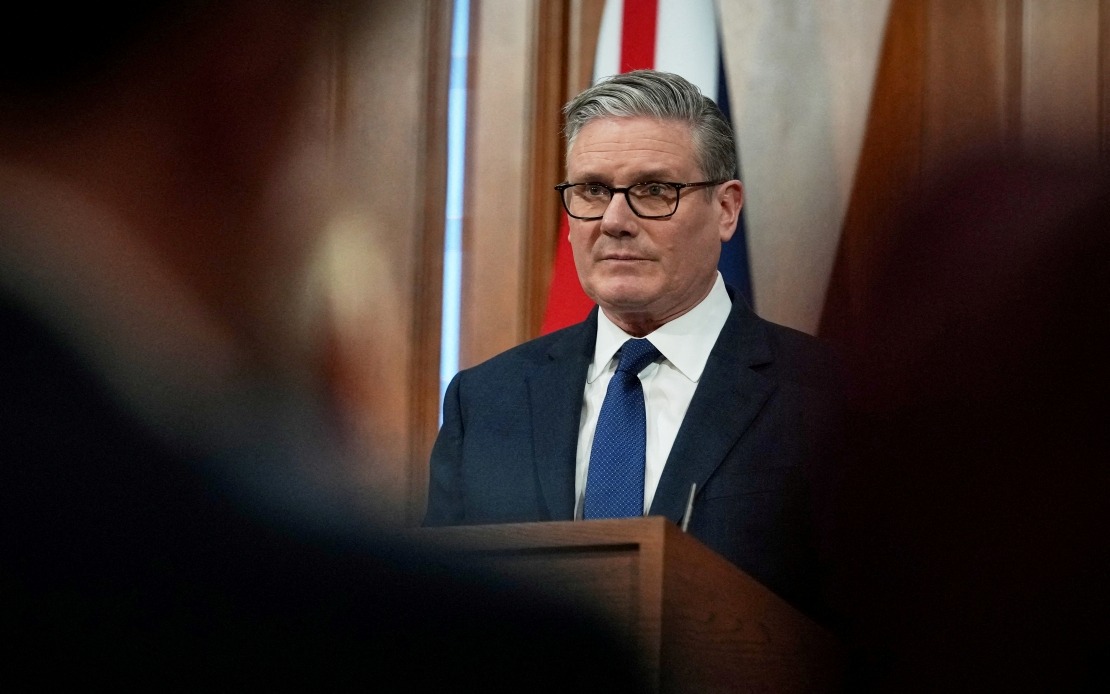
Echoing growing speculation about the future of Britain's leadership, US President Donald Trump publicly declared on Sunday that Prime Minister Keir Starmer will step down from his position, citing what he characterised as significant policy shortcomings. Speaking from Istanbul, Trump took to his Truth Social platform to voice his assessment of the British premier's political trajectory, specifically singling out two policy domains as sources of failure that would precipitate his departure.
The American president's criticism zeroed in on immigration management and energy strategy, with Trump notably emphasising what he viewed as insufficiently aggressive approaches to North Sea oil extraction. His intervention into British domestic politics reflected the kind of unsolicited commentary Trump has frequently directed at international leaders, delivered in the direct, confident tone characteristic of his social media pronouncements. The prediction, while framed as a forecasting statement, carried the weight of Trump's international profile and his willingness to weigh in on matters traditionally considered the preserve of domestic political discourse.
Trump's public pronouncement aligned with reporting emerging from within Westminster itself, where journalists and political insiders were already suggesting the possibility of imminent changes to Britain's top office. The BBC reported Sunday that government figures close to Starmer believed he might announce a resignation timetable as early as Monday, signalling that speculation about his future had reached a critical juncture. Multiple sources within the administration were apparently discussing scenarios in which the Prime Minister would formally outline a path toward stepping aside, indicating a shift in the internal political temperature.
The convergence of international pressure and domestic political instability created a complex backdrop for British governance. Starmer's tenure has faced mounting challenges across multiple fronts, and the two specific policy areas Trump identified—immigration control and energy independence—represent substantive areas of public concern in Britain. Immigration policy has been a particularly contentious issue in British politics, with successive governments struggling to articulate coherent approaches that satisfy both public opinion and operational reality. The government's energy strategy, particularly regarding domestic oil and gas production in the North Sea, has also drawn criticism from different quarters.
For Malaysian observers and policymakers, the political volatility in Britain carries relevance beyond mere international curiosity. The UK remains a significant trading partner for Malaysia, and stability in British governance directly influences bilateral relations, investment flows, and the broader international framework within which Southeast Asian nations conduct diplomacy. Leadership transitions, particularly when unexpected or precipitated by policy failures, can introduce uncertainty into foreign policy continuity and the prioritisation of international partnerships.
The timing of Trump's intervention also merits consideration within the broader context of contemporary international relations. Trump's return to prominence in American politics has emboldened him to commentary on global affairs with minimal diplomatic restraint, a pattern that reflects his previous approach to foreign leaders and their domestic challenges. His willingness to publicly predict Starmer's resignation, rather than employing the customary diplomatic language of observation and restraint, underscores how contemporary political communication has become increasingly immediate and unfiltered.
Starmer's position has been under strain following various policy implementation challenges and public dissatisfaction with the pace of change since Labour's election victory. The accumulation of difficulties across government departments, coupled with the natural friction that emerges as initial policy ambitions encounter practical constraints, had created a perception among political observers that leadership questions were not merely speculative but increasingly material to Westminster's functioning. The BBC's report of conversations among government insiders reflected a recognition that the Prime Minister's continuation in office might face fundamental obstacles.
The distinction between Trump's prediction and the internal British reporting is significant. While Trump offered a blunt assertion of what he believed would occur, the BBC's sources suggested a more conditional scenario in which resignation was a possible rather than inevitable outcome. This difference highlights how external commentary can amplify or dramatise political uncertainty that may not yet have crystallised into definitive action. Nevertheless, the alignment of international commentary with domestic speculation created an environment in which the question of Starmer's future became increasingly urgent.
For regional policymakers and observers in Southeast Asia, the episode illustrates how leadership crises in major Western democracies can unfold with remarkable speed and transparency compared to political transitions in other systems. The openness of British political discourse, with government insiders freely discussing potential resignations to major news organisations, reflects institutional characteristics that both stabilise and destabilise governance depending on circumstances. The contrast between such transparency and the more contained nature of political succession planning in some Asian contexts remains instructive.
The broader implications of potential British leadership change extend to NATO, trade negotiations, and the calibration of Britain's position within global institutions. A transition in British leadership could reset policy priorities and alter the bilateral dynamics between London and other capitals, including those in Southeast Asia. The UK's approach to trade agreements, technology regulation, and regional security partnerships might shift depending on who leads the government and their particular policy orientation.

