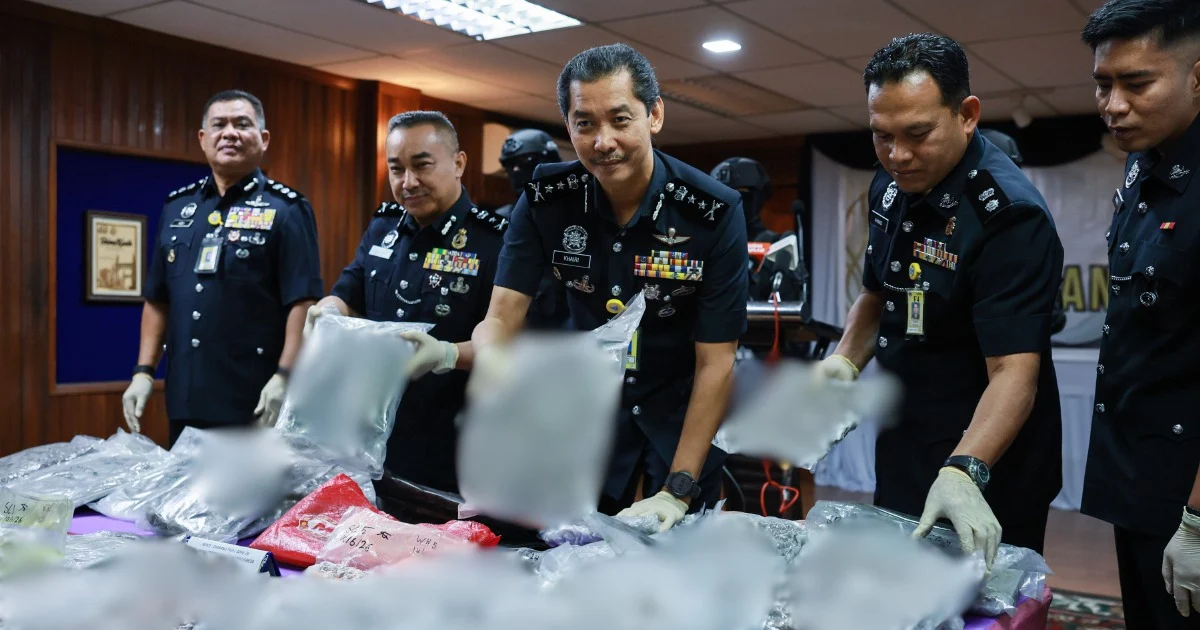
Police in Kuala Terengganu have apprehended two brothers implicated in a major drug trafficking operation centred on their residence in Kampung Duyong Besar. The arrest culminated a law enforcement operation that uncovered approximately RM1.76 million worth of narcotics concealed within the family home, marking a significant interdiction in the state's ongoing battle against organised drug distribution networks.
The discovery at the Kampung Duyong Besar property represents the type of domestic-scale trafficking infrastructure increasingly identified by Malaysian authorities. Rather than relying solely on commercial warehousing or industrial facilities, drug syndicates have begun embedding distribution hubs within residential neighbourhoods, a tactic that complicates detection and allows perpetrators to maintain apparent legitimacy within their communities.
Terengganu has emerged as a crucial transit point within Malaysia's narcotics geography. Its coastal location and proximity to maritime smuggling routes make it particularly vulnerable to drug trafficking operations. The northern state also maintains transport corridors linking it to both the central peninsula and the east coast pipeline, rendering it strategically valuable for syndicates seeking to disseminate contraband throughout the region. Previous operations in the state have similarly targeted domestic storage facilities disguised as ordinary residences.
The detention of both siblings simultaneously suggests investigators had developed sufficient intelligence to execute a coordinated response. The brothers' relationship may have facilitated their involvement in the enterprise—family connections often feature prominently in mid-level trafficking operations where trust between parties becomes essential for managing financial transactions and product accountability. Law enforcement agencies frequently exploit these familial ties when seeking to dismantle networks by targeting multiple participants simultaneously.
The RM1.76 million valuation provides meaningful context about the operation's scale. This figure typically represents wholesale or street-level assessment rather than production cost, indicating the drugs were likely destined for retail distribution rather than serving as precursor materials. The magnitude suggests either a distribution centre supplying multiple retailers across the state or a consolidated shipment awaiting onward transport to other regions, such as the Klang Valley or Penang.
For Malaysian drug enforcement agencies, residential trafficking operations present distinct operational challenges. These premises often occupy civilian areas, complicating surveillance activities and warrant execution. Privacy considerations also constrain the frequency and intensity of monitoring, allowing perpetrators to conduct transactions with reduced scrutiny compared to commercial locations. However, the Kampung Duyong Besar discovery demonstrates that conventional policing methods—likely informed by community intelligence, financial investigation, or prior drug-related incidents—remain effective in identifying such operations.
The arrest underscores persistent vulnerabilities within Malaysia's supply chain disruption strategies. Despite escalating interdictions at borders and port facilities, significant quantities of narcotics continue penetrating the country's interior through established smuggling routes. The presence of RM1.76 million in inventory suggests sophisticated procurement capabilities and reliable supply lines extending beyond Malaysia's borders. Regional trafficking organisations have demonstrated resilience by adapting their methods when confronted with enforcement pressure.
Terengganu's position within the broader Southeast Asian narcotics landscape extends beyond Malaysia's borders. The state serves as a distribution node for substances transiting throughout the Association of Southeast Asian Nations, including products sourced from the Golden Triangle and destined for markets across East Asia. Thai and Myanmar-based production operations have forged supply relationships with Malaysian-based distribution networks precisely because operators like those arrested in Kampung Duyong Besar provide reliable local infrastructure for inventory management and retail distribution.
The investigation's success highlights the intelligence-gathering capacity of Malaysian law enforcement, particularly within the Royal Malaysian Police's Narcotics Crime Investigation Division. The coordination required to identify, monitor, and apprehend trafficking networks operating from residential premises demands sustained investigative effort and often collaboration with community intelligence sources. Public cooperation remains essential when perpetrators attempt to blend ordinary domestic activities with criminal enterprise.
For residents in Kuala Terengganu and comparable communities, the arrest illustrates how trafficking networks strategically position themselves within civilian environments to exploit the anonymity offered by suburban neighbourhoods. Drug syndicates deliberately establish operations in areas where residential activity appears unremarkable, enabling regular vehicle movements and visitor traffic without attracting undue attention from authorities or suspicious neighbours.
The case will likely feature prominently in ongoing discussions about residential drug trafficking across peninsular Malaysia. State authorities have increasingly recognised that dismantling organised distribution requires targeting not merely street-level retailers but the intermediate infrastructure supporting retail networks. Removing storage facilities disrupts supply continuity and forces syndicates to rebuild distribution architecture—a costly proposition that stretches criminal resources and reduces profitability.
Moving forward, the arrested brothers' prosecution and any subsequent network mapping will inform ongoing enforcement against sophisticated trafficking organisations. The Terengganu operation demonstrates that significant narcotics quantities remain vulnerable to interdiction despite trafficking groups' ongoing adaptation strategies. Sustained, intelligence-led enforcement targeting domestic staging points continues yielding results even as criminal syndicates increasingly invest in operational security and geographic dispersion.

