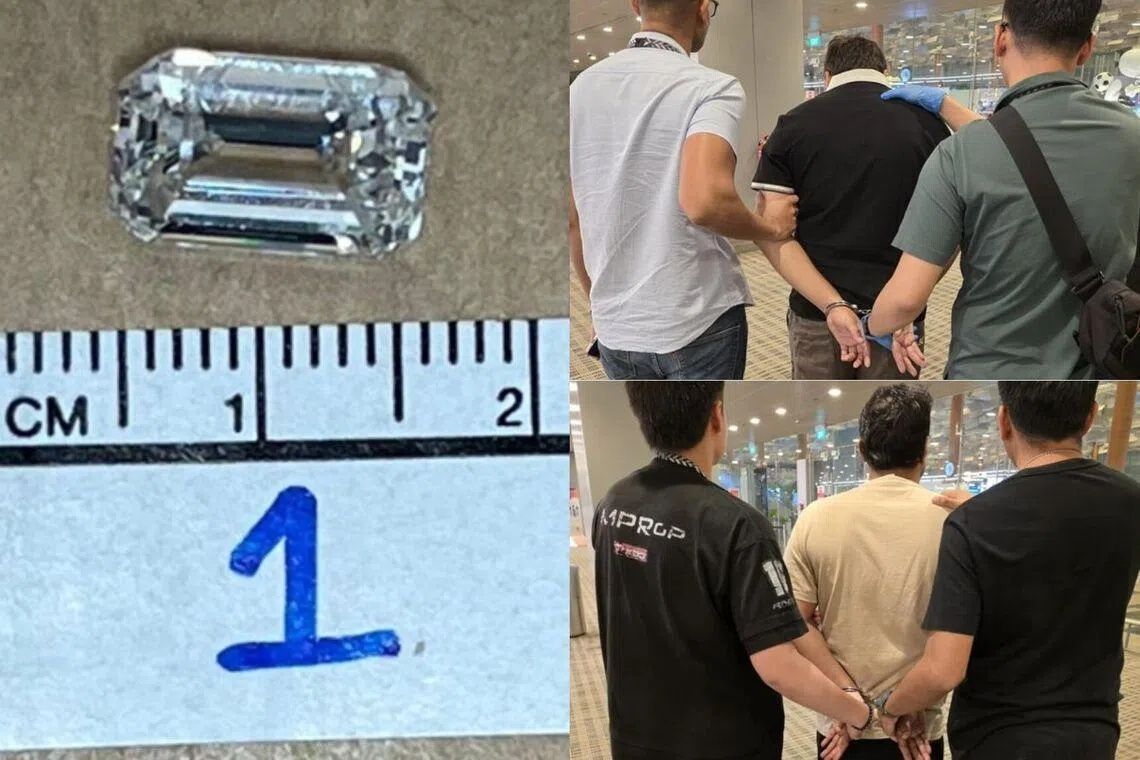
Singapore's police have arrested two men suspected of orchestrating a high-value theft at a jewellery store in Chinatown, with authorities recovering the stolen diamond worth more than S$235,000. The 30-year-old and 42-year-old suspects were taken into custody at Changi Airport Terminal 3 on Friday, June 19, following swift police work that combined traditional investigative methods with modern surveillance technology.
The theft occurred at approximately 3.40pm the same day along Kreta Ayer Road in Chinatown's commercial district. Shop staff immediately alerted authorities after discovering that the precious stone they had been showing to the two men had been switched with a counterfeit replica. The jewellery store's management called for police assistance, triggering a coordinated response that would ultimately lead to the suspects' apprehension within hours.
The Central Police Division and Police Operations Command Centre worked in tandem to track down the suspects, leveraging closed-circuit television footage from the store as well as police surveillance cameras in the area. Ground enquiries complemented the video evidence, allowing officers to establish a clear chain of events and build a case against the two men. Their identities and nationalities were withheld by police in the official statement, though investigators had flagged them through systematic follow-up procedures.
According to preliminary investigations, the theft followed a calculated approach. The two suspects initially expressed genuine interest in purchasing the diamond while browsing at the jewellery store, allowing them to handle and examine the stone at close quarters. During this crucial window, they executed what police describe as a sleight-of-hand operation, swiftly substituting the authentic diamond with a fake version while the shop assistant remained unaware of the exchange.
The attempted crime unravelled quickly after the perpetrators left the store without completing a purchase. The departure itself aroused immediate suspicion among shop staff, who promptly conducted a physical check of the diamond. The discovery that they were holding a counterfeit stone galvanized the response, with the jewellery store contacting police without delay. This rapid detection—combined with the suspects' attempted departure through a major airport terminal—created the conditions for their quick arrest.
The recovery of the stolen diamond represents a significant success for Singapore's law enforcement agencies. The stolen item, valued at over S$235,000, was seized as a case exhibit and will likely be returned to the jewellery store following the conclusion of legal proceedings. The swift recovery demonstrates the effectiveness of coordinated inter-agency policing, particularly when dealing with high-value theft cases that require immediate action to prevent suspects from leaving the country.
The two suspects now face formal charges for theft in dwelling with common intention, a charge that carries substantial legal penalties. If convicted, each man could be sentenced to up to seven years' imprisonment, with additional fines imposed at the court's discretion. The severity of the potential sentence reflects Singapore's tough stance on organized theft targeting the luxury goods sector, particularly when the crime involves deliberate deception and careful planning.
This incident shines a spotlight on a sophisticated modus operandi that targets premium jewellery retailers across Asia-Pacific regions. The substitution technique—known informally as the switch or swap—relies on the perpetrators' ability to distract staff and exploit the brief moments when attention lapses during transactions. For retailers, the challenge lies in balancing customer service with heightened security vigilance, particularly when high-value items are being showcased to potential buyers.
Singapore's police have issued a formal warning to all luxury goods retailers in response to the incident. The advisory encourages shop owners to remain vigilant against similar sleight-of-hand theft tactics, emphasizing the importance of procedural safeguards when handling precious items. Police recommend enhanced staff training, improved point-of-sale security protocols, and increased CCTV coverage within retail spaces—measures that have proven effective in other jurisdictions facing comparable challenges.
The implications extend beyond Singapore's borders to the broader Southeast Asian retail sector. Luxury jewellery stores throughout Malaysia, Thailand, and other regional markets operate under similar vulnerability profiles, with affluent consumers and valuable inventory attracting organized theft rings. The incident serves as a cautionary tale for regional retailers about the evolving sophistication of organized retail crime, where perpetrators conduct reconnaissance, study staff routines, and execute carefully choreographed schemes designed to minimize the risk of detection.
Police statements accompanying the charges reinforced Singapore's official zero-tolerance position toward theft crimes. Authorities emphasized their commitment to deploying all available investigative resources to apprehend offenders and pursue prosecutions with full rigor under the law. This posture reflects broader regional trends toward treating luxury retail theft as a serious priority, given its connection to organized criminal networks and international smuggling operations.
The case also underscores the continuing importance of human vigilance in retail security. While surveillance technology played a crucial role in tracking and apprehending the suspects, it was the alert shop assistant's post-transaction observation that initially triggered the investigation. This combination of technology and human awareness represents the most effective deterrent against sophisticated retail theft schemes currently operating across Asia-Pacific shopping districts.

