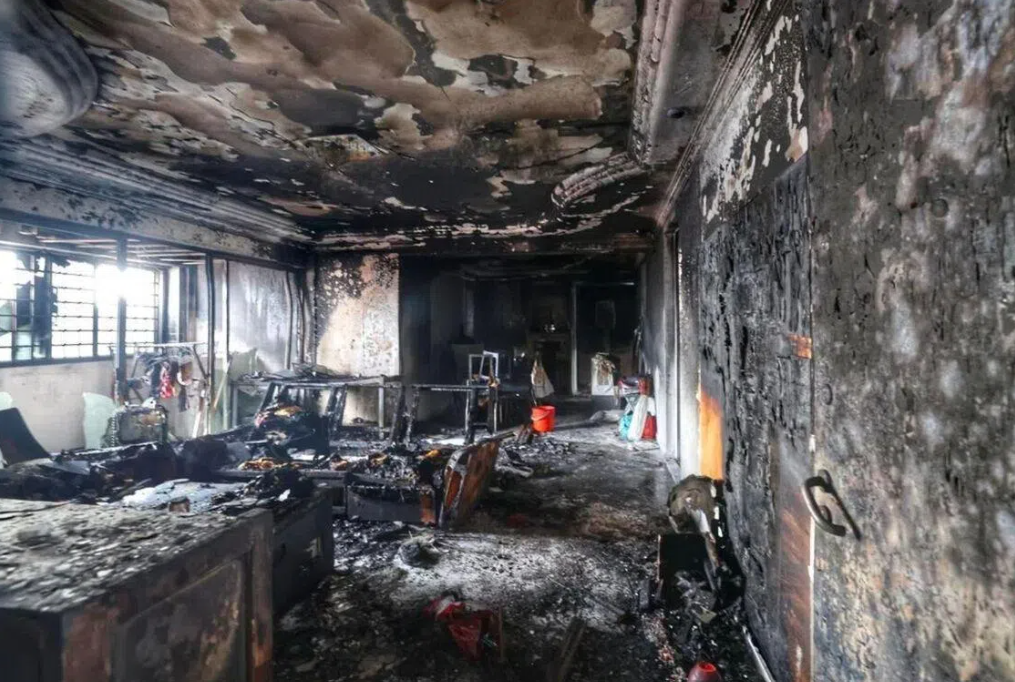
Emergency responders extracted two residents from a high-rise housing unit after flames engulfed their flat in the early morning hours of June 17 in Singapore's Jurong West precinct. The Singapore Civil Defence Force (SCDF) received the emergency call at approximately 3.35am, directing crews to Block 842 Jurong West Street 81, where a residential unit located on the 13th storey was already actively burning. The rapid response and swift intervention by firefighters prevented what could have escalated into a far more serious disaster.
Upon arrival at the scene, SCDF personnel discovered that the living room of the affected unit was fully engulfed in flame and thick smoke had pervaded the interior spaces. Firefighters entered the smoke-filled flat and engaged in direct firefighting operations, ultimately bringing the blaze under control using a pressurized water jet. The entire family of four living in the unit—including the two individuals who required rescue—was transported to Singapore General Hospital for medical evaluation and treatment. In a precautionary evacuation measure intended to ensure the safety of residents throughout the building, approximately 40 other occupants from adjacent and nearby units were relocated to assembly areas.
Initial findings from fire investigators point to an electrical malfunction as the probable cause of the incident. The specific origin appears to have been electrical equipment or wiring located within the living room area, a common source of residential fires across high-rise housing developments. Such fires underscore the particular vulnerability of densely-packed apartment complexes where flames can spread rapidly through vertical shafts and shared infrastructure, potentially endangering large numbers of residents in a short timeframe.
Local media outlet Lianhe Zaobao dispatched reporters to the scene approximately 12 hours after the fire was extinguished, where they documented the extent of damage. Their observations revealed that the interior walls and ceiling of the affected unit had been heavily scorched and blackened by intense heat and smoke exposure. Windows had been blown out by the force and thermal stress of the flames, leaving jagged remnants in their frames and exposing the compromised interior to the outside air.
According to accounts gathered by Lianhe Zaobao, the family had been sleeping when the fire suddenly erupted without warning. The incident likely would have gone unnoticed for critical additional minutes if not for the alertness of a young neighbour. An 18-year-old student residing in the unit directly above the burning flat was awake at the time, occupied with gaming activities on his computer. The teenager detected the smell of smoke and observed it seeping upward through the windows beneath his unit, triggering his investigative response.
Realizing the severity of the situation, the quick-thinking teenager descended to the affected floor and found the entrance door to the burning unit was dangerously hot to the touch. Understanding that occupants inside might be unaware of the danger, he began repeatedly knocking on doors throughout the corridor to alert residents to the developing emergency and encourage immediate evacuation. He then rushed back to his own residence to warn his family to leave the building, before his mother contacted the police and emergency services to report the incident and summon professional firefighting assistance.
During the evacuation process, the neighbour witnessed firsthand the consequences of exposure to the fire and smoke. A young woman from the affected unit came to the teenager's door requesting towels, explaining that she needed them to treat injuries to her father. The student observed that her hair appeared singed from heat exposure and her facial features were covered in a layer of black soot from smoke inhalation. He also noticed a man with severe thermal burns across his back and arms, the exposed skin exhibiting a bright red coloration characteristic of significant burn injuries requiring immediate medical attention.
The visible response by the emergency services was substantial. A neighbour living on the 12th storey reported observing at least five fire engines positioned at street level near the base of the residential block, indicating the scale of the multi-unit response coordinated by fire service command. This deployment reflected both the seriousness with which authorities treated the blaze and their awareness that similar structures throughout the city face comparable fire risks due to their design and density.
Following the incident, Singapore's Civil Defence Force has reinforced public guidance on preventing similar electrical fires in residential environments. Residents have been cautioned against overloading electrical outlets, a common practice that generates dangerous levels of heat within wiring systems. Authorities recommend that household appliances be powered down when they are not actively in use, rather than left in standby mode or continuously connected to power sources. The agency has also emphasized the importance of using only electrical appliances and power adapters that carry the official Safety Mark certification, a credential issued by Singapore's Consumer Product Safety Office that indicates compliance with established electrical and thermal safety standards.
Additional fire prevention measures promoted by the SCDF include changing behaviour around battery-powered devices and rechargeable equipment. Residents are now being urged to avoid leaving batteries and electronic devices unattended while they charge, and to refrain from leaving them connected to power sources overnight or for extended durations. These recommendations address a particular class of residential fire risks that have become more prevalent with the proliferation of lithium-ion batteries and portable electronic devices in modern households.
The scope of the fire hazard facing Singapore's residential sector is reflected in official statistics released by the SCDF in February of this year. The total number of fires across all sectors increased by 3 per cent year-on-year, rising from 1,990 recorded incidents in 2024 to 2,050 in 2025. More significantly, residential buildings accounted for roughly half of all fires during this period, with 1,051 residential fires recorded, suggesting that approximately one in two fires in the city-state occur within housing units. For Malaysia, where many residents live in similar high-rise developments and face comparable electrical infrastructure challenges, the incident and preventive guidance offer relevant lessons about fire safety preparedness and the critical importance of community vigilance in multi-unit residential buildings.